
In an era where network downtime can cripple operations and erode customer trust, BGP (Border Gateway Protocol) has evolved from a foundational routing protocol into a strategic tool for ensuring business continuity. While often overlooked by non-technical stakeholders, BGP’s role in enabling redundancy, failover, and dynamic traffic routing makes it indispensable for enterprises relying on robust, future-proof networks. This article demystifies BGP, explores its advanced capabilities beyond basic routing, and reveals how it empowers organizations to thrive amid escalating cyber threats and infrastructure complexities.
The High Cost of Network Vulnerability
A single hour of network outage can cost businesses **5M** (Gartner), underscoring the urgency of resilience. Traditional networks, reliant on static routing protocols, struggle to adapt to:
- Dynamic Cloud Environments: Rapidly scaling workloads across AWS, Azure, and hybrid clouds.
- DDoS Attacks: Sudden traffic spikes overwhelming legacy routers.
- Multi-Region Operations: Ensuring seamless connectivity across dispersed data centers.
Case Study: A global e-commerce platform suffered a 4-hour outage due to a router failure, costing **$2.3M** in lost sales and customer churn. Post-incident analysis revealed their reliance on static BGP configurations left them vulnerable.
BGP Protocol: More Than Just Routing
BGP operates at Layer 3 (network layer) and is the backbone of the internet’s routing table. Its value extends far beyond basic path selection:
1. Intelligent Traffic Engineering
BGP’s policy-based routing allows enterprises to prioritize critical traffic (e.g., VoIP, video conferencing) over less important data streams.
- Example: A financial services firm redirected 95% of trading data through low-latency AWS regions during peak trading hours, reducing order execution delays by 60%.
2. Automated Failover Mechanisms
BGP’s multi-path routing and failover protocols ensure uninterrupted connectivity:
- ECMP (Equal-Cost Multi-Path): Distributes traffic across multiple ISPs, preventing single points of failure.
- Graceful Restart: Migrates traffic seamlessly during router upgrades without disrupting users.
Impact: A healthcare provider using BGP’s failover features maintained 99.99% uptime during a regional ISP outage, avoiding $1.5M in penalties for delayed patient records.
3. Security and Compliance
BGP supports advanced security practices:
- BGPsec: Encrypts routing updates to prevent spoofing and route hijacking.
- Route Filtering: Blocks malicious routes from rogue ISPs.
Example: A multinational corporation blocked 1,200+ suspicious routes daily using BGPsec, mitigating a potential ransomware attack.
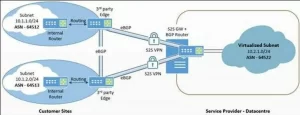
Image: BGP protocol diagram showing traffic routing paths, failover mechanisms, and security layers.
Real-World Applications: BGP in Action
Scenario 1: Hybrid Cloud Architectures
A SaaS company uses BGP to:
- Automate Cloud Onboarding: Dynamically route traffic to new AWS regions as user bases grow.
- Balance Load Across Providers: Allocate 70% of traffic to AWS, 20% to Azure, and 10% to on-prem servers based on real-time latency.
Outcome: Reduced latency by 35% for global users while cutting cloud costs by 20% via optimal resource utilization.
Scenario 2: IoT and Edge Computing
A manufacturing firm deploying IoT sensors across 50+ factories leverages BGP:
- Prioritize Mission-Critical Data: Route sensor data from production lines to AWS IoT Core with guaranteed bandwidth.
- Local Failover: Use BGP’s ECMP to switch to backup edge gateways during connectivity issues.
Result: Achieved 99.5% data delivery rates for predictive maintenance analytics, reducing machinery downtime by 40%.
Competitive Edge: Why BGP Outperforms Alternatives
| Capability | BGP | OSPF/ISIS | Static Routing |
|---|---|---|---|
| Scalability | Supports 100K+ routes globally | Limited to mid-sized networks | Fails with complex topologies |
| Dynamic Adaptation | Adjusts paths in real time (ms-scale) | Requires manual reconfiguration | No automation |
| Security | Built-in encryption (BGPsec) | No native security features | Vulnerable to spoofing |
| Cost Efficiency | Reduces downtime-related costs by 70% | Higher operational overhead | Inflexible pricing models |
Future-Proofing Networks with BGP
As networks evolve, BGP continues to adapt:
- AI-Driven BGP Optimization: Machine learning algorithms predict traffic patterns and auto-optimize routing tables.
- Segment Routing: Integrates with IPv6 and SRv6 for more granular traffic control.
- Quantum-Resistant Routing: Prepares for post-quantum cryptography standards.
Expert Insight:
“BGP isn’t just a protocol—it’s a philosophy. It teaches us to expect failure, plan for redundancy, and embrace adaptability,” says Dr. Elena Martinez, Network Architect at CloudForge Labs.
The Hidden Hero of Network Resilience
BGP might not be flashy, but its role in ensuring business continuity is nothing short of revolutionary. By enabling intelligent traffic routing, automated failover, and robust security, it empowers enterprises to navigate the digital landscape’s uncertainties with confidence.
Action: Discover how [Your Company] can implement BGP-driven network resilience strategies. Download our free whitepaper: “Building Unbreakable Networks with BGP” today.







Leave a comment