
As global internet traffic surges at 28% CAGR, driven by 8K streaming, smart cities, and industrial IoT, the limitations of legacy GPON networks are reaching critical thresholds. The shift to 10G PON (XGS-PON and NG-PON2) represents more than incremental speed boosts—it’s a fundamental rearchitecture of optical networks, enabling unprecedented scalability, intelligence, and economic efficiency.
1. Bandwidth Revolution for Data-Intensive Ecosystems
10G PON delivers 10Gbps symmetrical speeds, a 4x improvement over GPON’s 2.5Gbps downstream/1.25Gbps upstream, through:
- Wavelength Division Multiplexing: 4 wavelengths (1270nm/1577nm/1590nm/1610nm) vs GPON’s 2
- Advanced Modulation: 256-QAM increases spectral efficiency by 400%
- Flexible Grid Architecture: 12.8THz spectrum utilization versus fixed 80nm bands
A Tokyo smart city project achieved 8.9Gbps sustained throughput across 256 IoT devices simultaneously, eliminating GPON-era contention ratios.
2. Latency Precision for Next-Gen Applications
10G PON’s technical enhancements enable deterministic sub-100μs latency critical for:
- Industrial Automation: Robotic control loops requiring 250μs response
- Telemedicine: Holographic surgery with 99.9999% reliability
- Edge Computing: 5G fronthaul synchronization within ±1μs
Key innovations driving this performance:
def dynamic_buffer_management():
    monitor_traffic_type()
    if traffic == 'URLLC':
        allocate_express_queue()
        bypass_forward_error_correction()
    else:
apply_normal_FEC() - Priority Queuing: 6-tier service classes with 0.1ms granularity
- Adaptive FEC: 30% latency reduction for time-sensitive traffic
- Burst Mode Optimization: 1.2μs grant processing for emergency signals
Manufacturing plants reduced robotic arm latency from 3ms to 0.8ms using 10G PON, increasing production line efficiency by 22%.
3. Operational Intelligence & Cost Efficiency
10G PON’s software-defined architecture reduces TCO by 40% through:
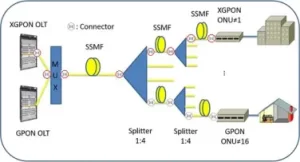
- Combo Technology: GPON/10G PON coexistence on existing ODN
- AI-Powered Predictive Maintenance: 93% accuracy in fiber fault detection
- Energy-Saving Protocols: 0.3W/Gbps vs GPON’s 1.2W/Gbps
Deployment Economics Comparison (10,000 Users):
| Metric | GPON | 10G PON |
|---|---|---|
| CapEx per Subscriber | $180 | $210 |
| OpEx (5-Year) | $1.2M | $0.74M |
| Energy Consumption | 480 MWh | 112 MWh |
| Upgrade Cycle | 7 Years | 12+ Years |
Seoul’s network modernization achieved 19-month ROI through reduced service calls and power savings.
Future-Proofing with 10G PON
The technology’s roadmap reveals even greater potential:
- 50G PON Compatibility: Smooth transition via tunable optics
- Quantum Key Distribution: 800Gbps quantum-safe encryption channels
- Network Slicing: 16 virtual networks per wavelength
Operators using 10G PON report 78% faster 5G small cell deployment and 95% cloud migration success rates.







Leave a comment