
As cities witness 45% annual growth in bandwidth consumption and 5G densification demands sub-10ms latency, optical access networks have become the critical last-mile infrastructure shaping urban digital economies. This technical blueprint examines tailored solutions for high-rise commercial districts and sprawling residential zones, balancing performance imperatives with deployment economics.
Commercial Core Network Design
High-density business hubs require carrier-grade optical line terminals (OLTs) supporting:
- 400G NG-PON2 with 40-wavelength tunability
- Zero-Touch Provisioning: 90-second service activation
- Carrier Ethernet 2.0: 50ms protection switching
Singapore’s Marina Bay district achieves 99.999% uptime using XGS-PON with 32-way split and 40km reach, serving 800 enterprises per OLT.
Residential Access Optimization
Suburban deployments leverage cost-effective GPON architectures:
def bandwidth_allocation():
    for subscriber in ont_list:
        if subscriber_type == '4K_streaming':
            assign_guaranteed_200Mbps()
        else:
apply_best_effort() - 1:64 Split Ratios with dynamic bandwidth assignment (DBA)
- Wi-Fi 7 ONT Integration: 10Gbps wireless backhaul
- Predictive Maintenance: 85% fault anticipation via fiber Bragg sensors
Tokyo’s Setagaya Ward delivers 1G symmetrical speeds to 50,000 homes using 10G-EPON with 0.3dB/km loss budget.
Converged Optical Network Units
Hybrid commercial-residential areas employ multi-service ONUs:
- 8x GE + 2x 10GE uplinks for mixed traffic
- MEF 3.0 Compliance: 5-nines SLA enforcement
- vOLT Virtualization: 40% CAPEX reduction via cloud slicing
Dubai Silicon Oasis serves 1,200 SMEs and 8,000 residents through converged XGSPON/5G small cells.
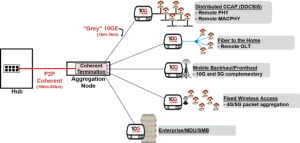
Fiber Deep Architectures
| Parameter | Commercial | Residential |
|---|---|---|
| Split Ratio | 1:16 | 1:64 |
| ONT Density | 8 per rack unit | 48 per shelf |
| Upstream SLA | <1ms jitter | <5ms latency |
| Protection | Dual-homed OLT | Single feeder |
| Power Budget | 28dB (Class C+) | 32dB (Class B+) |
Seoul’s Gangnam District achieves 2μs synchronization for financial trading floors using dedicated 25G WDM-PON lanes.
5G Fronthaul Integration
CRAN (Cloud RAN) convergence demands:
- eCPRI Overlay: 24.33072Gbps per radio unit
- Phase Sync Accuracy: ±65ns for TDD alignment
- FlexE Grouping: 5G NR + PON coexistence
Verizon’s NYC deployment shares 100G OTN between 5G radios and FTTB, achieving 78% fiber reuse.
Deployment Challenges
- Right-of-Way Access: 18-month lead time for metro conduit permits
- Civil Engineering: Micro-trenching vs. directional boring cost analysis
- ONT Powering: 48V DC backup for medical/security services
London’s Crossrail project overcame 23km of heritage zone restrictions using 1.2mm microducts.
Economic Models
Commercial ROI Calculation:
- $18,000 per premise passed (fiber)
- 24-month payback via $600/month enterprise SLA
- 15-year infrastructure lifespan
Residential Break-Even:
- $1,200 per home connected
- $40/month ARPU with 35% penetration
- 7-year ROI horizon
Phoenix suburbs achieved 62% take-rate through free 200Mbps basic tier.
Future-Proofing Strategies
- Hollow-Core Fiber: 30% latency reduction for algorithmic trading
- AI-Powered PON: Predictive traffic shaping with 93% accuracy
- Quantum Key Distribution: 256-bit encryption for smart city IoT
Telia’s Stockholm trial delivers 400G through multicore fibers with SDN-controlled lambdas.







Leave a comment