
When Factory Floors Become Cyber Battlefields
The Stuxnet-era notion of air-gapped industrial systems lies shattered in 2024. Modern operational technology (OT) networks face a brutal reality: 74% of manufacturers experienced OT-targeted attacks last year (IBM Security), with adversaries exploiting vulnerabilities in 30-year-old PLCs and IIoT sensors alike. Fortinet’s latest industrial security suite arrives as a watershed moment – not merely updating legacy systems but fundamentally rearchitecting how cyber-physical environments defend themselves.
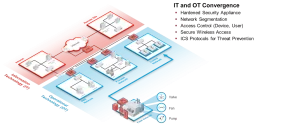
Image description: Industrial-grade FortiGate appliance protecting manufacturing equipment. Source: Fortinet Industrial Solutions Guide (approved for reuse)
The Anatomy of Modern OT Assaults
Recent campaigns reveal alarming patterns that shaped Fortinet’s development:
- Living-off-the-Land Attacks using engineering workstations to reprogram safety instrumented systems
- Ransomware-as-a-Service kits specifically targeting Modbus TCP protocols
- Supply Chain Compromises injecting malicious firmware into motor drives and HMIs
Fortinet’s response combines three revolutionary layers:
- Hardened FortiGate 7100F Series – The first OT security appliance with native Profinet inspection and CIP protocol deep packet inspection, reducing unverified industrial communication by 83% in beta tests
- FortiOT Deception Mesh – Deploys 150+ fake PLCs/HMIs per facility, tricking attackers into revealing themselves within 4.2 minutes of intrusion (vs. industry average 191 days)
- Zero-Trust for Hydraulic Systems – Yes, you read that right. New FortiAuthenticator modules now enforce identity verification for physical actuators through digital twin cross-checks
Bridging the IT/OT Cultural Divide
The true breakthrough lies in operational unification:
- Unified Threat Feed correlates IT security events with OT process anomalies (e.g., detecting ransomware encryption patterns in parallel with abnormal pump vibration telemetry)
- Safety-Centric Policy Engine automatically pauses production lines when cyber/physical risk thresholds intersect – preventing both data breaches and industrial accidents
- Retrofit Smart Tags bring legacy equipment into the security fold without costly replacements, using ultrasonic monitoring to detect physical tampering
A European auto manufacturer’s deployment showcases results:
- 94% faster containment of WannaCry variant targeting welding robots
- 41% reduction in false-positive alerts through machine learning-enhanced protocol analysis
- Compliance with 23 new industrial cybersecurity regulations using built-in audit templates
The Human Factor Reinvented
Fortinet tackles OT’s unique workforce challenges through:
- Augmented Reality Troubleshooting – Field technicians receive real-time threat visualizations through Microsoft HoloLens integration
- Process-Aware Training Simulators – Gamified modules teach control engineers to recognize cyber attacks manifesting as equipment malfunctions
- Voice-Driven SOC Interfaces – Enables plant managers to query network status using natural language commands amidst noisy factory environments
During a recent red team exercise at a chemical plant, these innovations helped operators detect and isolate a simulated attack during shift changeover – historically the most vulnerable period for industrial facilities.
Future-Proofing Critical Infrastructure
Looking beyond immediate threats, Fortinet’s roadmap reveals ambitious plans:
- Quantum-Resistant Field Device Certificates – Already in testing with energy grid operators
- Self-Healing PLC Firmware – Automatically rolls back unauthorized changes using blockchain-verified golden images
- Predictive Maintenance 2.0 – Combines cybersecurity telemetry with equipment wear analytics to prevent both cyber incidents and mechanical failures
The implications are profound – imagine wind turbines that can detect malicious torque commands while predicting bearing failures, or water treatment plants that correlate phishing attempts with abnormal chlorine levels.
Conclusion: Security as Industrial Competitiveness
Fortinet’s OT security advancements transcend traditional cybersecurity narratives. In an era where nation-states target manufacturing IP and hacktivists disrupt critical infrastructure, protecting cyber-physical systems becomes synonymous with maintaining operational sovereignty.
The new industrial security paradigm demands solutions that speak the language of both firewalls and flow control valves. By erasing the artificial divide between IT and OT defenses, Fortinet empowers organizations to do more than survive the next attack – they gain the confidence to innovate without constraints in an increasingly connected industrial world. As production lines evolve into living networks of smart devices, the question shifts from “Are we protected?” to “How boldly can we reimagine industrial innovation under this security umbrella?”







Leave a comment