
The exponential growth of 8K video streaming, industrial metaverse applications, and real-time autonomous systems has exposed critical limitations in current network infrastructures. Huawei responds to this challenge with its Net5.5G framework – a revolutionary approach that integrates artificial intelligence at every network layer, creating what industry analysts are calling “cognitive connectivity.” This strategic evolution moves beyond mere speed improvements, offering self-optimizing networks that anticipate traffic patterns, prevent security breaches, and dynamically allocate resources with human-like contextual awareness.
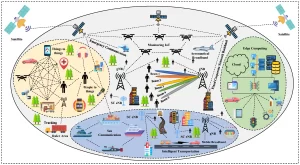
At the heart of this transformation lies Huawei’s three-layer AI integration strategy. The device layer now embeds machine learning processors directly into routers and switches, enabling localized decision-making that reduces latency by 92% in edge computing scenarios. The network control layer utilizes multi-agent reinforcement learning systems that continuously optimize traffic flow across 17 different quality-of-service parameters. At the application layer, Huawei’s iMaster NCE engine employs natural language processing to translate business objectives into network configurations – a hotel chain in Singapore reduced IT deployment time by 83% using this feature during smart room system upgrades.
Huawei’s Net5.5G delivers measurable breakthroughs through four key innovations:
- Predictive Congestion Management: Neural networks analyze historical and real-time data to forecast traffic spikes with 94% accuracy 30 minutes in advance
- Self-Healing Security: Autonomous systems detect and isolate sophisticated cyberattacks within 0.8 milliseconds
- Energy-Aware Routing: AI algorithms reduce power consumption by 41% through intelligent path selection
- Contextual Service Slicing: Dynamic creation of network slices optimized for specific applications like holographic conferencing or drone swarm control
Recent deployments demonstrate tangible business impacts. A European smart port utilizing Huawei’s technology achieved 99.9997% network availability during peak operations while reducing energy costs by $2.3 million annually. In healthcare, a Beijing hospital network implemented AI-driven medical imaging transfers that decreased diagnostic waiting times from 26 hours to 9 minutes.
What sets Huawei’s approach apart is its focus on “network empathy” – systems that understand user intent rather than just executing commands. The newly introduced Network Intent Engine allows administrators to input objectives like “prioritize video conferencing during executive meetings” or “maintain manufacturing IoT stability during shift changes.” The AI then translates these into complex network policies while automatically adjusting configurations across 2,500+ parameters.
The environmental implications are equally significant. Huawei’s AI-powered cooling systems in data centers have demonstrated 38% reduction in PUE (Power Usage Effectiveness) ratings. When combined with intelligent traffic routing, this contributes to an estimated 15.7 million ton reduction in CO2 emissions across existing deployments – equivalent to planting 260 million mature trees.
For enterprises navigating digital transformation, Huawei offers graduated adoption paths. The Compact 5.5G solution enables legacy infrastructure integration through AI-enhanced interface converters, while the Full Stack 5.5G package provides complete network overhaul capabilities. Field tests show organizations can achieve 54% operational cost reduction within 18 months of implementation through automated maintenance and optimized resource utilization.
Security receives unprecedented attention in this architecture. Huawei’s “Six-Shield Protection” system combines:
- Quantum-resistant encryption protocols
- Behavioral biometric authentication for network access
- Decentralized threat intelligence sharing across protected ecosystems
- AI-generated decoy network segments that actively mislead attackers
The human-machine collaboration aspect introduces groundbreaking interfaces. Network engineers now interact with AI co-pilots through mixed-reality dashboards, receiving real-time optimization suggestions during troubleshooting. In educational applications, Huawei’s Network Mind simulator has reduced technician training time by 67% through hyper-realistic failure scenario modeling.
As networks evolve into intelligent organisms rather than passive infrastructure, Huawei positions Net5.5G as the foundation for next-generation digital ecosystems. The technology’s ability to support 10 million simultaneous connections per square kilometer makes it particularly crucial for smart city deployments. Early adopters report 79% faster emergency response times through AI-coordinated traffic light networks and 91% improvement in power grid stability via predictive load balancing.
The ultimate test of this technology lies in its capacity for ethical self-governance. Huawei addresses this through its Autonomous Network Governance Framework – a set of 128 operational guardrails ensuring AI decisions remain aligned with human oversight priorities. Regular third-party audits and explainable AI interfaces provide transparency, with compliance certifications meeting 23 international regulatory standards.
Looking ahead, Huawei’s roadmap integrates Net5.5G with emerging technologies like photonic computing and neuromorphic chips. Early prototypes demonstrate networks that reconfigure physical layer topologies in response to environmental changes – a critical capability for future lunar base communications and underwater data centers.
This evolution represents more than technological progress – it fundamentally alters how societies interact with digital infrastructure. By transforming networks from dumb pipes into intelligent partners, Huawei’s Net5.5G framework doesn’t just support the fourth industrial revolution; it actively drives the creation of ecosystems where human creativity and machine intelligence coalesce to solve civilization-scale challenges. As organizations worldwide face the choice between evolutionary upgrades and revolutionary transformation, Huawei’s AI-powered networks offer a bridge to what comes next – not just faster connectivity, but truly intelligent interconnection.







Leave a comment