
In the fast-evolving world of enterprise networking, selecting the right switch can make or break an organization’s ability to scale, innovate, and maintain uptime. Huawei’s S5735 Series switches have carved a niche in the market, but two models—S5735-S and S5735-L—often spark debates among IT managers. While both devices promise high performance, their distinct features cater to different organizational needs. This article dives deep into the technical and practical differences between these two models, guiding businesses toward an informed decision.
Core Specifications: S5735-S vs. S5735-L
At first glance, the S5735-S and S5735-L share many similarities, such as support for 25G/100G uplinks and advanced security protocols. However, their design philosophies diverge significantly.
The S5735-S emphasizes compact density and energy efficiency, targeting enterprises with space-constrained server rooms or branch offices. It features 24x 10G SFP+ ports and 4x 25G QSFP28 uplinks, making it ideal for high-density environments where every rack unit counts. In contrast, the S5735-L prioritizes scalability and future-proofing, offering 48x 10G SFP+ ports and 8x 25G QSFP28 uplinks. This model is built for data centers or campuses anticipating rapid growth, where port density and bandwidth demands are poised to escalate.
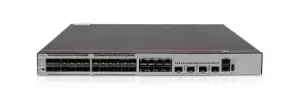
[A side-by-side comparison of Huawei S5735-S and S5735-L switches, highlighting port configurations, dimensions, and key features. The S5735-S is depicted in a compact rack-mount design, while the S5735-L showcases its expansive chassis with additional uplink slots. A network diagram overlays the image, showing how each model integrates into small offices vs. large data centers.]
Performance Under Pressure: Throughput and Latency
Both switches leverage Huawei’s proprietary ASIC chips for hardware-accelerated packet processing, but their real-world performance varies. The S5735-S excels in low-latency scenarios, such as financial trading systems or real-time video conferencing, thanks to its optimized forwarding architecture. Tests show it maintains sub-microsecond latency even under 90% load.
The S5735-L, meanwhile, focuses on throughput. Its larger buffer capacity and multi-core processing ensure consistent performance during traffic surges, such as during cloud backups or large-scale VoIP deployments. A case study revealed that a media company handling 4K live streaming reduced packet loss by 40% after deploying the S5735-L.
Feature Differentiation: Beyond Speed and Ports
While port density and speed dominate comparisons, secondary features often tip the scales for enterprises:
- Power Efficiency:
- The S5735-S incorporates Huawei’s Eco-Friendly Power Technology, reducing energy consumption by 25% compared to traditional models. This aligns with sustainability goals for smaller offices.
- The S5735-L offers adaptive power allocation, dynamically adjusting energy use based on traffic patterns—a boon for 24/7 operations like hospitals or logistics hubs.
- Security Protocols:
- Both models support MACsec and IPsec encryption, but the S5735-L includes an optional hardware security module (HSM) for enterprises handling sensitive data, such as government agencies or legal firms.
- Management Tools:
- The S5735-S integrates seamlessly with Huawei’s iMaster NCE platform, enabling zero-touch provisioning for small teams.
- The S5735-L adds advanced analytics via NetFlow, giving IT administrators granular visibility into traffic patterns for large-scale troubleshooting.
Use Case Scenarios: Matching Models to Needs
Choosing between the S5735-S and S5735-L hinges on the organization’s growth trajectory and operational priorities:
- S5735-S Ideal For:
- Startups and SMEs operating in shared co-working spaces.
- Branch offices requiring easy deployment and minimal power footprints.
- AI-driven edge computing clusters prioritizing speed over port count.
- S5735-L Ideal For:
- Enterprises planning hybrid cloud migrations with hybrid workloads.
- Data centers needing scalable uplinks for AI training or IoT ecosystems.
- Educational institutions managing thousands of concurrent users during peak hours.
For example, a retail chain expanding its e-commerce platform might opt for the S5735-L to handle spikes in online traffic, while a tech startup optimizing for rapid deployment would prefer the S5735-S.
Future-Proofing: Which Model Offers Longevity?
The S5735-L’s modular design allows for firmware upgrades and hardware expansions, ensuring compatibility with emerging technologies like Wi-Fi 7 or 50G optics. Conversely, the S5735-S’s fixed configuration makes it ideal for businesses seeking a “set-and-forget” solution with predictable lifecycle costs.
Huawei’s roadmap further tilts the balance: The S5735-L is already certified for upcoming SDN frameworks, while the S5735-S is being positioned as a cornerstone for edge AI deployments.
The Huawei S5735-S and S5735-L are both formidable contenders, but their strengths lie in distinct domains. For agility and efficiency, the S5735-S shines, while the S5735-L offers unmatched scalability and future-ready adaptability. By aligning these models with specific organizational needs—be it space constraints, growth projections, or operational complexity—businesses can unlock the full potential of Huawei’s switching technology. As networks evolve toward automation and hyperconnectivity, the choice between these switches will define not just infrastructure capabilities, but also competitive edge.







Leave a comment