
Network headaches aren’t just about downtime – they’re silent profit killers. When your access layer buckles under IoT devices, VoIP drops mid-call, and security policies feel like spaghetti code, growth stalls. That’s where Huawei S5720-EI series switches datasheet stops being a PDF and starts looking like a lifeline. Imagine switches that morph with your chaos – handling routing, security, and scaling in one rugged chassis. But let’s cut through the jargon: Does hybrid stacking genuinely slice through the Gordian knot of enterprise complexity? Grab your coffee; we’re dissecting hardware that refuses to play by yesterday’s rules.
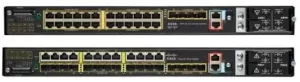
Right off the bat, Huawei S5720-EI series rewires expectations. These aren’t mere Layer 2 traffic cops – they’re multitasking powerhouses with enterprise DNA baked into steel frames. Flip open that datasheet, and you’ll find virtual stacking tech that links 9 switches into a single brain – sans proprietary cables or licensing traps. PoE++? Check. Juice 60W IoT displays or pan-tilt-zoom cameras from ports 1-48 without external injectors. Redundant power supplies slide out like magazine clips mid-operation, while hardware-based IPv6 routing sidesteps forklift upgrades. Need to segment finance from R&D? M-LAG pairs create active-active uplinks faster than rebooting a server. This hardware laughs when your SaaS traffic spikes at 3 PM.
So, does hybrid stacking tame the complexity beast? Without a doubt. Here’s the raw truth: Traditional stacks crumble when adding different switch models. S5720-EI’s hybrid approach chains mismatched generations – mix EI with older S5700s – sharing configurations across the cluster like gossip. Picture expanding a retail backbone: Add new PoE++ switches to power digital signage while older units handle CCTV, all managed as one entity. Security policies propagate instantly; no more manual port-by-port replication. QoS gets surgical: Hardware queuing shoves VoIP packets ahead of social media scrapers – auto-tagged via application awareness, not primitive port rules.
But the real unlock? Service chaining. Redirect guest Wi-Fi traffic through your firewall before it touches the core – configured via drag-and-drop, not CLI puzzles. Suspicious IoT thermostat pinging China? sFlow telemetry triggers ACL blocks in real-time, while MACsec encryption armor-plates data between switches. Energy waste? Dead ports throttle to 0.05W. For disaster scenarios: Hitless failover swaps control planes in 50ms – less than a human eye-blink.
Deployment feels almost too simple. Web UI templates deploy ACLs/QoS profiles across the stack with checkbox clicks. Cloud management optional. Forget firmware update nightmares: Upgrade one master unit after hours; changes ripple silently downstream. Troubleshooting? LEDs map bottlenecks like airport runway lights. When marketing demands 40 new IP phones by Friday, you just plug in – PoE++ handles the rest.
See this beast in the wild: A hospital runs patient monitors (VLAN 10), guest Wi-Fi (VLAN 20), and building controls (VLAN 30) on one hybrid stack. QoS prioritizes heart-rate data over YouTube streams. Campus networks? Lecture halls stream 4K video while M-LAG uplinks prevent STP loops from tanking the backbone. Manufacturing plants isolate robotic arms from office traffic yet share threat intelligence globally.
The verdict? Huawei S5720-EI series switches turn complexity into your weapon. Hybrid stacking isn’t just convenient – it’s a force multiplier letting lean teams punch like enterprise juggernauts. Security scales without consultants. Uplinks self-heal. Networks evolve organically. Compared to the previous-gen S5700 series, the S5720-EI datasheet reveals generational leaps: application-aware QoS, deeper telemetry, and true L3 features without router dependencies.
Stop treating switches as dumb pipes. With S5720-EI, you’re deploying a resilient nervous system that anticipates fires instead of reacting to them. When your competitors sweat over network diagrams, you’ll be scaling into new markets. Complexity conquered? More like weaponized.







Leave a comment