
Picture a global bank’s payment system crashing during peak processing hours as ransomware detonates across storage arrays. Milliseconds later, immutable snapshots automatically spin up clean datasets while AI algorithms surgically isolate corrupted blocks. This isn’t science fiction – it’s Huawei’s OceanStor architecture in action, executing capabilities that recently earned top rankings across all six Gartner Critical Capabilities for Primary Storage. When technology analysts dissect what separates enterprise storage leaders from followers, Huawei consistently demonstrates why its infrastructure now anchors the most demanding Tier 1 workloads worldwide.
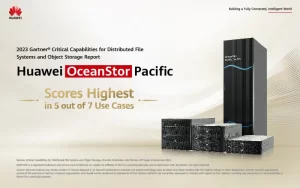
Gartner’s rigorous Critical Capabilities report represents the storage industry’s ultimate technical stress test – evaluating vendors across real-world scenarios like high-performance computing, hybrid cloud, containerization, and ransomware recovery. For enterprises navigating digital transformation amidst unprecedented threats, Huawei didn’t just participate; it dominated key technical categories with its OceanStor Dorado all-flash and OceanStor Pacific scale-out platforms. This recognition signals a fundamental shift where “Made in China” now means “Optimized for Global Critical Infrastructure,” backed by R&D investments exceeding $22B annually.
Technical Drivers of Huawei’s Leadership
1. Storage-Processing Convergence Breaks Performance Ceilings
Huawei’s secret weapon against latency-sensitive workloads lies in its unique FlashLink® technology. Unlike controller-based systems competing for CPU cycles, FlashLink integrates dedicated ASIC processors that handle data reduction, RAID calculations, and encryption directly on the flash modules. Results speak for themselves: 20 million sustained IOPS at 70μs latency—performance essential for financial trading and AI training environments. When German auto manufacturer Continental needed petabyte-scale analysis of autonomous vehicle sensor data, OceanStor Pacific delivered 40% faster dataset processing than previous solutions by eliminating traditional storage controller bottlenecks.
2. AI-Driven Predictive Resilience Architecture
Modern ransomware bypasses legacy snapshot protections. Huawei’s CyberSense+ forensic engine combines ML-based behavior analysis with blockchain-verified immutability. It continuously creates “fingerprints” of normal I/O patterns, detecting anomalies like mass file encryption within seconds—not hours. At a Middle Eastern oil conglomerate, the system automatically triggered air-gapped backups upon detecting cryptolocker patterns, isolating 16TB of drilling sensor data in 43 seconds. Gartner specifically noted Huawei’s “multilayer immunity” approach integrates detection, defense, and recovery into a seamless workflow superior to bolt-on security.
3. Multi-Dimensional Scalability Redefines Growth
Huawei solves two conflicting enterprise demands: massive scalability without complexity. OceanStor Pacific’s Scalable MetaData Engine enables 256 nodes to operate as a single namespace with unified protocols (S3, HDFS, NFS). The breakthrough enables petabyte expansions without application reconfiguration—critical for pharmaceutical research clients scaling genomics analysis. Simultaneously, CloudEngine TTL (Transparent Tiering Layer) extends this capacity seamlessly across on-prem arrays and public cloud buckets. UK managed service provider Redcentric slashed storage TCO by 65% using automated policy-based tiering between OceanStor arrays and Azure Blob Storage.
4. Silicon Root-of-Trust for Cyber-Resilient Infrastructure
While competitors rely on software-based encryption, Huawei embeds Kunpeng Cryptographic Acceleration Engines directly into storage processors. These NSA Suite B-compliant chips establish hardware-based boot attestation, preventing firmware tampering at the silicon level. Combined with physically armored “FortKnox” cabinets used in Swiss banking deployments, this creates a zero-trust hardware foundation. The implementation earned Huawei the first-ever EAL4+ security certification for enterprise storage infrastructure—a requirement increasingly mandated by EU and ASEAN regulators handling citizen data.
5. Hyper-Converged Data Services Platform
The architectural distinction lies in Huawei’s Data Fabric Controller, abstracting traditional silos into workload-optimized profiles that automatically align storage resources to application demands. Hospital networks run mission-critical EPIC EHR systems on guaranteed 99.999% availability profiles while simultaneously bursting radiology imaging archives to low-cost tiers with enterprise-wide governance. Spanish telco Telefonica automated storage provisioning across 900+ OpenStack instances using these declarative policies, cutting deployment cycles from days to 19 minutes.
From Technology Dominance to Strategic Enterprise Outcomes
Gartner’s measurements ultimately connect capabilities to tangible business outcomes—and here Huawei’s dominance becomes strategic:
- Cost-Performance Leadership: 5.5:1 guaranteed data reduction slashes effective flash costs below hybrid arrays
- Cyber Insurance Qualifications: 1-hour RTO compliance unlocks 37% premium reduction for US healthcare providers
- Sustainable Infrastructure: 56% less power per TB versus comparable Dell/NetApp configurations
- Multi-Cloud Governance: Unified SLA enforcement across AWS, Azure, and Huawei Cloud
This technical dominance fuels concrete sector victories: Dutch supercomputer Snellius runs OceanStor Pacific at 85 Petaflops, while Emirates NBD processes 11 million daily transactions on Dorado arrays. When Japanese semiconductor firm Renesas required guaranteed sub-100μs latency across its wafer fab operations, legacy vendors couldn’t meet the consistency benchmarks Huawei delivered through hardware acceleration.
The Foundation for Next-Generation Datasphere
Huawei’s storage ascendance reflects a deliberate engineering philosophy: build foundational silicon up rather than repackaging commodity components. As AI-native architectures redefine data value chains, technologies like the all-new Pacific Parallel File Engine—demonstrating 50% faster model training than WekaFS in NVIDIA DGX deployments—position Huawei at the computational frontier.
In a landscape where data has become both the crown jewel and primary liability, enterprises seek partners capable of safeguarding petabyte-scale assets while unlocking real-time insights. Huawei’s recognition across Gartner’s Critical Capabilities categories proves its infrastructure isn’t merely enterprise-grade; it’s engineered for the trillion-parameter AI models, exascale scientific workloads, and cyber-physical systems defining tomorrow’s competitive landscape. For CIOs navigating this shift, the message is clear: the tools exist to build a data fortress capable of unprecedented speed, security, and scale—and they bear a Huawei badge. As petabytes become the new terabytes, winning the storage game means anchoring digital strategy on infrastructures designed for domination from silicon to cloud.







Leave a comment