
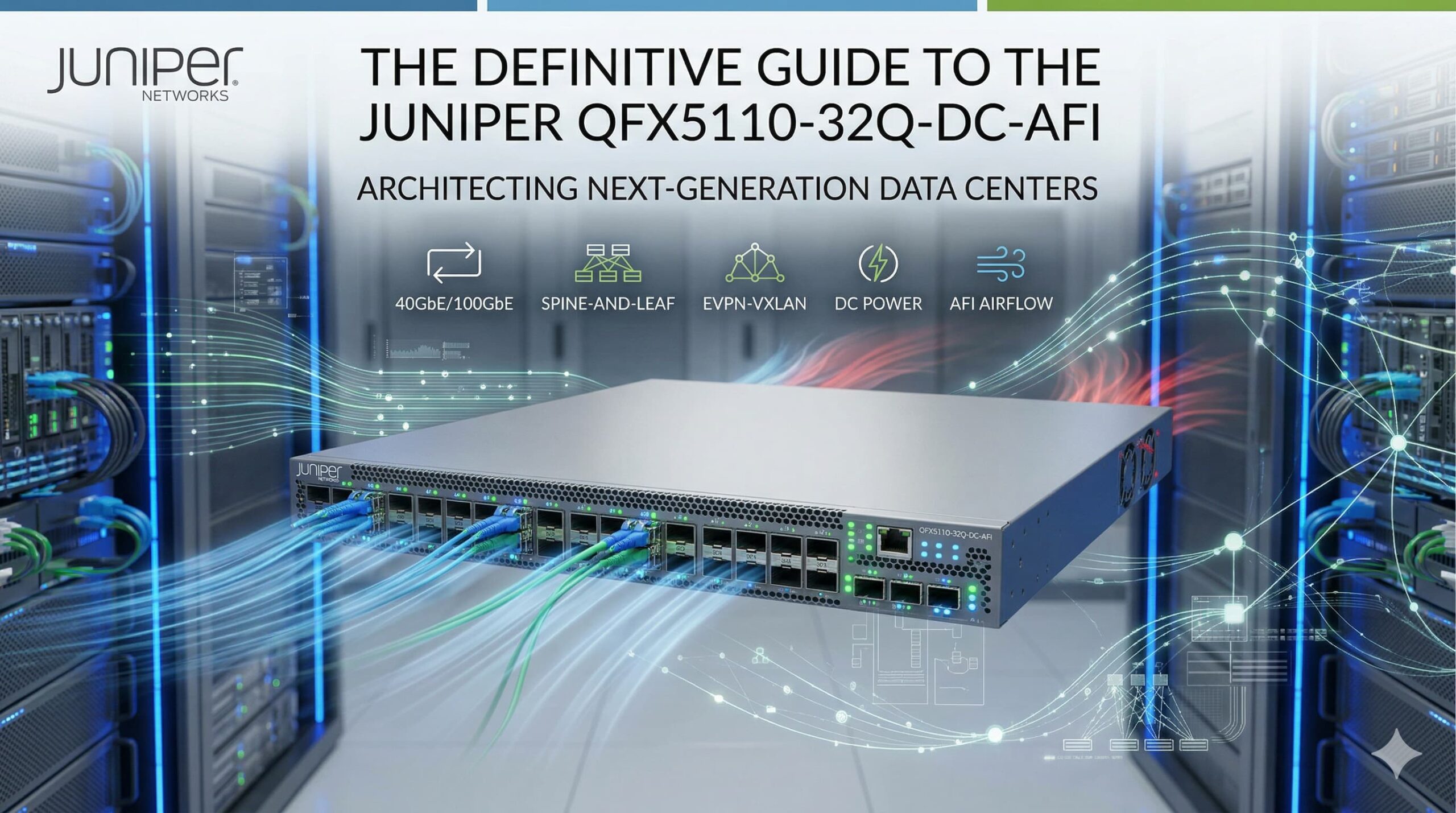
The Definitive Guide to the Juniper QFX5110-32Q-DC-AFI: Architecting Next-Generation Data Centers
What: This comprehensive whitepaper explores the intricate technical architecture, operational capabilities, and deployment strategies of the Juniper QFX5110-32Q-DC-AFI, a highly versatile 40GbE/100GbE data center switch. We dissect its underlying ASIC performance, routing protocol support, and power configuration specifics.
Why: As modern enterprise workloads migrate toward hybrid cloud environments and AI-driven applications, the demand for low-latency, high-throughput network fabrics has never been higher. Legacy spanning-tree networks are bottlenecking east-west traffic. Understanding how to leverage high-density platforms with robust overlay capabilities (like EVPN-VXLAN) is critical for network architects aiming to prevent traffic congestion and reduce Total Cost of Ownership (TCO).
How: By reading this guide, network engineers and IT decision-makers will learn actionable strategies for deploying spine-and-leaf architectures, implementing Junos OS automation protocols to reduce manual provisioning errors, and optimizing data center facility power and cooling using the switch’s DC-AFI design.
Unveiling the Core Architecture of the Juniper QFX5110 Series
At the heart of the modern data center network lies the requirement for predictable performance and immense scalability. The Juniper QFX5110-32Q-DC-AFI is engineered precisely to meet these rigorous demands. Acting as a compact 1 U high-density platform, it is primarily positioned as a lean spine or a high-capacity top-of-rack (ToR) leaf switch.
Silicon and Forwarding Capabilities
The QFX5110 series is powered by advanced merchant silicon, specifically the Broadcom Trident II+ ASIC. This silicon foundation allows the switch to deliver unprecedented wire-speed packet processing. It provides a staggering 2.56 Tbps of aggregate throughput and a forwarding capacity of up to 1.44 Billion packets per second (Bpps). Unlike legacy switches that rely on software-based forwarding for complex overlays, the ASIC in the QFX5110 processes Layer 2 and Layer 3 encapsulations in hardware, ensuring deterministic latency across the fabric.
Port Density and Interface Flexibility
One of the core advantages of the QFX5110-32Q-DC-AFI is its port agility. It is equipped with 32 Quad Small Form-factor Pluggable Plus (QSFP+) ports. However, its true value lies in its breakout capabilities and 100GbE support:
-
40GbE Mode: All 32 ports can be utilized for 40GbE uplinks or server connectivity.
-
100GbE Mode: The switch can be configured to support up to four 100GbE QSFP28 ports, leaving 20 ports available for 40GbE connections.
-
10GbE Breakout: Using breakout cables, the 40GbE ports can be channelized into four 10GbE interfaces, supporting up to 104 10GbE ports for legacy server aggregation.
For a complete breakdown of compatible fiber optics and transceivers, you can explore the robust inventory of optical transceivers at Telecomate, ensuring your physical layer integration is seamless.
The Strategic Importance of DC Power and AFI Airflow (DC-AFI)
When evaluating enterprise networking hardware, power and cooling configurations are just as critical as packet forwarding rates. The suffix “-DC-AFI” in the Juniper QFX5110-32Q-DC-AFI denotes two vital physical specifications: Direct Current (DC) power and Airflow In (AFI).
Maximizing Efficiency with Direct Current (DC)
While AC power is standard in commercial enterprise racks, telecommunications facilities, colocation centers, and hyperscale environments often rely on -48V DC power infrastructures. DC power supplies eliminate the need for centralized uninterrupted power supply (UPS) AC-to-DC-to-AC conversions, which are notoriously inefficient.
By leveraging native DC power, data centers can realize a power efficiency gain of up to 10-15% compared to traditional AC environments (Source: Uptime Institute Data Center Infrastructure Report, 2024). This translates to massive OpEx savings at scale. The dual, hot-swappable DC power supplies in this unit ensure high availability, keeping the fabric resilient against localized power faults.
Decoding AFI (Airflow In / Port-to-FRU)
Thermal management dictates hardware lifespan. AFI means “Airflow In,” traditionally known as port-to-FRU (Field Replaceable Unit) or front-to-back airflow. In an AFI configuration, cold air is drawn in through the port side (where the transceivers are plugged in) and exhausted out the back through the fans and power supplies.
This is crucial for ToR deployments where the switch ports face the cold aisle alongside the server network interface cards (NICs), aligning perfectly with cold-aisle/hot-aisle containment strategies to prevent thermal mixing and reduce HVAC workloads.
Mastering Spine-and-Leaf Architectures with EVPN-VXLAN
Legacy data centers utilized three-tier (Core, Aggregation, Access) architectures driven by Spanning Tree Protocol (STP). STP structurally blocks redundant links to prevent loops, wasting up to 50% of available bandwidth. The Juniper QFX5110-32Q-DC-AFI operates optimally in a modern Spine-and-Leaf Clos architecture, utilizing Equal-Cost Multi-Path (ECMP) routing to utilize all available links simultaneously.
Overcoming Layer 2 Boundaries with VXLAN
Virtual Extensible LAN (VXLAN) addresses the scalability limitations of traditional VLANs (capped at 4,096 segments). VXLAN encapsulates Layer 2 Ethernet frames into Layer 3 UDP packets, allowing data center operators to stretch Layer 2 domains seamlessly across robust Layer 3 IP fabrics. The QFX5110 processes VXLAN encapsulation and decapsulation natively in silicon, incurring zero latency penalties.
BGP EVPN as the Control Plane
While VXLAN provides the data plane encapsulation, Ethernet VPN (EVPN) provides the highly scalable, standards-based control plane. Relying on Multiprotocol BGP (MP-BGP), EVPN advertises MAC and IP addresses across the fabric rather than relying on inefficient flood-and-learn mechanisms.
The QFX5110 supports multiple EVPN route types, including:
-
Type 2 (MAC/IP Advertisement): Dramatically reduces ARP flooding broadcast traffic, which is a major pain point in dense virtual machine environments.
-
Type 5 (IP Prefix Route): Facilitates inter-subnet routing natively within the EVPN domain, creating a distributed anycast gateway architecture that optimizes east-west traffic between servers.
According to recent industry analysis, implementing EVPN-VXLAN in enterprise data centers can reduce network provisioning time by up to 60% and reduce broadcast traffic overhead by 40% (Source: Gartner Magic Quadrant for Data Center and Cloud Networking, 2023).
Junos OS: The Software Engine Driving Automation and Telemetry
Hardware is only as powerful as the operating system that governs it. The Juniper QFX5110-32Q-DC-AFI runs on Junos OS, an operating system globally renowned for its modular architecture, stability, and programmatic interfaces. Because Junos OS isolates the control plane from the data plane, a process failure in a routing protocol will not halt active packet forwarding.
Programmability and Zero Touch Provisioning (ZTP)
Manual configuration of dozens of spine and leaf switches is an error-prone and time-consuming task. Junos OS supports ZTP, allowing a factory-default QFX5110 to automatically acquire its IP address, download its Junos OS image, and pull its specific configuration file from a centralized server (via DHCP and TFTP/HTTP) the moment it is plugged in.
For continuous integration, engineers can leverage native APIs and integration tools:
-
PyEZ: A microframework for Python that allows engineers to manage Junos devices as programmable objects.
-
Ansible & Terraform: Full support for Infrastructure as Code (IaC) playbooks and modules, treating the physical switch state identical to cloud infrastructure.
Streaming Telemetry for Proactive Observability
Traditional SNMP polling is insufficient for the microsecond-level visibility required by modern AI and financial workloads. The QFX5110 supports OpenConfig and gRPC-based streaming telemetry. Instead of a management server querying the switch every five minutes, the switch actively pushes granular data (queue depths, CPU utilization, interface statistics) to a time-series database in real-time. This allows network operation centers (NOCs) to detect microbursts and proactively reroute traffic before dropped packets impact application performance.
For organizations looking to deploy fully automated fabrics, sourcing the right core infrastructure is paramount. You can explore competitive pricing and availability for the Juniper QFX5110-32Q-DC-AFI at Telecomate, ensuring your hardware procurement aligns with your automation goals.
Comparing High-Performance Switches: QFX5110 vs. QFX5200 Series
To make an informed B2B procurement decision, it is vital to contextualize the QFX5110-32Q against its peers in the Juniper portfolio. The table below outlines the critical parameter differences.
| Specification / Dimension | Juniper QFX5110-32Q | Juniper QFX5120-32C | Juniper QFX5200-32C |
| Target Data Center Role | Spine / High-Density Leaf | Leaf / Lean Spine | High-Performance Spine |
| ASIC Silicon | Broadcom Trident II+ | Broadcom Trident 3 | Broadcom Tomahawk |
| Max Port Configuration | 32 x 40GbE or 4 x 100GbE | 32 x 100GbE | 32 x 100GbE |
| Max Throughput | 2.56 Tbps | 6.4 Tbps | 6.4 Tbps |
| Buffer Capacity | 16 MB Shared Buffer | 32 MB Shared Buffer | 16 MB Shared Buffer |
| Primary Use Case | 10G/40G Migration, Storage | 100G Data Center Fabric | High-Speed AI/ML Clusters |
Note: While the QFX5120 and QFX5200 offer higher absolute throughput for pure 100GbE environments, the QFX5110-32Q remains the undisputed leader for data centers actively bridging legacy 10GbE/40GbE environments to 100GbE uplinks, offering superior cost-efficiency for colocation migrations. If you require massive 100GbE density, it may be worth evaluating the Juniper QFX5200 series via Telecomate for your spine layer.
Deployment Scenarios and ROI for Enterprise Networks
Deploying the Juniper QFX5110-32Q-DC-AFI provides immediate CapEx and OpEx benefits across several scenarios.
1. Colocation and Telco Provider Edges
Due to the stringent NEBS (Network Equipment Building System) compliance often required in telco environments, the DC power design of the QFX5110-32Q-DC-AFI makes it a perfect fit. It is frequently deployed at the provider edge as an aggregation switch, taking in thousands of customer 10GbE connections and funneling them into robust 40GbE/100GbE core uplinks.
2. VMware NSX Hardware VTEP Integration
For enterprises deeply invested in VMware virtualized networks, the QFX5110 can serve as a hardware VTEP (VXLAN Tunnel Endpoint). This allows bare-metal servers (which cannot run hypervisor-based virtual switches) to be seamlessly bridged into the VMware NSX virtual overlay network, ensuring consistent security policies and microsegmentation across both physical and virtual workloads.
3. Financial Services and High-Frequency Trading (HFT)
While it isn’t an ultra-low latency FPGA switch, its cut-through switching architecture delivers sub-microsecond latency for standard L2/L3 forwarding. The dynamic buffer allocation of the Trident II+ ASIC ensures that during the volatile market open/close periods (where microbursts of traffic occur), packets are queued efficiently rather than indiscriminately dropped.
Frequently Asked Questions (FAQs)
What does DC-AFI mean in the Juniper QFX5110-32Q-DC-AFI model number?
DC refers to the switch operating on Direct Current (-48V to -60V), which is standard in telecom and colocation facilities for better energy efficiency. AFI stands for Airflow In (port-to-FRU), meaning cold air enters through the port side and exhausts through the fan modules at the back.
Can the QFX5110-32Q support 100GbE ports?
Yes. While it is primarily a 40GbE switch (supporting 32 x 40GbE QSFP+ ports), it can be licensed and configured to support up to four 100GbE QSFP28 interfaces, allowing for high-bandwidth uplinks to core or spine layers.
What is the maximum forwarding capacity of this switch?
The QFX5110-32Q-DC-AFI delivers robust line-rate performance with an aggregate throughput of 2.56 Terabits per second (Tbps) and a packet forwarding rate of up to 1.44 Billion packets per second (Bpps).
Does the QFX5110 support EVPN-VXLAN natively in hardware?
Yes. The Broadcom ASIC inside the QFX5110 allows for line-rate VXLAN routing and EVPN control plane integration. This enables scalable Layer 2 extensions over Layer 3 Clos fabrics without any performance degradation.
What routing protocol features are included in the base Junos OS?
The base software includes robust Layer 2 features, static routing, OSPF, and basic BGP. However, advanced data center features like EVPN-VXLAN, advanced BGP, and MPLS typically require the Advanced Feature (AFL) or Premium Feature (PFL) licenses.
How does the QFX5110 handle microbursts in traffic?
It utilizes a 16 MB shared packet buffer. The Junos OS dynamically allocates this buffer space across active ports, absorbing sudden, intense bursts of east-west storage or application traffic to prevent packet loss.
Is the QFX5110-32Q more suitable for a Spine or Leaf role?
It is highly versatile. In medium-sized data centers, it functions perfectly as a spine switch aggregating 10GbE leaf switches. In larger scale-out hyperscale designs, it acts as an ultra-high-density Top of Rack (ToR) leaf switch connecting directly to compute nodes.
What are the compatible transceivers for this model?
The switch accepts standard QSFP+ transceivers (SR4, LR4, ER4) for 40GbE. For 100GbE uplinks, it accepts QSFP28 transceivers. It also supports direct attach copper (DAC) and active optical cables (AOC) for cost-effective, short-reach intra-rack connections.
Conclusion
The transition toward automated, highly virtualized, and cloud-native applications requires a networking foundation built on non-blocking performance and open programmability. The Juniper QFX5110-32Q-DC-AFI stands out as a formidable architecture that successfully bridges the gap between legacy 10G/40G environments and next-generation 100G overlays.
By pairing the low-latency Trident II+ ASIC with the programmatic brilliance of Junos OS, and packaging it within a highly efficient DC power/AFI chassis, Juniper Networks provides a solution that dramatically reduces both provisioning times and long-term operating costs.
Ready to upgrade your data center fabric? Stop letting legacy STP networks bottleneck your multi-cloud strategy. Evaluate your network topology today and explore deployment options for the Juniper QFX5110 series to bring wire-speed EVPN-VXLAN scale directly to your server edge.
Leave a comment