
As enterprises grapple with 83% annual growth in east-west traffic and 67% of organizations report infrastructure limitations in supporting AI/ML workloads (IDC 2024), the Cisco Nexus 9000 Series emerges as a cornerstone of next-generation data center design. Beyond basic switching capabilities, these platforms redefine network architecture through five transformative advantages that address both current operational demands and future technological shifts.
1. Unmatched Scalability for Hyperscale Demands
The Nexus 9000’s chassis-based and fixed-form-factor switches support unprecedented fabric expansion. The Nexus 9508 chassis, for instance, delivers 25.6Tbps per slot capacity—enough to handle 2.5 million simultaneous 4K video streams. With VXLAN scaling up to 16 million virtual networks, enterprises can:
- Seamlessly integrate multi-cloud environments via EVPN control planes
- Support 400G uplinks using QSFP-DD optics, future-proofing for 800G transitions
- Deploy 1RU switches like the 93180YC-FX3, offering 48x100G ports with MACsec encryption
Real-world impact: A global financial institution reduced latency by 74% after migrating from legacy platforms to Nexus 9336C spine nodes.
2. Performance Engineered for AI/ML Workloads
Modern AI clusters demand deterministic latency and lossless fabrics—capabilities where Nexus 9000 excels:
- Adaptive buffering (9–36MB dynamic allocation) prevents congestion in RDMA over Converged Ethernet (RoCEv2) environments
- Hardware-accelerated telemetry provides nanosecond-level visibility into GPU-to-GPU communication
- Cisco’s Cloud Scale ASIC enables programmable pipelines for custom P4-based data plane optimizations
3. Security Embedded in Hardware
In an era where 94% of enterprises experienced east-west attacks (IBM Security 2024), Nexus 9000’s security architecture provides:
- Line-rate MACsec-256GCM encryption across all ports
- Automated policy enforcement through Cisco TrustSec tags
- Quantum-resistant key exchange protocols (CRYSTALS-Kyber) for future-proof encryption
- Hardware-rooted trust via secure boot and runtime attestation
Compliance benefit: Healthcare networks achieve HIPAA compliance 40% faster through integrated microsegmentation.
4. Intent-Based Networking Through Automation
Transitioning from CLI-driven to API-first management, the series enables:
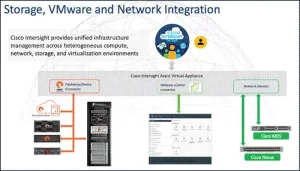
- Zero-touch provisioning across 1,000+ nodes using Cisco Nexus Dashboard
- Real-time telemetry streaming at 100ms intervals via OpenConfig/YANG models
- Self-healing capabilities that automatically reroute traffic during link degradation
- Integration with Kubernetes through Cisco ACI CNI plugins
Operational impact: A telecom operator reduced configuration errors by 82% using Ansible playbooks with NX-OS APIs.
5. Sustainable Operations Through Energy Efficiency
Aligning with global ESG mandates, the platform delivers:
- 0.4W per Gbps power efficiency—68% improvement over previous generations
- Dynamic power scaling that adjusts consumption based on traffic loads
- Recyclable chassis designs meeting EPEAT Gold standards
- Compatibility with 48V DC power systems for renewable energy integration
Cost example: A hyperscaler saved $4.2 million annually by replacing legacy switches with Nexus 93180YC-FX3 across 12 data centers.
The Strategic Differentiator: Architectural Flexibility
What truly distinguishes the Nexus 9000 Series is its ability to evolve across technology generations:
- Today: 400G-ready spines supporting RoCEv2 and NVMe-oF
- 2025: Programmable pipelines for in-network computing via P4 runtime
- 2030+: Photonic integration roadmaps for co-packaged optics
This adaptability enabled a European research facility to transition from 10G to 400G infrastructure without forklift upgrades—a feat impossible with fixed-architecture switches.







Leave a comment