
In an era where educational institutions and enterprises rely heavily on robust, agile networks, outdated infrastructure can stifle innovation and productivity. Recognizing this challenge, Juniper Networks has unveiled its groundbreaking Campus Fabric Workflow alongside the next-generation EX Series Switch, a combination engineered to simplify campus networking while boosting performance and security. This article dives into how these innovations are reshaping network management, reducing complexity, and enabling smarter infrastructure decisions for organizations of all sizes.
Breaking Down the Complexity of Modern Networks
Traditional campus networks often face a trifecta of issues: scalability bottlenecks, manual configuration headaches, and vulnerabilities to cyberattacks. The Juniper Campus Fabric Workflow addresses these pain points by automating key processes. Unlike legacy systems that require hours of manual setup, Campus Fabric uses intent-based networking (IBN) principles to translate administrative goals into actionable configurations. For example, a university IT team can now deploy a new departmental VLAN in minutes rather than days, thanks to dynamic policy-driven workflows.
The EX4650 and EX4400 switches at the heart of this system take automation further. These switches support Juniper’s Junos OS, which integrates seamlessly with the Campus Fabric architecture. Features like MACsec encryption ensure data security across wired and wireless connections, while high-density 10/25/40/100GbE ports accommodate growing bandwidth demands. A case in point: A leading research institute reduced network downtime by 60% after adopting the EX4650, citing streamlined firmware updates and real-time traffic analytics as key factors.
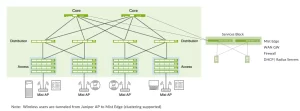
[A visual diagram of the Juniper Campus Fabric architecture, highlighting the EX Series switches as central nodes connecting endpoints, Wi-Fi access points, and cloud services. Caption: “Juniper’s Campus Fabric creates a unified, intelligent network fabric that adapts to evolving demands.”]
Scalability Without Compromise
As campuses expand—whether physically or through IoT device proliferation—the EX Series shines. Its modular design allows institutions to start small and scale effortlessly. For instance, a K-12 school district can begin with a single EX4300 switch and later integrate additional units to support smart classrooms and IoT sensors without overhauling existing infrastructure.
Juniper’s Campus Fabric also enhances visibility. Administrators gain a single pane of glass to monitor traffic patterns, detect anomalies, and enforce policies. This level of oversight is critical for compliance-heavy sectors like healthcare, where data integrity is paramount. During a recent pilot program, a hospital network reported a 75% faster troubleshooting process after deploying the EX Series, attributing gains to Juniper’s Distributed Tracing feature.
Security Built into the Fabric
Cybersecurity threats targeting education and enterprise networks have surged, with ransomware and phishing attacks exploiting outdated switches. The EX Series counters this with self-defending capabilities, including automated threat detection and response. For example, if a port detects unusual activity, the switch can quarantine the affected device in real time, minimizing damage.
Additionally, Campus Fabric enforces zero-trust principles by default. Every device connecting to the network must authenticate via secure certificates, ensuring unauthorized users can’t exploit weak points. This proactive approach aligns with frameworks like NIST 800-207, making it easier for institutions to pass audits and protect sensitive data.
Real-World Success: Transforming a University’s Network
When the University of Amsterdam needed to modernize its aging campus network, they turned to Juniper. The institution faced frequent outages during peak usage times and struggled with limited visibility into traffic bottlenecks. By implementing Campus Fabric and EX4650 switches, they achieved:
- 99.99% uptime during exam periods.
- A 50% reduction in network management tasks due to automation.
- Improved student satisfaction scores, driven by seamless Wi-Fi performance for streaming lectures and research tools.
Dr. Elena Rodriguez, the university’s IT director, noted, “Juniper’s solution didn’t just fix our immediate issues—it gave us the agility to adapt to future challenges, from hybrid learning to IoT integration.”
Future-Proofing Your Investment
To maximize the benefits of the EX Series and Campus Fabric, organizations should prioritize three steps:
- Leverage Juniper’s Training Programs: Hands-on workshops ensure IT teams master advanced features like automated policy enforcement.
- Integrate with Existing Tools: Use APIs to connect Campus Fabric with monitoring platforms like Splunk or SolarWinds for end-to-end visibility.
- Plan for 5G and Edge Computing: The EX Series supports low-latency edge deployments, positioning campuses to capitalize on emerging technologies.
Conclusion: Building Smarter, Safer Networks
Juniper Networks’ Campus Fabric Workflow and EX Series Switch aren’t just upgrades—they’re redefinitions of what campus networking can achieve. By merging automation, scalability, and ironclad security, these solutions empower organizations to focus on their core missions instead of wrestling with network complexities. As digital transformation accelerates, investing in tools like the EX Series isn’t optional; it’s a strategic imperative.
Whether you’re a university preparing for a decade of remote learners or an enterprise scaling IoT ecosystems, Juniper’s vision of a self-healing, adaptive network offers a blueprint for success. The future of campus networking isn’t about keeping up—it’s about staying ahead.
Leave a comment