
In 2024, a fleet of autonomous drones buzzed over Riyadh’s construction sites, mapping progress for the $500 billion NEOM megacity—not with human pilots, but via Saudi Arabia’s newly launched 5G-Advanced network. This scene isn’t sci-fi; it’s a snapshot of the Kingdom’s ICT metamorphosis. Fueled by Vision 2030’s ambitious reforms, Saudi Arabia’s tech sector is growing at 13.4% annually (GSMA, 2024), outpacing global averages. But beyond the skyscrapers and drone fleets lies a deeper story: a nation racing to become the Middle East’s digital nucleus, where cloud cities, AI-driven oilfields, and quantum-ready networks converge.
The numbers tell a compelling tale:
- $24 billion invested in ICT infrastructure since 2021 (Saudi Ministry of Communications).
- 94% mobile broadband penetration, surpassing the EU average (ITU).
- 450+ tech startups incubated in Riyadh’s KAUST Innovation Hub in 2023 alone.
Yet, Saudi Arabia’s tech revolution isn’t just about spending—it’s about rewiring an economy. Let’s unpack the forces driving this transformation.
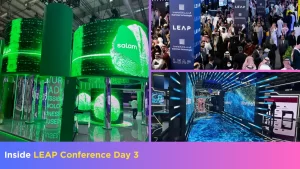
Image: Attendees explore AI solutions at LEAP 2024, the Middle East’s largest tech event. Source: Saudi Press Agency
Catalysts Igniting Growth
1. Oil-to-Tech Pivot: With 60% of Saudi GDP still oil-dependent, the Kingdom is aggressively diversifying. The National Cloud Policy mandates that 75% of government data migrate to local hyperscale centers by 2025—a boon for AWS and Google Cloud, which opened Riyadh regions in 2023. Aramco’s $1.5 billion venture fund now backs AI startups optimizing oil extraction, slashing drilling costs by 18% in pilot projects.
2. Regulatory Reboot: Saudi Arabia’s Digital Government Authority (DGA) has cut red tape, enabling same-day business licensing for tech firms. When Chinese e-giant SHEIN set up its MENA HQ in Riyadh, approvals took 72 hours—a process that once took months. Meanwhile, relaxed foreign ownership laws attracted $7.2 billion in venture capital since 2022, with SoftBank and Sequoia leading deals.
3. Talent Cultivation: The TAQADAM Accelerator is grooming homegrown innovators. Take Nana, a grocery delivery app that leveraged Saudi’s high smartphone usage (98% penetration) to dominate 63% of the market, outmaneuvering Careem and Amazon. The Kingdom now graduates 40,000 STEM students yearly, with 34% being women—a strategic edge in a region facing tech talent shortages.
Frontier Markets Defining the Future
A. Smart Cities Beyond NEOM:
While NEOM grabs headlines, Riyadh 4.0 quietly deploys AI traffic systems that reduced congestion by 41% in 2023. Sensors on 500,000 streetlights now adjust brightness using pedestrian heatmaps, saving $130 million annually in energy costs.
B. HealthTech Surge:
Post-pandemic, Saudi invested $1.8 billion in telemedicine. Platforms like Vezeeta connect patients with doctors via Arabic-language AI chatbots, cutting hospital wait times from 14 days to 24 hours. The Saudi Data and AI Authority (SDAIA) predicts AI will diagnose 30% of chronic diseases by 2027.
C. Gaming and Esports:
With 67% of Saudis under 35, gaming is a 6billionpriority.TheSavvyGamesGroup(ownedbyPIF)acquiredScopelyfor4.9 billion in 2023, while ESL Gaming’s Riyadh Masters tournament drew 2 million viewers—a soft power play to position KSA as the region’s entertainment hub.
Challenges in the Oasis
Saudi’s tech ascent faces hurdles:
- Energy Paradox: Data centers consume 4% of national power—problematic for solar-rich but water-scarce deserts.
- Global Skepticism: Critics question NEOM’s feasibility after The Line’s scaled-down redesign.
- Geopolitical Rivalry: UAE’s lead in fintech and Israel’s cybersecurity dominance pressure Saudi to differentiate.
Yet, the Kingdom is countering smartly. The Green Data Center Initiative mandates 30% renewable energy use for tech infrastructure by 2025, with solar-powered server farms already operational in Al-Khobar.
Final Insights
Saudi Arabia’s ICT revolution isn’t just building networks—it’s building a post-oil identity. As Minister of Communications Abdullah Al-Swaha stated at LEAP 2024: “We’re coding our future in binary and ambition.” From AI-optimized mosques that adjust cooling for prayer crowds to blockchain-based halal supply chains, the Kingdom is blending tradition with hyper-innovation.
For global investors, the message is clear: Saudi tech is open for business, but patience is key. Success here requires navigating a unique ecosystem where tribal governance meets Silicon Valley speed. Those who adapt will tap a market projected to hit $43 billion by 2027—a digital oasis where bytes flow faster than oil.







Leave a comment