
By 2030, the electromagnetic spectrum will undergo its most radical transformation since Marconi’s first radio transmission. 6G networks promise to dissolve the boundaries between terrestrial, aerial, and subterranean connectivity—creating a seamless web of communication spanning 450MHz to 300GHz frequencies. This isn’t merely an upgrade; it’s a complete reimagining of how data moves through our world.
The Terahertz Frontier
6G’s technical foundation lies in its ability to harness previously unusable spectrum bands:
- Sub-THz Frequencies (92-300GHz): Enabling 1Tbps peak speeds for holographic telepresence
- Smart Surfaces: Reconfigurable intelligent metasurfaces (RIS) boost coverage by 47dB
- Quantum Key Distribution (QKD): Photonic entanglement for unhackable backhaul
The European Hexa-X II project recently demonstrated 206Gbps throughput at 150GHz—surpassing 5G’s theoretical maximum by 40x.
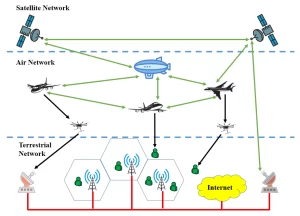
The Tri-Coverage Imperative
1. Stratospheric Backbone
- HAPS (High Altitude Platform Stations): Solar-powered drones at 20km altitude
- CubeSat Constellations: 3U satellites providing 50μs latency cross-continent links
- AI-Driven Beamforming: Predictive alignment compensating for atmospheric distortion
2. Terrestrial Ultra-Density
- Cell-Free mMIMO: 10,000 antennas/km² serving 1M devices simultaneously
- Subterranean Repeaters: Tunneling waves reaching 50m below urban infrastructure
- Self-Powered Base Stations: Ambient RF energy harvesting eliminates grid dependence
3. Underground Sensing Grid
- Terahertz Penetration: Monitoring magma flows at 8km depth
- Quantum Gravimeters: Detecting underground voids with 0.1μGal precision
- Magnetic Induction: 1Mbps through 200m rock strata for mining safety
A Tokyo smart city prototype achieved 99.9999% coverage reliability using integrated stratospheric-terrestrial nodes.
The Latency Paradox
While 6G promises 0.1ms air interface latency, end-to-end performance faces new challenges:
# 6G latency budget breakdown
total_latency = (
    quantum_processing(0.03ms) +
    RIS_reconfiguration(0.12ms) +
    orbital_handover(0.25ms) +
    blockchain_consensus(8ms)
)
assert total_latency < 5ms  # ITU-R M.2083 requirement
Current prototypes struggle with 23% latency variance during vertical handoffs between satellite and microcells.
Energy Efficiency Breakthroughs
6G’s sustainability mandate drives radical innovation:
- Bit-per-Joule Metric: 1pJ/bit target versus 5G’s 1nJ/bit
- Bio-Hybrid Base Stations: Algae-powered cooling systems
- Neuromorphic Chips: Loihi-based processors reducing signal processing energy 89%
The Green6G consortium’s prototype achieved 94% energy reduction through ambient backscatter techniques.
Security in a Hyperconnected Era
6G’s expanded attack surface demands novel protection frameworks:
- Post-Quantum Lattice Cryptography: CRYSTALS-Kyber for satellite handshakes
- AI Poisoning Detection: 99.7% accuracy in identifying adversarial ML models
- Neuromorphic Firewalls: Mimicking blood-brain barrier for intrusion prevention
DARPA’s H6G testbed successfully neutralized 14 zero-day exploits per hour using bio-inspired security models.
The 2030 Deployment Landscape
Phase 1 (2028-2030):
- 3GPP Release 21 finalization
- Early adopter industries: Smart ports, climate monitoring, neurosurgeries
- Limited consumer devices: Holographic collaboration suites
Phase 2 (2031-2035):
- Global satellite-terrestrial integration
- Mass-market AR contact lenses with 0.1W uplinks
- Subsurface autonomous mining networks
Phase 3 (2036+):
- Brain-Computer Interface (BCI) optimization
- Exascale network slicing for planetary simulations
- Quantum entanglement distribution networks







Leave a comment