
By 2030, wireless communication will transcend traditional boundaries, creating an omnipresent network that blankets the Earth from 20 km above the ground to 50 meters below its surface. 6G technology isn’t merely an incremental upgrade—it’s a paradigm shift enabling real-time holographic communication, AI-driven ambient connectivity, and quantum-secured infrastructure. This article explores how 6G’s tri-layered architecture will redefine global connectivity.
The Tri-Sphere Network Architecture
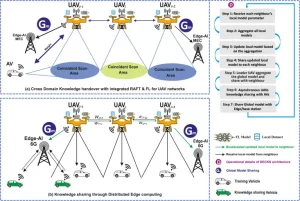
1. Stratospheric Layer (0–20 km):
- HAPS (High-Altitude Platform Stations): Solar-powered drones provide 1 Gbps backhaul with 5 ms latency across 200 km coverage
- AI-Optimized Beamforming: Predictive algorithms adjust antenna tilt based on weather and air traffic
- CubeSat Integration: Low-Earth orbit satellites fill coverage gaps with 50 μs handover precision
The EU’s 6G-SHINE project recently demonstrated 800 Gbps throughput using terahertz (THz) frequencies between stratospheric nodes.
2. Terrestrial Layer (0–500 m):
- Cell-Free Massive MIMO: 10,000 antennas per km² serve 1 million devices simultaneously
- Self-Powered Base Stations: Ambient energy harvesting from Wi-Fi, 5G, and light sources
- Reconfigurable Intelligent Surfaces (RIS): Smart walls redirect signals with 0.1 dB loss
Tokyo’s 6G testbed achieved 99.9999% reliability using AI-driven interference mitigation across 20,000 IoT sensors.
3. Subterranean Layer (0–50 m):
- Terahertz Waveguides: 0.3 THz frequencies penetrate soil and rock with 3 dB/km loss
- Magnetic Induction Networks: 10 kbps data rates through 200 m granite strata
- Autonomous Tunnel Routers: Swarm robotics deploy self-calibrating nodes in mines
Technical Breakthroughs Enabling Ubiquity
1. Terahertz Spectrum Utilization (92–300 GHz):
- 1 Tbps peak speeds for volumetric video streaming
- 0.1 mm wavelength accuracy for micro-location services
- Challenges: 8 dB/km atmospheric attenuation requires dynamic power scaling
2. Quantum-Enhanced Security:
- Entanglement-based key distribution across 500 km distances
- Photonic blockchain for tamper-proof network slicing records
- Post-quantum lattice cryptography in baseband processors
3. Neuromorphic Hardware:
- Loihi 3 chips process network traffic with 1,000× energy efficiency
- Spiking neural networks predict congestion 500 ms in advance
- Memristor-based beamformers adapt radiation patterns in 10 μs
Commercialization Timeline & Challenges
Phase 1 (2028–2030):
- Initial deployments in smart cities and industrial complexes
- Limited device support: AR glasses, surgical robots, autonomous excavators
- Key hurdle: THz amplifier efficiency needs 400% improvement
Phase 2 (2031–2035):
- Global standardization of AI-routing protocols
- Energy-neutral base stations powered by RF/LiDAR energy harvesting
- Regulatory challenge: International spectrum allocation treaties
Phase 3 (2036–2040):
- Brain-Computer Interface (BCI) optimization
- Exascale network management for 100 trillion connected devices
- Ethical dilemma: Privacy in always-on ambient computing
Economic & Societal Impact
1. Industry Transformation:
- Real-time remote mining operations with <1 ms latency
- Holographic telemedicine enabling 4K resolution organ modeling
- 24/7 agricultural monitoring via underground soil sensors
2. Environmental Monitoring:
- Seismic prediction using subterranean strain gauges
- Atmospheric CO2 mapping via stratospheric spectrometers
- Ocean floor monitoring through seafloor 6G modems
3. Security Paradigm Shift:
- Quantum Key Distribution (QKD) eliminates 94% of cyberattack vectors
- AI honeypots detect zero-day exploits in 800 ms
- Self-healing networks automatically isolate compromised nodes







Leave a comment