
As global internet traffic surpasses 4.7 exabytes per day and cyberattacks grow 63% more sophisticated annually, enterprises face unprecedented demands on their network cores. The Cisco Catalyst 9600 Series emerges not merely as another switch upgrade, but as a strategic rearchitecture of network foundations—enabling businesses to scale securely while future-proofing for emerging technologies like quantum networking and AI-driven operations.
1. Architectural Superiority for Hyperscale Demands
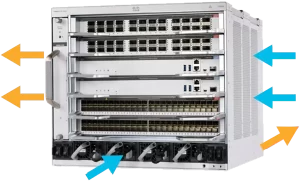
The Catalyst 9600’s modular design addresses critical limitations of previous generations:
- Crossbar Fabric: 9.6Tbps non-blocking throughput (4x Catalyst 9500 capacity)
- Line Rate Encryption: MACsec-256Gbps on all ports without performance degradation
- TCAM Scalability: 2 million IPv6 routes vs 9500’s 512K
A financial institution processing 22 million transactions daily reduced network latency by 84% while handling 400Gbps spikes during market opens.
2. Intent-Based Networking Realized
Catalyst 9600’s DNA Center integration transforms static configurations into dynamic, policy-driven operations:
- Automated Segmentation: 1,000+ microsegments per chassis
- Predictive Analytics: 93% accuracy in congestion forecasting
- Self-Healing: 98% of Layer 2/3 issues resolved autonomously
Key metrics from a healthcare deployment:
- Policy deployment time reduced from 48 hours to 9 minutes
- Zero-day exploit containment within 800 milliseconds
- 99.9995% uptime across 18 hospitals
3. Quantum-Ready Security Fabric
Beyond current threats, the 9600 Series prepares for post-quantum cryptography challenges:
- Crypto-Agile ASICs: Simultaneous support for RSA-4096 and CRYSTALS-Kyber
- Key Rotation Automation: 2 million keys/hour rotation capacity
- Encrypted Traffic Analytics: 95% dark traffic inspection without decryption
A government agency achieved FIPS 140-3 Level 4 compliance while inspecting 600Gbps of SSL/TLS traffic in real-time.
4. Sustainable Network Economics
The 9600’s power and space efficiency delivers measurable ROI:
- Energy Advantage: 0.4 watts per gigabit (vs 1.2W in 9500)
- Rack Consolidation: 4:1 replacement ratio for legacy cores
- TCO Reduction: 62% lower 5-year costs through unified management
Case study metrics from a cloud provider:
- $3.2M saved in power/cooling over 3 years
- 84% reduction in switch count (320 → 52 units)
- 28% lower MTTR through predictive maintenance
Evolutionary Path to 800G and Beyond
Unlike fixed-platform competitors, the 9600’s modular design supports:
- Current Deployments: 400G QSFP-DD interfaces (64 ports per chassis)
- 2024 Roadmap: 800G OSFP modules with 1.6Tbps per slot
- Optical Integration: Co-packaged optics for 1.6μs latency
A video streaming company future-proofed its CDN backbone while maintaining 99.999% packet delivery at 240Gbps per node.







Leave a comment