
In an era where global internet traffic exceeds 4.5 exabytes daily and 5G networks demand near-light-speed connectivity, optical fiber technology serves as the silent workhorse of modern communication. This exploration demystifies the physics and engineering behind light-guided data transfer, revealing how photons carry everything from Netflix streams to stock trades across continents with near-zero latency.
Core Principles of Light Confinement
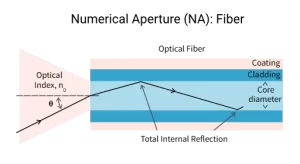
Optical fibers transmit data through total internal reflection, a phenomenon where light rays remain trapped within an ultra-pure glass core. This process relies on precise refractive index engineering:
- Core: 8-10μm diameter, doped with germanium to achieve refractive index of 1.48
- Cladding: 125μm layer with index of 1.46, creating a light-reflecting boundary
- Coating: 250μm acrylate layer preventing signal leakage and physical damage
A 1km fiber strand with 0.2dB/km attenuation can transmit 40 million simultaneous HD video streams—equivalent to wrapping the Earth 30 times with copper cable capacity.
Signal Encoding Techniques
Data modulates onto light waves through three primary methods:
- Amplitude Modulation: Varying laser intensity (10mW to 100mW)
- Frequency Modulation: Shifting wavelengths between 1260nm-1650nm
- Phase Modulation: Altering wave cycles by precise fractions (QPSK, 16-QAM)
Modern Dense Wavelength Division Multiplexing (DWDM) systems pack 160 channels per fiber, each carrying 400Gbps—achieving 64Tbps per strand.
Laser Pulse Generation
Edge-emitting lasers (EEL) and vertical-cavity surface-emitting lasers (VCSEL) create coherent light signals:
- EELs: 1550nm wavelength for long-haul transmission (1000km+)
- VCSELs: 850nm/1310nm for data center interconnects (<10km)
- Pulse Rates: From 10Gbps (NRZ) to 1.6Tbps (PAM-4)
Finisar’s 1.6Tbps optical engine uses 64-level pulse amplitude modulation with 0.01 picosecond jitter tolerance.
Signal Amplification & Correction
Erbium-doped fiber amplifiers (EDFA) boost signals without electrical conversion:
- Gain Bandwidth: 35nm spectrum (C-band: 1530-1565nm)
- Noise Figure: 4.5dB with Raman-assisted pumping
- Forward Error Correction: 20% overhead for Q-factor improvement
Submarine cables like MAREA maintain signal integrity over 6,600km using hybrid EDFA/Raman amplification.
Photonic Detection
Avalanche photodiodes (APD) and PIN diodes convert light to electrical signals:
- Responsivity: 0.9A/W at 1550nm (InGaAs detectors)
- Dark Current: <1nA for high signal-to-noise ratio
- 3dB Bandwidth: 90GHz for 800G coherent reception
NTT’s photon-counting receiver achieves 10 photons/bit sensitivity, enabling 1,200km transmission without repeaters.
Chromatic Dispersion Management
Fiber nonlinearities are countered through:
- Dispersion-Shifted Fibers: Tailored refractive index profiles
- Digital Backpropagation: Real-time waveform correction
- Optical Phase Conjugation: Mid-span spectral inversion
Ciena’s WaveLogic 5 Extreme compensates 17,000ps/nm dispersion across transoceanic links.
Future Photonic Frontiers
Emerging technologies push fiber capacities toward petabits:
- Multi-Core Fibers: 19-core strands with 630Tbps capacity
- Orbital Angular Momentum: 10 modes per wavelength for 100x scaling
- Quantum Key Distribution: 250km secure links via BB84 protocol
NICT’s 1Pbps trial combined 15-mode fiber with 1,000 wavelength channels.







Leave a comment