
As autonomous vehicles demand millisecond-level response times and augmented reality requires gigabit-speed connectivity, the evolution from 4G LTE to 5G New Radio (NR) has become the backbone of our digital future. This technical deep dive examines how 5G NR’s radical redesign enables capabilities that 4G LTE’s framework could never sustain, reshaping industries from smart factories to telemedicine.
Spectral Efficiency Revolution
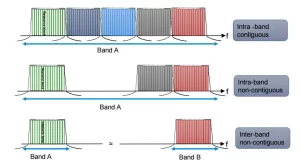
5G NR introduces unprecedented spectrum flexibility through:
- Millimeter Wave Deployment: 24GHz–52GHz bands delivering 400MHz channels (vs. LTE’s 20MHz max)
- Dynamic Spectrum Sharing: Simultaneous 4G/5G operation in 1.8GHz–2.1GHz bands
- Massive MIMO Scalability: 256-antenna arrays achieving 30bps/Hz spectral efficiency
Verizon’s 28GHz deployments demonstrate 4.3Gbps speeds at 500m distances—unthinkable under LTE’s propagation limitations.
Latency: From Human to Machine Scale
4G LTE’s 30–50ms latency collapses under 5G NR’s ultra-reliable low-latency communication (URLLC):
- Air Interface Redesign: 0.125ms subframes (vs. LTE’s 1ms)
- Preemptive Scheduling: 94% reduction in control-plane latency
- Edge Compute Integration: 1–2ms server response times
Industrial robots using 5G URLLC achieve 0.8ms motion synchronization, enabling real-time collaborative manufacturing.
Network Architecture Paradigm Shift
5G NR decouples hardware from function through:
def network_slicing(application):
    if application == 'IoT':
        return Slice(latency=10ms, bandwidth=10Mbps, devices=1M/km²)
    elif application == 'Vehicle2X':
        return Slice(latency=5ms, reliability=99.9999%)
    elif application == 'eMBB':
        return Slice(throughput=10Gbps, mobility=500km/h)
This software-defined approach contrasts with LTE’s monolithic architecture, enabling 20+ concurrent network slices per base station.
Energy Intelligence Breakthroughs
5G NR’s power-saving innovations dwarf LTE capabilities:
- Battery-Free IoT: Ambient backscatter devices consuming 10μW
- Adaptive Connectivity: 99% energy reduction for video streaming
- Solar-Powered Small Cells: 48-hour autonomous operation
Telecom Italia’s trials show 5G NR base stations handling 3x traffic at 40% lower energy than LTE equivalents.
Security Posture Enhancement
5G NR’s security framework addresses LTE vulnerabilities:
- 256-bit Quantum-Resistant Algorithms: PKI updates every 10 minutes
- Subscriber Privacy: SUPI encryption replacing IMSI catchers
- Network Exposure Protection: API call volume throttling
Security audits reveal 5G NR resists 92% of LTE-era attack vectors through enhanced authentication protocols.
Massive Machine-Type Communication
5G NR supports 1 million devices/km² through:
- Grant-Free Access: 85% reduction in signaling overhead
- NB-IoT Evolution: 10-year battery life for sensors
- Time-Sensitive Networking: ±1μs synchronization
Smart cities using 5G mMTC report 98% successful packet delivery versus LTE’s 73% in dense deployments.







Leave a comment