
Abstract
As global internet traffic surges and user bandwidth expectations reach unprecedented heights, telecommunications operators are forced to re-evaluate their optical access networks. This comprehensive guide explores the ZTE ZXA10 C600 OLT (Optical Line Terminal), a flagship product built on ZTE’s innovative TITAN platform.
What you will learn: We will conduct a deep technical dive into the distributed architecture, line card configurations, and supported protocols (GPON, XGS-PON, Combo PON) of the ZTE C600.
Why it matters now: With the imminent convergence of 5G backhaul, ultra-broadband residential services, and enterprise cloud access, legacy centralized OLTs are becoming bottlenecks. Upgrading to a cloud-native, SDN-ready architecture is no longer optional for Tier-1 and Tier-2 ISPs.
How you can act: Readers will extract actionable strategies for network migration, zero-touch provisioning, and leveraging Combo PON technology to seamlessly transition from standard GPON to 10G PON without overhauling existing Optical Distribution Networks (ODNs).
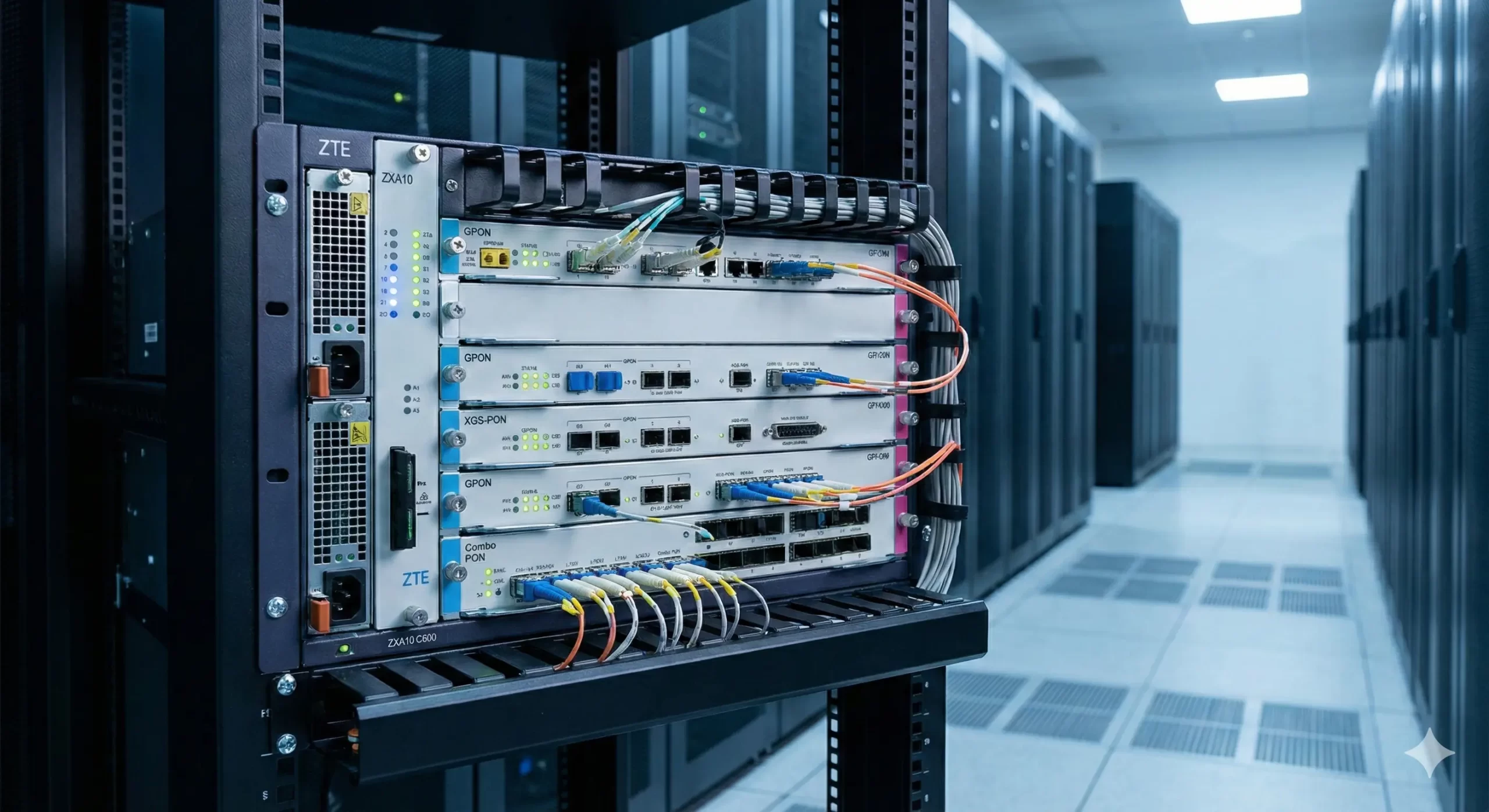
Understanding the ZTE ZXA10 C600 Architecture and Core Capabilities
The telecommunications landscape is undergoing a massive paradigm shift. As consumer behaviors pivot toward 8K streaming, immersive AR/VR environments, and heavy cloud computing, the traditional Optical Line Terminal (OLT) must evolve from a simple aggregation box into a dynamic, edge-computing powerhouse. The ZTE ZXA10 C600 represents this exact evolution.
Built upon ZTE’s proprietary TITAN platform, the C600 is a large-capacity, high-density, and fully distributed OLT designed to meet the rigorous demands of the next decade. Unlike legacy systems that rely heavily on a centralized switching matrix—which often creates a data bottleneck during peak load times—the ZTE C600 utilizes a fully distributed architecture. This means that data forwarding and processing are largely handled at the line-card level rather than solely at the main control board.
The Shift to a Distributed Forwarding Mechanism
In a traditional centralized OLT, all traffic from the subscriber-facing ports must traverse the backplane to the control and switching board before being routed to the uplink network. As ISPs introduce symmetrical 10 Gbps connections via XGS-PON, this centralized matrix quickly becomes saturated.
The ZTE C600 solves this through distributed processing. The control and switch boards (such as the SFGH or SFGW) handle system management, protocol processing, and route calculation, while the individual service boards (line cards) manage the actual data packet forwarding. This architectural leap guarantees non-blocking forwarding for all ports, even when fully populated with 10G or future 50G PON line cards.
High-Density Line Cards and Supported PON Technologies (GPON, XGS-PON, Combo PON)
To justify the capital expenditure (CapEx) of a network core upgrade, an OLT must offer unparalleled density and backward/forward compatibility. The ZTE C600 excels in this dimension by offering 17 service slots in a standard 11RU (Rack Unit) chassis.
Legacy Support and GPON (GFGH / GFGL)
For regions where standard Gigabit-capable Passive Optical Networks (GPON) are still the commercial standard, the C600 supports ultra-high-density boards.
1.GFGH Board: Provides 16 GPON ports.
2.GFGM Board: An even higher density 16-port board optimized for specific MAC/forwarding tables.
These boards support maximum split ratios of 1:128, allowing a single chassis to serve tens of thousands of Optical Network Units (ONUs) or Optical Network Terminals (ONTs). If you are looking to populate your chassis, exploring the various ZTE OLT Boards is a critical step in capacity planning.
The Power of Combo PON (HFGH / HFGL)
Perhaps the most crucial technological advancement within the ZTE C600 ecosystem is the introduction of Combo PON technology. Historically, upgrading a neighborhood from GPON (2.5 Gbps downstream / 1.25 Gbps upstream) to XG-PON or XGS-PON (10 Gbps symmetrical) required external WDM1r (Wavelength Division Multiplexing) modules to combine the different light wavelengths onto a single fiber. This added immense complexity, took up valuable rack space, and introduced optical insertion loss.
ZTE’s Combo PON line cards, such as the HFGH (16-port XGS-PON & GPON Combo board), house the WDM multiplexer directly inside the optical transceiver (the SFP+ module).
1.Seamless Migration: An ISP can deploy a Combo PON board today. Existing customers with standard GPON ONTs connect seamlessly. When a specific customer upgrades their service plan to a 10G tier, the ISP simply mails them an XGS-PON ONT. No central office (CO) rewiring is necessary.
2.Cost Efficiency: According to optical network deployment analyses (Source: Light Reading Fiber Report, 2024), utilizing Combo PON reduces Central Office footprint requirements by up to 60% and lowers optical insertion loss by approximately 1.5 dB compared to external multiplexing.
Preparing for the Future: 50G PON
The TITAN platform is designed with future-proofing in mind. The backplane capacity of the C600 is vastly over-provisioned to support the upcoming ITU-T standardization of 50G PON, ensuring that investments made today will remain viable for the next 10 to 15 years.
Technical Specifications: ZTE C600 vs. Legacy Architectures
When evaluating B2B telecom equipment, procurement engineers must look past marketing terminology and focus on raw specifications. Below is a detailed comparison demonstrating the generational leap from legacy OLTs to the ZTE C600.
| Comparison Dimension | Traditional Legacy OLT (e.g., Early C300) | ZTE ZXA10 C600 (TITAN Platform) | Impact on ISP / Enterprise Operations |
| System Architecture | Centralized Switching Matrix | Fully Distributed Architecture | Eliminates data bottlenecks; ensures 100% line-rate non-blocking forwarding for 10G/50G. |
| Max Service Slots | 14 slots (10U) | 17 slots (11U) | Higher density per rack unit, reducing overall real estate costs in the data center. |
| PON Technology Focus | EPON, GPON | GPON, XG-PON, XGS-PON, Combo, 50G-ready | Enables tiered monetization strategies (standard broadband vs. premium 10G symmetrical). |
| SDN / NFV Support | Minimal / Add-on required | Native Cloud-Ready / Netconf / YANG | Allows for network slicing, edge computing integration, and automated provisioning. |
| Control Board Redundancy | 1+1 Active/Standby | 1+1 Active/Standby with Hitless Upgrade | Near-zero downtime during firmware updates, preserving strict enterprise SLAs. |
Deployment Strategies for FTTx Networks Using ZTE C600
Deploying a core OLT is not a one-size-fits-all endeavor. The flexibility of the ZTE C600 allows it to be situated at various points within the network topology depending on the specific use case.
FTTH (Fiber to the Home) for Ultra-Broadband
In a standard residential FTTH scenario, the C600 is placed in a central office or a hardened street cabinet. Using 1:64 or 1:128 passive optical splitters, a single 16-port GPON board can service up to 2,048 homes. To manage these endpoint devices efficiently, operators pair the C600 with high-performance ZTE GPON ONUs at the customer premises, ensuring end-to-end quality of service (QoS).
Fixed-Mobile Convergence (FMC) and 5G Backhaul
As 5G cell density increases, laying dedicated active fiber to every micro-cell becomes economically unviable. The ZTE C600 supports low-latency, high-precision time synchronization protocols (such as 1588v2 and SyncE), making it an ideal device for 5G Mobile Backhaul (MBH). Network operators can slice the physical OLT into multiple “virtual OLTs.” One slice handles best-effort residential internet, while another strictly prioritized slice handles the ultra-reliable, low-latency communication (URLLC) required by 5G base stations.
Enterprise Campus and FTTM (Fiber to the Machine)
In smart manufacturing and large corporate campuses, traditional copper-based LANs are being replaced by Passive Optical LANs (POL). The ZTE C600 can serve as the core switch for a massive enterprise facility, delivering secure, encrypted (AES-128) connections to thousands of desktop ONTs, Wi-Fi 6 access points, and industrial IoT sensors across distances up to 20 kilometers—far exceeding the 100-meter limit of standard Ethernet.
Future-Proofing Telecom Infrastructure: SDN, NFV, and Network Evolution
The transition from hardware-defined networks to Software-Defined Networking (SDN) and Network Functions Virtualization (NFV) is the defining trend of the 2020s. (Source: Gartner Hype Cycle for Enterprise Networking, 2025).
The ZTE C600 runs on ROSng, a next-generation, highly reliable operating system. ROSng decouples the control plane from the data forwarding plane.
Netconf and YANG Models
Legacy network management relied heavily on SNMP (Simple Network Management Protocol) and manual Command Line Interface (CLI) configurations, which are prone to human error and difficult to automate at scale. The ZTE C600 natively supports Netconf over SSH and uses YANG data modeling. This allows modern ISPs to use automated orchestration tools (like Ansible or proprietary SDN controllers) to program the network programmatically.
Edge Computing Integration
The TITAN platform allows for the integration of built-in blade servers directly within the OLT chassis. This edge computing capability means that ISPs can host virtual network functions (VNFs) or third-party applications right at the edge of the network, reducing latency for critical applications such as cloud gaming or autonomous vehicle telemetry.
High Availability, Security, and Quality of Service (QoS)
In B2B and critical infrastructure deployments, downtime translates to massive financial losses. The ZTE C600 is engineered for carrier-grade reliability.
- Redundancy Mechanisms: Every critical component within the C600 chassis is modular and hot-swappable. It features 1+1 redundancy for control boards, power boards, and uplink connections.
- Type B & Type C Protection: The optical distribution network itself can be protected. The C600 supports Type B (single-homing optical trunk protection) and Type C (dual-homing full end-to-end protection), ensuring that a fiber cut in the field triggers a switchover to a backup fiber path in less than 50 milliseconds.
- Advanced Security: To prevent malicious network attacks, the system utilizes advanced MAC/IP anti-spoofing, DHCP snooping, and strict Broadcast/Multicast storm control.
- Hierarchical QoS (HQoS): The device can classify traffic at multiple levels (port, VLAN, user, service). This means VoIP traffic can be guaranteed low latency and zero jitter, while bulk file downloads are managed in a best-effort queue.
For ISPs looking to fully integrate these robust chassis systems into their existing infrastructure, reviewing the base configurations and pricing at the ZTE C600 platform page is highly recommended.
Conclusion
The ZTE C600 is not merely an incremental upgrade over previous generations of optical access equipment; it is a fundamental architectural redesign built for the terabit era. By moving to a distributed forwarding architecture, natively supporting Combo PON for seamless XGS-PON migration, and fully embracing SDN/NFV cloud-native protocols, ZTE has positioned the TITAN platform as the ultimate foundation for modern ISPs and enterprise POL architectures.
As global bandwidth consumption continues to grow exponentially, deploying the ZTE ZXA10 C600 ensures your network is robust, scalable, and fully prepared for the 10G and 50G future.
Call to Action (CTA): Ready to modernize your optical infrastructure and reduce your long-term CapEx? Explore deep technical specifications, request a quote, and consult with deployment engineers today to see how the ZTE C600 can transform your network architecture.
Frequently Asked Questions (FAQs)
What is the maximum switching capacity of the ZTE C600?
The ZTE C600 features a massive system switching capacity of up to 14 Tbps, enabled by its fully distributed architecture. This massive backplane bandwidth ensures zero packet loss and non-blocking forwarding even when the chassis is fully loaded with 10G or XGS-PON line cards.
Does the ZTE ZXA10 C600 support 50G PON?
Yes, the TITAN platform on which the C600 is built is completely forward-compatible. Its high-capacity backplane and distributed design allow ISPs to insert 50G PON line cards in the future without needing to replace the core chassis or power systems.
What is Combo PON and why is it important in the C600?
Combo PON technology integrates standard GPON and 10G XG(S)-PON wavelengths into a single optical transceiver module. It allows ISPs to offer both legacy and next-gen 10G services on the exact same fiber strand simultaneously, eliminating the need for bulky external WDM1r equipment.
How many line card slots does the ZTE C600 chassis have?
The standard ZTE ZXA10 C600 chassis (which is 11U in height) provides 17 dedicated slots for service boards (line cards). It also includes dedicated slots for control, power, and uplink boards, maximizing density for high-capacity deployments.
Which control boards are compatible with the ZXA10 C600?
The main control boards for the C600 include the SFGH and SFGW series. These boards handle system management, Layer 2/Layer 3 route calculations, and network synchronization, functioning in a 1+1 active/standby redundant configuration for maximum uptime.
Can the ZTE C600 integrate with third-party ONUs?
Yes. While ZTE recommends using ZTE ONUs for optimal management and seamless zero-touch provisioning via their NetNumen software, the C600 strictly adheres to ITU-T standards (G.984 / G.9807), allowing interoperability with standard-compliant third-party ONT/ONU devices.
What are the typical power consumption metrics for the C600?
Through intelligent thermal management algorithms and port-level power scaling, the C600 is highly energy efficient. It can automatically shut down idle optical modules and reduce power consumption by over 30% during off-peak hours compared to legacy centralized systems.
What is the ROSng operating system?
ROSng (Routing Operating System Next Generation) is ZTE’s proprietary, carrier-grade software architecture running on the C600. It separates the control plane from the forwarding plane, enabling high reliability, rapid hitless upgrades, and native integration with modern SDN (Software-Defined Networking) controllers.







Leave a comment