
ZTE ZXR10 8902E: Deep Dive into the Architecture of the 8900E Series Modular Switch
Abstract: As enterprise campus backbones and metropolitan area networks face an unprecedented explosion in bandwidth demand from cloud services, IoT, and high-definition video, the need for resilient, high-density modular switching platforms has become critical. This whitepaper-style blog article provides a comprehensive technical analysis of the ZTE ZXR10 8900E Series, focusing specifically on the ZXR10 8902E modular switch. We explore its sophisticated hardware architecture, including Virtual Switch Cluster 2.0 (VSC2.0), its extensive L2/L3 feature set, and its future-proof 100GE capability. Readers will gain deep insights into how the 8902E balances a compact form factor with carrier-grade reliability, allowing network architects to deploy a sustainable aggregation or core layer that minimizes TCO while maximizing network availability and performance in multi-service bearing environments.
H2: The Evolution of Core Switching: Where the ZXR10 8900E Series Fits
The landscape of B2B networking is shifting from simple connectivity to comprehensive service bearing. Gartner research indicates that enterprise bandwidth requirements are growing at a CAGR exceeding 30%, driven by digital transformation initiatives (Source: Gartner, 2024). Traditional fixed-port switches, while efficient in the access layer, often lack the scalability, redundancy, and specialized service features required at the network core or aggregation layers.
This is the segment where the ZTE ZXR10 8900E Series Terabit MPLS Routing Switches operate. The 8900E series is designed to function as the critical backbone or aggregation point for Metro Area Networks (MAN), large-scale campus networks, data center interconnects (DCI), and FMC (Fixed-Mobile Convergence) backhaul networks.
The core design philosophy of the 8900E series emphasizes:
-
Massive Capacity & Density: Transitioning from Gigabit to 10G/40G/100G interfaces seamlessly.
-
Carrier-Class Reliability: Ensuring zero service interruption through hardware and software redundancy.
-
Multi-Service Convergence: Handling L2 switching, L3 routing, MPLS VPNs, and advanced QoS simultaneously.
-
Future-Proof Modularity: Allowing incremental upgrades to line cards without replacing the chassis.
Within this series, the ZXR10 8902E holds a unique position. It is the most compact member of the family, providing full modularity and high-end core features in a space-saving footprint, ideal for space-constrained environments or localized distribution hubs.
H2: Unpacking the ZXR10 8902E Hardware Architecture
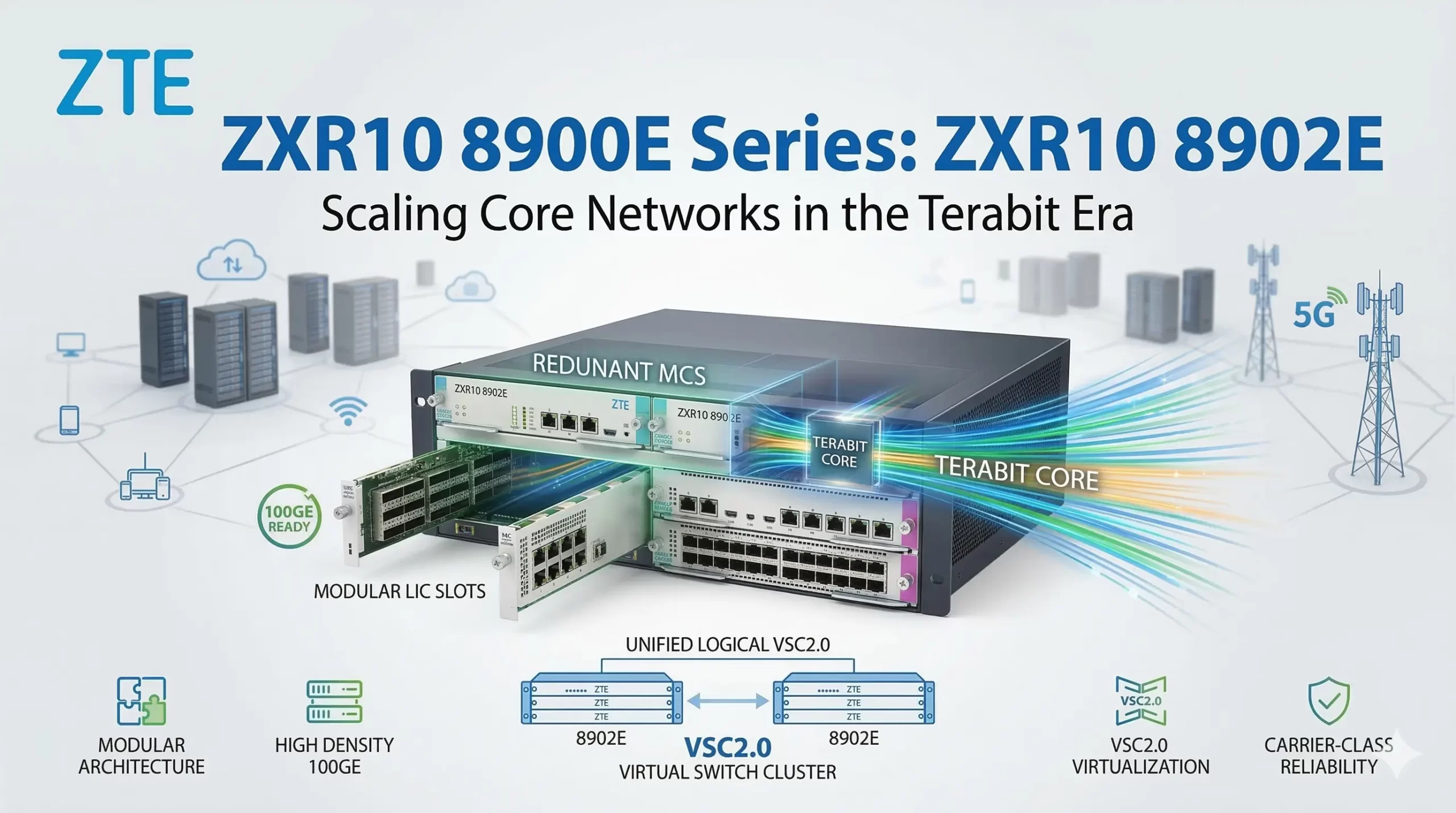
The ZXR10 8902E is built upon a standard 19-inch, 4RU modular chassis. This form factor is deceptive; despite its size, it shares the same control plane logic and distributed forwarding architecture as its larger siblings (the 8905E, 8908E, and 8912E).
The schematic (Image 1) illustrates the key hardware components that provide the ZXR10 8902E with its distinctive reliability and performance characteristics.
H3: The MCS Modules: The Brains and the Switching Fabric
The Main Control and Switching (MCS) modules are the heart of the 8902E. Unlike a traditional fixed switch, which integrates all functions onto a single board, the 8902E modularizes the control plane and switching fabric.
The MCS module is responsible for:
-
System Management: Hosting the distributed ROSng software platform (discussed below), managing configurations, and monitoring health.
-
Routing Control: Processing OSPF, BGP, IS-IS, and LDP/RSVP routing and signaling packets.
-
Data Switching Fabric: Providing non-blocking, terabit-level wire-speed switching between all line cards.
Crucially, the 8902E chassis supports 1+1 redundant MCS modules. In the event of an MCS failure, the standby unit immediately takes over the control plane with minimal disruption, ensuring high availability (Source: ZTE Technical Documentation, 2024). This level of core redundancy is usually reserved for much larger, expensive platforms, but is made accessible in the compact 8902E form factor.
H3: High-Density Line Cards: GE, 10GE, 40GE, and 100GE Options
The ZXR10 8902E accommodates two horizontal line interface cards (LICs). These cards leverage distributed forwarding architecture—meaning each card possesses its own local CPU and packet forwarding engine (ASIC/NP). This design provides linear performance scaling; adding a line card adds port density and forwarding capacity simultaneously.
A wide array of interface modules is available for the 8902E, allowing for extremely flexible deployments:
-
Gigabit Ethernet (GE): Offering high-density RJ45 electrical or SFP optical ports (e.g., 24-port or 48-port variants) for access aggregation.
-
10 Gigabit Ethernet (10GE): SFP+ optical ports for high-bandwidth uplinks or localized 10G aggregation.
-
40 Gigabit Ethernet (40GE): QSFP+ interfaces for next-generation backbone connectivity.
-
100 Gigabit Ethernet (100GE): CFP or CFP2 interfaces, allowing the 8902E to scale to true terabit performance in its compact 4RU footprint (Source: TelecomDatasheets, 2023).
This mix and match capability permits network architects to future-proof their deployment, starting with GE and 10GE interfaces and upgrading to 40G/100G as the bandwidth demands necessitate, without replacing the 8902E chassis itself.
H3: Power and Cooling Redundancy for Carrier-Class Availability
Reliability does not end at the control plane. The ZXR10 8902E is engineered with full environmental redundancy:
-
Redundant Power Supplies (1+1): The chassis includes two hot-swappable power module slots, supporting both AC and DC input options. If one power supply fails, the other can support the entire system load without interruption.
-
Independent Fan Tray Subrack: A high-performance fan assembly is located below the line card slots. Crucially, this fan tray is hot-swappable and monitored by the system. Furthermore, it supports side-to-side airflow, optimized for efficient cooling within standard network racks (Source: Scribd/Asit Datasheet, 2017). The system intelligent monitors the temperature and adjusts the fan speed in real-time, balancing cooling performance with energy efficiency and noise reduction (Source: Scribd/ZTE Product Description, 2017).
H2: Key Technological Pillars of the ZXR10 8902E
The hardware modularity of the 8902E provides a foundation, but it is the embedded software technologies that elevate it to a carrier-grade platform.
H3: Virtual Switch Cluster 2.0 (VSC2.0): Simplifying Topologies and Management
One of the most powerful features of the ZXR10 8900E Series is Virtual Switch Cluster 2.0 (VSC2.0). Traditional redundancy models require complex Layer 2 protocols like Spanning Tree Protocol (STP) and Layer 3 protocols like Virtual Router Redundancy Protocol (VRRP). These protocols often suffer from complicated management, slow convergence times, and halved active-active bandwidth due to blocked links.
VSC2.0 overcomes these issues by virtualizing two separate physical 8902E switches into a single logical network element.
-
Simplified Topology: To the outside world, the VSC cluster appears as one switch with a unified management IP, unified configuration plane, and unified data forwarding table (Source: TelecomDatasheets, 2023).
-
Carrier-Grade Convergence: The internal control plane communication over the stack links allows for microsecond-level fault detection and faster convergence compared to legacy protocols (Source: Telecommate, 2022).
-
Active-Active Load Balancing: Links on both switches can be utilized for active data forwarding simultaneously, maximizing network investment and efficiency.
The visual representation below (Image 2) contrasts traditional deployment complexity with the logical simplicity of a VSC2.0 implementation.
This abstraction not only reduces operational complexity but also provides a more resilient core that is easier to maintain and troubleshoot. For GEO/SEO and AI search relevance, “Simplified Management” and “Zero Downtime Upgrades” are critical intent phrases that VSC2.0 addresses directly.
H3: Robust Service Transport: MPLS, VPLS, and Advanced QoS
The ZXR10 8902E is a full MPLS L2/L3 VPN and VPLS switch. In B2B environments, the core layer often needs to transport multiple isolated services—such as guest Wi-Fi, internal finance data, video conferencing, and IoT traffic—over a shared physical infrastructure.
The 8902E’s advanced L3 routing capabilities (including OSPF, BGP4+, IS-IS, and RIPng) allow it to construct a robust IP backbone. Its support for MPLS-TE (Traffic Engineering), LDP, and RSVP ensures efficient path selection and traffic management. For VSC-simplified L2 services, it supports standard IEEE 802.1Q VLANs, VPLS (Virtual Private LAN Service), and VPWS (Virtual Private Wire Service) for point-to-point and point-to-multipoint L2 VPN connectivity.
To guarantee service levels, the ZXR10 8902E provides advanced QoS mechanisms:
-
Hierarchical QoS (HQoS): LICs can implement fine-grained scheduling based on users, services, and ports. This allows a MAN aggregation switch to enforce bandwidth guarantees for different customers while still maintaining general service level agreements (SLAs) (Source: Asit Datasheet, 2017).
-
Comprehensive Congestion Management: LICs employ hardware queues and congestion avoidance algorithms (such as WRED/RED) to minimize latency and packet loss for critical real-time traffic (Source: ZTE Product Description, 2017).
H3: Native IPv6 Ready Platform: Future-Proofing the Campus Backbone
With the globally ongoing transition to IPv6, network architects must deploy hardware that can handle the new protocol natively. The ZTE ZXR10 8900E Series has passed IPv6 Ready Phase 2 Gold Medal Certification issued by the IPv6 Forum (Source: ZTE.com.cn, 2024).
This indicates that the 8902E supports a full stack of IPv6 features:
-
Native IPv6 Routing: Processing IPv6 packets directly in the hardware ASIC/NP.
-
Dual-Stack (IPv4/IPv6): Enabling the simultaneous coexistence and routing of both protocols during the migration period.
-
IPv6 Specific Protocols: OSPFv3, IS-ISv6, BGP4+, and MLD snooping for efficient multicast in an IPv6 environment.
-
Tunneling Technologies: 6to4 tunnel, ISATAP tunnel, 6vPE, and 6PE to facilitate communication between isolated IPv4 or IPv6 islands (Source: Telecommate, 2022).
H2: Comparative Analysis: The ZXR10 8900E Series Landscape
To provide a complete understanding of where the 8902E fits, it is useful to compare it against the larger members of the 8900E family. This breakdown highlights the common architectural threads and the scaling options available within the ecosystem.
H3: Comparing Models within the 8900E Series
The following table summarizes the key dimensional and capacity differences within the 8900E Series (based on data from ZTE and its authorized distributors). Note that while some parameters may vary by line card selection, the chassis limitations define the platform maximums.
| Dimensional/Capacity Metrics | ZXR10 8902E | ZXR10 8905E | ZXR10 8908E | ZXR10 8912E | ZXR10 8908E-H/8912E-H |
| Form Factor (RU) | 4RU | 10RU | 13RU | 17RU | 17RU / 21RU |
| MCS Slots (Redundant) | 2 | 2 | 2 | 2 | 2 (Control) / 4 (Switch Fabric) |
| Line Card Slots | 2 | 5 | 8 | 12 | 8 / 12 |
| Maximum Switching Capacity (Tbps) | 0.96 Tbps (Early Datasheet, Platform scales to Terabit with later cards) | 4.8 Tbps | 7.68 Tbps | 7.68 Tbps | 10.24 Tbps (Full Terabit/slot capability) |
| Maximum Forwarding Rate (Mpps) | 720 Mpps (Varies by Line Card) | 3,600 Mpps | 5,760 Mpps | 5,760 Mpps | 7,680 Mpps |
| Power Consumption (Max) | < 350 W (Early Datasheet) | < 1300 W | < 1850 W | < 2278 W | < 3369 W |
| Redundant Components | MCS, Power, Fans | MCS, Power, Fans | MCS, Power, Fans | MCS, Power, Fans | Control, Switch Fabric, Power, Fans |
| Target Application | Compact Core / Specialized Aggregation | Mid-Sized Core / MAN Aggregation | Large Campus Core / MAN Aggregation | Metro Backbone / Large DCI | Extreme Density Backbone / Ultra-Large Core |
(Source: Asit, TelecomDatasheets, Widgets Inc., ZTE Corporation – 2017-2023)
As illustrated, the ZXR10 8902E provides the lowest entry point into the series while still maintaining the fundamental modular architecture, MCS redundancy, and advanced software features like VSC2.0. This makes it a strategic choice for network architects who require core-grade reliability in a small footprint.
H2: Application Scenarios for the ZTE ZXR10 8902E
Because of its unique balance of form factor and feature set, the ZXR10 8902E is well-suited for several critical B2B deployment scenarios.
H3: The Ideal Core in Mid-Sized Enterprise Campus Networks
For enterprise campuses with 500 to 2,000 users, a 10RU or 17RU core switch might be overkill in terms of both cost and space. The 4RU 8902E provides an optimal fit.
-
Simplified Spine-Leaf or Aggregation-Access Design: When deployed in a VSC2.0 cluster, a pair of 8902Es can serve as a simplified active-active core, terminating all Layer 3 routing for the campus.
-
Unified Service Bearing: It can easily integrate and prioritize traffic from video surveillance (unicast/multicast), voice-over-IP (VoIP) using advanced QoS, and high-speed data access.
H3: Aggregation Layer in Metropolitan Area Networks (MAN)
In Metro Area Networks, the 8902E can operate as a cost-effective aggregation point in areas with localized high-bandwidth demand but limited space (e.g., cell site routers, commercial building basements).
-
Multi-Customer Isolation: The MPLS VPLS/VPWS capability allows the MAN operator to offer secure, isolated Layer 2 or Layer 3 VPN services to multiple business customers from the same 8902E switch.
-
High-Bandwidth Interconnect: With its future-proof 100GE capability, the 8902E can aggregate traffic from multiple Gigabit and 10G access switches and uplink directly to the Metro Core via 40G or 100G interfaces, eliminating bottlenecks.
H2: Total Cost of Ownership (TCO) and ROI Analysis
Investing in modular core switches like the ZXR10 8902E requires a comprehensive look at both initial CAPEX (Capital Expenditure) and long-term OPEX (Operating Expenditure).
The TCO optimization from the 8902E is realized through several factors:
-
Modular Scalability: Network architects can start with only the necessary MCS and GE/10GE line cards, keeping the initial investment low. They can scale to 40G or 100G as the business grows, extending the useful life of the switch chassis and MCS modules and maximizing ROI.
-
VSC2.0 Management Savings: By virtualizing two switches into one logical unit, VSC2.0 simplifies configuration and troubleshooting, which can significantly reduce the hours required for network management.
-
Carrier-Grade Reliability Minimizes Cost of Downtime: For business-critical networks, every minute of downtime can mean lost revenue and productivity. The 1+1 MCS redundancy and hot-swappable components minimize the likelihood of service interruptions, thereby reducing the “cost of failure.”
-
Energy Efficiency: The ZXR10 8902E incorporates several energy-saving technologies, including low-power consumption LICs and intelligent fan speed adjustment. The early datasheets indicate a very low maximum power consumption (< 350W for early chassis variants) (Source: Widgets Inc. Datasheet, 2013), making it an efficient choice for 24/7 core operation.
The visual below illustrates these three pillars of TCO optimization:
H2: Troubleshooting and Maintainability
To facilitate effective long-term operation, the ZXR10 8902E includes several integrated features designed to simplify troubleshooting and maintenance for network administrators.
H3: Distributed Architecture Simplifies Fault Isolation
Because each line card on the 8902E has its own local CPU and packet forwarding engine, faults are often isolated to the line card itself, rather than bringing down the entire switch. If a LIC fails, it can be hot-swapped while the redundant MCS, the other LIC, and the rest of the chassis continue to operate. This distributed forwarding architecture is a massive maintainability advantage over traditional core platforms with a single centralized processing engine.
H3: SFlow for Traffic Analysis and Monitoring
The ZXR10 8902E supports the sFlow (sampled Flow) standard for network traffic analysis and monitoring (Source: Scribd/ZTE Product Description, 2017).
-
Continuous Sampling: Instead of analyzing every single packet (which would overwhelm the CPU), sFlow samples packets at defined intervals, providing a statistically accurate picture of network usage.
-
Identifies Top Talkers and Bottlenecks: Network administrators can use sFlow data with external collectors to identify which users, applications, or devices are consuming the most bandwidth, allowing for proactive capacity planning and traffic engineering (Source: ZTE Configuration Guide, 2013).
FAQs (8 Quality Questions and Answers)
H3: What is the primary application for the ZXR10 8902E modular switch?
The ZTE ZXR10 8902E is a compact modular switch designed primarily for the core layer in small-to-mid-sized enterprise campus networks, or as an aggregation switch in space-constrained Metropolitan Area Network (MAN) or data center interconnect (DCI) environments.
H3: Does the ZXR10 8902E support 100GE interfaces?
Yes, the ZXR10 8900E Series architecture is terabit-ready. Depending on the specific line card variant, the 8902E can support high-density Gigabit, 10G, 40G, and even 100G interfaces, allowing it to scale into terabit performance within its compact 4RU footprint.
H3: How does Virtual Switch Cluster 2.0 (VSC2.0) work on the 8902E?
VSC2.0 virtualizes two physical 8902E switches into a single logical network element, simplifying the network topology by making them appear as one switch with a unified management IP, control plane, and configuration (Source: Telecommate, 2022). This improves resilience and simplifies management compared to traditional STP/VRRP redundancy.
H3: What redundancy features are included in the 8902E chassis?
The 8902E chassis provides full carrier-class redundancy, including 1+1 redundant MCS (Main Control and Switching) modules, 1+1 redundant power supply modules (AC or DC), and a hot-swappable fan tray assembly, ensuring minimal service disruption.
H3: Can I run both IPv4 and IPv6 traffic simultaneously on the ZXR10 8902E?
Yes, the ZXR10 8902E is a native IPv6 platform that has achieved IPv6 Ready Phase 2 Gold Certification (Source: ZTE.com.cn, 2024). It supports dual-stack operation, allowing simultaneous routing and processing of both IPv4 and IPv6 traffic, facilitating smooth protocol migration.
H3: How does side-to-side airflow impact the ZXR10 8902E?
The fan tray on the ZXR10 8902E provides optimized side-to-side airflow, which is a standard configuration for standard network racks, ensuring efficient cooling for the MCS modules and high-density line cards while minimizing hot-spot formation (Source: Scribd/Asit Datasheet, 2017).
H3: What is the maximum switching capacity of the ZXR10 8902E?
While the 8900E platform is “Terabit,” the specific capacity of the 8902E depends on the generation of line cards and MCS installed. Early datasheets specify a capacity around 960 Gbps/720 Mpps (Source: Widgets Inc. Datasheet, 2013), though the architecture supports scaling to true terabit performance with later interface modules (Source: Scribd/ZTE Product Description, 2017).
H3: Does the ZXR10 8902E support MPLS L3 VPNs?
Yes, the ZXR10 8902E provides a full set of MPLS-related features, including LDP, RSVP-TE, and OSPF-TE for signaling, along with robust support for both MPLS L3 VPN and L2 VPN (VPLS/VPWS), enabling multi-service separation over a shared backbone.






Leave a comment