
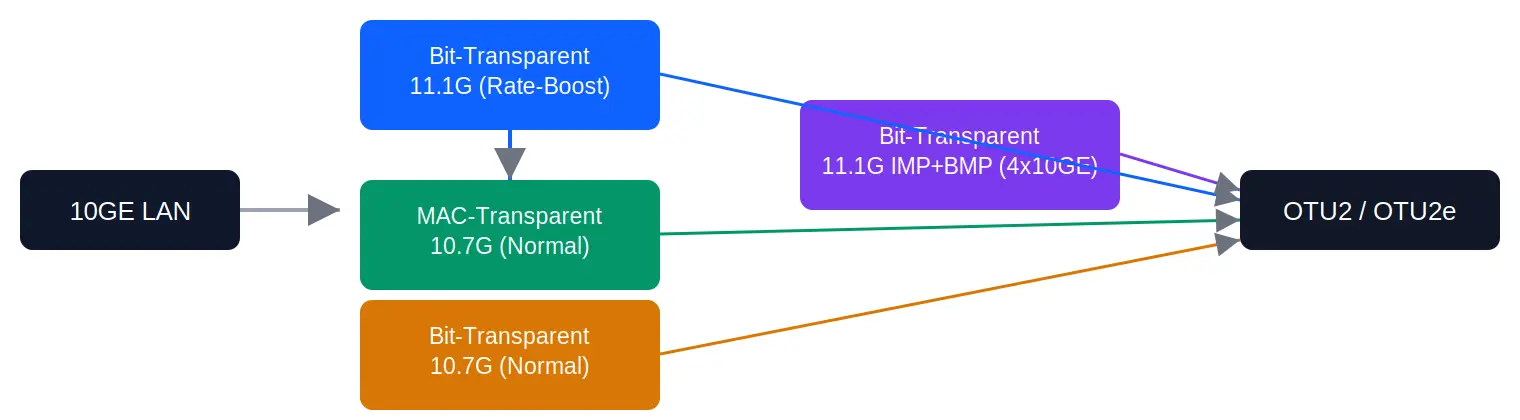
1. Bit-Transparent Mapping (11.1G, Rate-Boost Mode)
The client signal isn’t decoded at all. The system simply raises the OTU frame clock rate and maps the 10GE LAN bit stream straight into an OTU2e channel. Because nothing is stripped out, the full FEC coding gain is preserved, giving the best error correction and the longest reach on this list. The trade-off: it uses a custom frame structure, not the standard OTU2e frame, so it won’t interoperate transparently with third-party equipment.
Best for: high-bandwidth, short-to-medium reach links where clock synchronization isn’t a constraint.
2. MAC-Transparent Mapping (10.7G, Normal Mode)
Here the client’s 10GE LAN signal is first packaged with GFP-F framing at the MAC layer, then mapped into a standard OTU2 frame. This keeps full FEC/AFEC coding gain while staying fully standards-compliant, and it reuses the same encoding scheme as 10G SDH services.
Best for: long-haul links and multi-vendor interconnects — this is the safest choice for cross-vendor compatibility.
3. Bit-Transparent Mapping (10.7G, Normal Mode)
The client signal is again left undecoded, but instead of raising the clock rate, the system fits the 10GE LAN bit stream into the standard OTU2 frame by borrowing part of the FEC overhead area. Line rate stays standard, but because part of the FEC space is repurposed for payload, overall error-correction capability drops.
Best for: short-distance links with good link quality, where standard OTU2 rate matters more than maximum FEC margin.
4. Bit-Transparent Mapping (11.1G IMP+BMP)
A special-purpose mapping designed only for aggregating four 10GE LAN ports into one link. It uses a dedicated mapping logic and keeps full FEC coding gain, but it has no support for synchronous Ethernet processing or timing transparency — so it’s built purely for data aggregation, not for services needing precise clock sync.
Best for: 4x10GE LAN port aggregation scenarios only.
Side-by-Side Comparison
| Mapping Method | Line Rate | Frame Standard | FEC Capability | Key Constraint |
| Bit-Transparent (11.1G) | 11.1 Gbit/s | Custom OTU2e | Full gain retained | Higher-than-standard rate |
| MAC-Transparent (10.7G) | 10.71 Gbit/s | Standard OTU2 | Full gain retained | Compatible with 10G SDH rules |
| Bit-Transparent (10.7G) | 10.71 Gbit/s | Standard OTU2 | Reduced (uses FEC overhead) | Sacrifices correction for standard rate |
| Bit-Transparent (11.1G IMP+BMP) | 11.1 Gbit/s | Custom OTU2e | Full gain retained | No sync-Ethernet support |
Which One Should You Choose?
- Need maximum FEC margin and don’t need multi-vendor interop? → Bit-Transparent (11.1G).
- Need long-haul reach and cross-vendor compatibility? → MAC-Transparent (10.7G).
- Short link, good signal quality, must stay at standard OTU2 rate? → Bit-Transparent (10.7G).
- Aggregating four 10GE LAN ports? → Bit-Transparent (11.1G IMP+BMP).

Leave a comment