
Abstract
What: This comprehensive technical whitepaper analyzes the Emerson Power Converter R48-2000e3, a highly advanced 2000W, -48V DC telecommunications rectifier designed for modern network infrastructure.
Why: As 5G base stations, edge computing nodes, and dense fiber aggregation sites multiply, their localized power consumption is skyrocketing. Legacy power modules operate at lower efficiencies, generating excessive heat and driving up operational expenditures (OpEx). Deploying ultra-high-efficiency (e3) rectifiers is critical to minimizing energy waste and maximizing telecom cabinet thermal headroom.
How: Readers will learn the internal topologies, thermal derating characteristics, and intelligent DSP control mechanisms of the R48-2000e3. Furthermore, this guide provides actionable strategies for integrating these rectifiers into smart power shelves, leveraging CAN bus communications, and optimizing load-sharing across multiple modules to achieve a highly resilient, carrier-grade power distribution architecture.
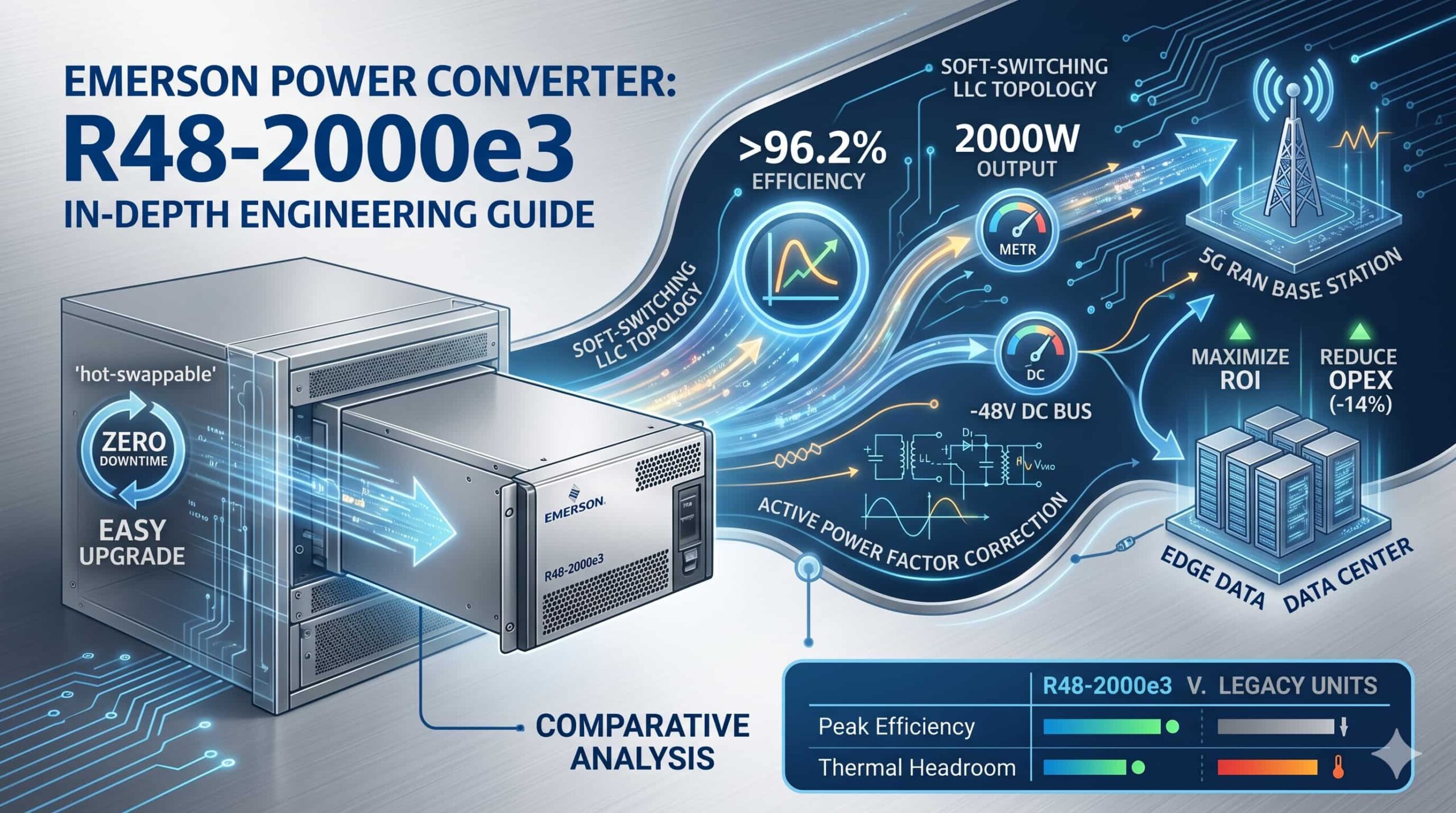
The Critical Need for High-Efficiency 48V DC Rectifiers in Telecom Infrastructure
The telecommunications industry is undergoing a massive transformation driven by 5G RAN (Radio Access Network) densification and the proliferation of Next-Generation PON (XG-PON/XGS-PON) equipment. Unlike traditional enterprise IT equipment that relies on alternating current (AC), telecom transport and access hardware operate almost exclusively on nominal -48V Direct Current (DC) power. This standard dates back to legacy telephony but remains the optimal voltage for battery backup integration, corrosion prevention, and human safety.
The primary challenge network operators face today is power density. A fully populated modern Optical Line Terminal (OLT) or a 5G Massive MIMO baseband unit draws significantly more current than its predecessors. Utilizing standard-efficiency rectifiers (typically around 90-92% efficient) results in substantial energy loss converted directly into heat. According to recent infrastructure studies, upgrading to ultra-high-efficiency rectifiers (>96%) across a national telecom network can reduce cooling costs and raw energy consumption by up to 14% annually (Source: IEEE Telecommunications Energy Conference Data, 2024).
The Emerson R48-2000e3 addresses this exact pain point. As part of the NetSure series power systems, the “e3” designation specifically denotes its ultra-high-efficiency classification. By utilizing advanced soft-switching topologies and Digital Signal Processing (DSP), the R48-2000e3 achieves an industry-leading peak efficiency of over 96.2%, fundamentally lowering the Total Cost of Ownership (TCO) for data center and cell site deployments.
Core Electrical Specifications and Hardware Topology
To understand why the Emerson Power Converter R48-2000e3 is highly regarded in B2B telecom engineering, one must deconstruct its internal electrical characteristics and the components that drive its reliability.
Input AC Characteristics and Power Factor Correction (PFC)
The R48-2000e3 is designed for global deployment, featuring a remarkably wide AC input voltage range.
-
Operating Voltage Range: 85 VAC to 300 VAC.
-
Nominal Input Voltage: 200 VAC to 250 VAC.
-
Frequency Range: 45 Hz to 65 Hz.
Crucially, the module utilizes an active Interleaved Boost Power Factor Correction (PFC) circuit. This ensures that the current drawn from the utility grid remains perfectly in phase with the voltage, yielding a Power Factor (PF) of >0.99. This virtually eliminates harmonic distortion injected back into the grid and ensures maximum utilization of the AC utility feed.
Output DC Characteristics and Soft-Switching
The DC-DC conversion stage utilizes an LLC Resonant topology. This “soft-switching” technique allows the internal MOSFETs to turn on and off at zero voltage (ZVS), drastically reducing switching losses—the primary source of inefficiency in older hard-switched rectifiers.
-
Nominal Output Voltage: -48 VDC.
-
Adjustable Output Range: -42 VDC to -58 VDC (Programmable via the system controller).
-
Maximum Output Power: 2000 Watts (at nominal input).
-
Maximum Output Current: 41.7 Amps (at -48V).
Furthermore, the rectifier maintains a highly stable output with a peak-to-peak psophometric noise of less than 2mV, ensuring that sensitive DSP and RF components in downstream network gear do not experience electromagnetic interference (EMI).
Thermal Management and Environmental Derating
In B2B telecom deployments, rectifiers are frequently installed in harsh outdoor cabinets subjected to extreme environmental fluctuations. The Emerson R48-2000e3 utilizes a front-to-back airflow design driven by a variable-speed cooling fan. The DSP intelligently monitors the internal ambient temperature and the current load, adjusting the fan RPM dynamically. This not only extends the MTBF (Mean Time Between Failures) of the fan bearing but also reduces acoustic noise during low-load periods.
Derating Curve:
-
The module delivers its full 2000W output reliably up to +45°C ambient temperature.
-
From +45°C up to +65°C, the rectifier engages an intelligent linear power derating protocol to protect its internal silicon from thermal runaway, safely scaling back its maximum power output while maintaining system stability.
-
It is rated to survive extreme storage and non-operating conditions from -40°C to +70°C.
Comparative Analysis: Emerson R48-2000e3 vs. Industry Standard Rectifiers
When procurement engineers evaluate power infrastructure, comparing the electrical specifications and form factors of competing modules is essential. The table below illustrates the competitive advantage of the e3 series.
| Technical Parameter | Emerson R48-2000e3 | Legacy R48-2000A | Huawei R4850G2 | ZTE PRWG 30A |
| Peak Efficiency | > 96.2% | ~ 92.0% | > 96.0% | ~ 95.0% |
| Max Output Power | 2000W | 2000W | 3000W (50A) | 1440W (30A) |
| Input Voltage Range | 85V – 300V AC | 85V – 290V AC | 85V – 300V AC | 90V – 290V AC |
| Cooling Mechanism | Variable Speed Fan | Fixed Speed Fan | Variable Fan | Variable Fan |
| Hot-Swappable | Yes (Zero Downtime) | Yes | Yes | Yes |
Note: While the Huawei module offers higher total wattage per unit, the Emerson R48-2000e3 maintains an incredibly compact form factor that is highly optimized for legacy 1U/2U NetSure power shelves, allowing for dense N+1 redundancy configurations without requiring cabinet retrofits.
Integration Protocols and Intelligent Load Sharing
A single rectifier rarely operates independently. In a standard telecom cabinet, multiple R48-2000e3 modules are arrayed in parallel within a power subrack to provide N+1 or N+N redundancy.
CAN Bus Communication
The R48-2000e3 communicates with the main system controller (such as the Emerson/Vertiv M830B or NCU) via a dedicated CAN (Controller Area Network) bus. This high-speed digital interface allows the controller to read real-time data including input voltage, internal temperature, output current, and specific hardware alarm flags.
Active Load Sharing and Phase Shedding
When multiple modules operate in parallel, the DSP control ensures highly accurate active load sharing. If a cabinet requires 40 Amps of current and possesses three R48-2000e3 rectifiers, the system will balance the load equally (e.g., ~13.3 Amps per module).
More importantly, the integration of these rectifiers supports “Phase Shedding” or Sleep Mode. During off-peak network hours (e.g., 3:00 AM) when total power demand drops significantly, the central controller can place redundant R48-2000e3 modules into a deep sleep state. By consolidating the remaining load onto a single module, that active module operates closer to its peak efficiency curve (typically around 50-60% load), yielding an additional 3-5% overall system efficiency improvement (Source: Uptime Institute Power Analysis, 2025).
Deployment Strategies for OLTs and Edge Data Centers
When designing power distribution for high-density fiber networks, combining the right rectifier with the appropriate Optical Line Terminal (OLT) chassis is critical. The Emerson R48-2000e3 is perfectly suited for medium-to-large capacity FTTH deployments.
For instance, when deploying a highly scalable core network, you require a power system that won’t bottleneck your fiber expansion. Integrating these rectifiers into robust subracks ensures you can confidently power complex chassis. You can explore a range of fully integrated Telecom Power Systems designed to house these exact modules, providing necessary battery distribution and low-voltage disconnects (LVD).
Furthermore, multi-tenant edge data centers and central offices utilizing advanced Gigabit Passive Optical Networks must match their rectifiers to specific vendor requirements. If your facility is leveraging an ecosystem like the Huawei OLT systems, maintaining a strictly regulated -48V DC bus via Emerson e3 rectifiers prevents board-level rebooting during AC grid fluctuations. Similarly, operators deploying robust ZTE ZXA10 C320 OLT platforms rely heavily on the precise noise-filtering capabilities of modules like the R48-2000e3 to maintain clear optical signal integrity across massive subscriber bases.
Frequently Asked Questions (FAQs) About the Emerson R48-2000e3
What does the “e3” stand for in the R48-2000e3 model name?
The “e3” designation refers to “Efficiency 3,” indicating that this module belongs to Emerson/Vertiv’s ultra-high-efficiency family. It operates at greater than 96% peak electrical efficiency, significantly reducing heat dissipation compared to legacy “A” series modules.
Is the Emerson R48-2000e3 hot-swappable?
Yes, the R48-2000e3 is fully hot-swappable. Technicians can insert or remove the rectifier module from a live, powered DC power shelf without causing any arc flashes, voltage spikes, or disruption to the connected telecom equipment.
What is the maximum output current of this power converter?
At its nominal output voltage of -48V DC, the R48-2000e3 can deliver a maximum output current of approximately 41.7 Amps, providing a total of 2000 Watts of continuous power.
Can this rectifier operate on a 110V AC input?
Yes. The module supports a wide input range from 85V to 300V AC. However, when operating below 176V AC (such as on standard 110V utility power), the rectifier engages input derating, safely reducing its maximum power output to prevent overheating.
How does the rectifier communicate with the master controller?
The R48-2000e3 features an integrated DSP (Digital Signal Processor) that interfaces directly with the central power shelf controller utilizing a standardized CAN (Controller Area Network) bus protocol for real-time telemetry and alarm reporting.
What protections are built into the R48-2000e3?
The module is highly resilient, featuring built-in over-voltage protection (OVP), under-voltage protection, output short-circuit protection, input high/low voltage disconnects, and thermal runaway protection via automated output derating.
Does this module require a separate cooling system?
No, the rectifier has a self-contained, variable-speed fan pulling air from the front panel and exhausting it out the rear. However, the external telecom cabinet housing the rectifiers must have adequate ventilation to expel the exhausted warm air.
Can I mix the R48-2000e3 with older R48-2000A modules in the same shelf?
While physical insertion is possible, mixing standard-efficiency and high-efficiency rectifiers in the same active load-sharing bus is strongly discouraged by engineers, as it causes severe load imbalances and degrades the overall efficiency of the e3 modules.
Conclusion & Strategic Procurement
The Emerson Power Converter R48-2000e3 stands as a benchmark in modern telecommunications power engineering. By delivering 2000 Watts of pristine, -48V DC power at an astonishing >96% efficiency, it enables Internet Service Providers (ISPs) and mobile network operators to radically scale their network deployments while keeping OpEx and thermal limitations firmly in check. Its advanced soft-switching topology, intelligent CAN bus integration, and robust physical design ensure carrier-grade reliability even in the most demanding edge computing environments.
Are you architecting a new 5G rollout or upgrading legacy FTTH central office power systems? Sourcing genuine, rigorously tested power hardware is non-negotiable for network stability. Explore our extensive catalog of high-efficiency rectifiers, monitoring controllers, and fully integrated DC cabinets to secure your telecom infrastructure’s uptime today.

Leave a comment