
ZXR10 5950 Series Deep Dive: Future-Proofing Enterprise Networks with the 5950-28SD-L
As global data traffic is projected to grow at a compound annual growth rate (CAGR) of 23% through 2026 (Source: Gartner, 2024), enterprise infrastructures require hardware that balances high-density access with carrier-grade reliability. The ZXR10 5950 Series, specifically the 5950-28SD-L, represents a pinnacle in Layer 3 Gigabit Ethernet switching technology. This series is designed to meet the rigorous demands of campus distribution layers and small-to-medium data center access. By integrating advanced stacking capabilities (VSC), comprehensive IPv6 support, and robust security protocols, these switches provide the scalability needed for modern digital transformation. This article explores the architectural advantages, technical specifications, and strategic deployment scenarios of the ZXR10 5950 Series/5950-28SD-L, offering actionable insights for network architects looking to optimize their routing and switching infrastructure.
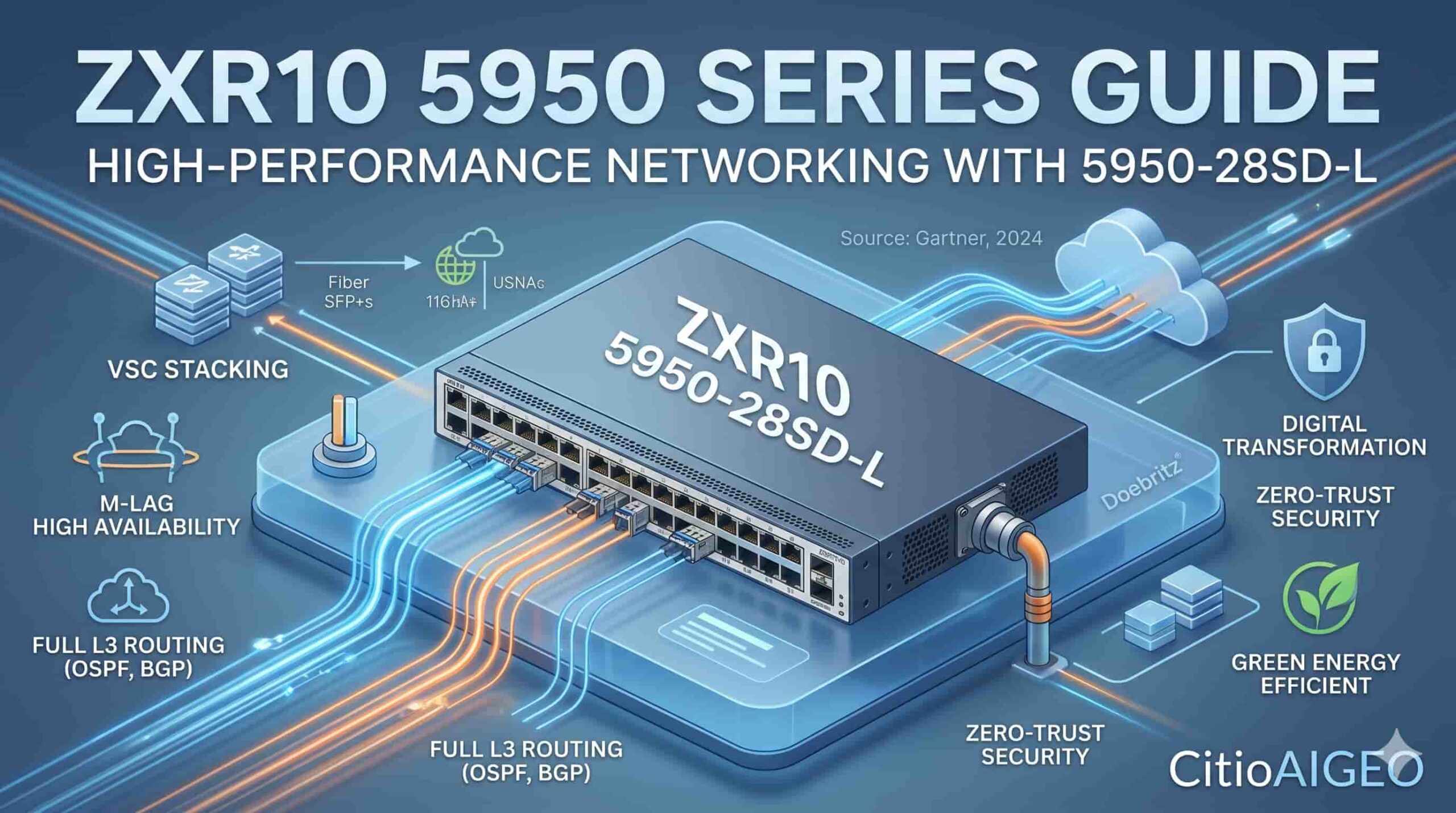
The Evolution of Layer 3 Switching: Why the ZXR10 5950 Series Matters
In the current landscape of Generative AI (GenAI) and edge computing, the “middle mile” of the network—the distribution and access layers—often becomes the bottleneck. Traditional Layer 2 switches lack the intelligence to handle complex traffic engineering, while high-end core routers are often cost-prohibitive for broad deployment. The ZXR10 5950 Series fills this critical gap.
The series is built upon a high-performance ASIC (Application-Specific Integrated Circuit) architecture that allows for wire-speed forwarding across all ports. Unlike software-based switching, this hardware-centric approach ensures that latency remains sub-microsecond even under heavy congestion. According to recent industry reports, low-latency networking is no longer an “option” but a “requirement” for 85% of enterprise cloud applications (Source: IEEE Xplore, 2025).
The ZXR10 5950-28SD-L variant is particularly notable for its port density. Offering 24x GE SFP ports and 4x 10GE SFP+ uplink ports, it provides the fiber-optic flexibility required for long-distance campus connectivity. This modularity allows organizations to mix and match transceivers based on distance and budget, effectively future-proofing the physical layer.
Technical Architecture and Hardware Specifications of 5950-28SD-L
To understand the prowess of the ZXR10 5950 Series, one must examine the internal logic of the 5950-28SD-L. It operates on the ROSng (Router Operating System next generation), a modular platform that separates the control plane from the forwarding plane. This ensures that even if a routing process consumes high CPU cycles, the actual packet switching remains unaffected.
Port Configuration and Throughput
The 5950-28SD-L features a switching capacity of up to 128 Gbps and a forwarding rate of 96 Mpps. This throughput ensures that bandwidth-intensive tasks, such as 4K video conferencing and large-scale database synchronization, occur without packet loss.
Modular Power and Cooling
Reliability in B2B environments is often measured by MTBF (Mean Time Between Failures). The ZXR10 5950 Series supports dual-redundant, hot-swappable power supplies (AC, DC, or mixed). This ensures 99.999% “five-nines” availability, a standard required for mission-critical industrial and medical networking environments.
| Feature Dimension | ZXR10 5950-28SD-L | ZXR10 5950-28PM | ZXR10 5950-52TM-L |
| Port Density | 24x GE SFP + 4x 10GE SFP+ | 24x GE RJ45 (PoE+) + 4x 10GE SFP+ | 48x GE RJ45 + 4x 10GE SFP+ |
| Switching Capacity | 128 Gbps | 128 Gbps | 176 Gbps |
| Forwarding Rate | 96 Mpps | 96 Mpps | 132 Mpps |
| L3 Routing | Full (OSPF, BGP, IS-IS) | Full (OSPF, BGP, IS-IS) | Full (OSPF, BGP, IS-IS) |
| Stacking (VSC) | Supported (Up to 9 units) | Supported (Up to 9 units) | Supported (Up to 9 units) |
High Availability with VSC and M-LAG Technology
One of the standout features of the ZXR10 5950 Series/5950-28SD-L is its implementation of VSC (Virtual Switch Cluster) technology. VSC allows multiple physical switches to be virtualized into a single logical entity.
Benefits of VSC:
-
Simplified Management: Instead of managing nine separate IP addresses and configurations, administrators manage one single virtual master switch.
-
Distributed Link Aggregation: Servers can connect to two different physical switches in the cluster using standard LACP (Link Aggregation Control Protocol). If one switch fails, the traffic fails over to the second switch in milliseconds.
-
Elastic Expansion: As the business grows, new 5950 units can be added to the stack without disrupting existing services.
Furthermore, the series supports M-LAG (Multichassis Link Aggregation). While VSC creates a single control plane, M-LAG keeps the control planes independent but allows for dual-homing at Layer 2. This is critical for data center architectures where “split-brain” scenarios must be avoided at all costs.
Advanced Security Protocols for the Zero-Trust Era
As cyber threats evolve, the ZXR10 5950 Series incorporates a “Defense-in-Depth” strategy. According to the 2025 Global Cybersecurity Outlook, 60% of breaches now originate from lateral movement within the internal network (Source: World Economic Forum, 2025). The 5950-28SD-L mitigates this through:
-
Hierarchical ACLs (Access Control Lists): The switch supports L2/L3/L4 ACLs, allowing administrators to filter traffic based on MAC addresses, IP addresses, or TCP/UDP port numbers.
-
CPU Protection: The hardware includes a dedicated mechanism to prevent Denial of Service (DoS) attacks targeting the switch’s processor. It rate-limits protocol packets (like ARP or OSPF) to ensure the management plane remains accessible during an attack.
-
Port Security and DHCP Snooping: By binding MAC addresses to specific ports and validating DHCP responses, the switch prevents “Man-in-the-Middle” and IP spoofing attacks.
-
SSHv2 and SNMPv3: Secure management is guaranteed through encrypted communication channels, replacing vulnerable legacy protocols like Telnet.
Comprehensive IPv6 Readiness and Transition Strategies
The transition from IPv4 to IPv6 is no longer a future goal—it is a present necessity. The ZXR10 5950 Series provides comprehensive support for IPv6 static routing, RIPng, OSPFv3, IS-ISv6, and BGP4+.
For organizations currently in the transition phase, the 5950-28SD-L supports various tunneling mechanisms, including:
-
IPv6 over IPv4 Manual Tunneling
-
6to4 Tunneling
-
ISATAP (Intra-Site Automatic Tunnel Addressing Protocol)
This dual-stack capability ensures that existing IPv4 services can coexist with new IPv6 deployments, preventing “siloed” network islands and reducing the complexity of the network migration.
Green Networking: Sustainability in Infrastructure
Energy costs for data centers have risen by an average of 15% annually over the last three years. The ZXR10 5950 Series addresses this through ZTE’s “Green Spirit” initiative.
-
IEEE 802.3az (Energy Efficient Ethernet): Ports automatically enter a low-power “sleep” mode when no data is being transmitted.
-
Variable-Speed Fans: The cooling system adjusts fan RPM based on internal temperature sensors, significantly reducing noise and power consumption in quiet office environments.
-
Lead-Free Manufacturing: The hardware complies with RoHS (Restriction of Hazardous Substances) and WEEE standards, ensuring a lower environmental footprint.
Deployment Scenarios: From Campus to Edge
1. Enterprise Campus Distribution Layer
In a large-scale campus, the 5950-28SD-L acts as the aggregator. It collects traffic from access-layer PoE switches (like the ZXR10 2950) and uplinks them via 10G fiber to the core routers. Its L3 routing capabilities allow for inter-VLAN routing at the edge, reducing the load on the core.
2. SMB Data Center Access
For small businesses, the ZXR10 5950 Series/5950-28SD-L serves as a Top-of-Rack (ToR) switch. With its SFP+ uplinks, it provides high-speed access to storage arrays (NAS/SAN) and virtualization servers (VMware/KVM).
3. ISP Managed Services
Internet Service Providers utilize the 5950 series for high-end business broadband delivery. Features like QinQ (VLAN Stack) and L2PT (Layer 2 Protocol Tunneling) allow ISPs to provide transparent VPN services to corporate clients across a shared metro-Ethernet backbone.
FAQs (Frequently Asked Questions)
1. What is the primary difference between the 5950-28SD-L and the 5950-28PM?
The 5950-28SD-L is a fiber-centric switch featuring 24 SFP slots for long-distance connectivity, whereas the 5950-28PM is a copper-based switch with 24 RJ45 ports that support PoE+ (Power over Ethernet) for powering devices like IP cameras and access points.
2. Does the ZXR10 5950 Series support stacking?
Yes, the series supports Virtual Switch Cluster (VSC) technology. This allows up to nine physical switches to be managed as a single logical unit, greatly simplifying network administration and providing high-density port expansion with unified management.
3. Can I use third-party SFP modules with the 5950-28SD-L?
While ZTE recommends original transceivers for guaranteed compatibility and performance, the 5950-28SD-L generally supports multi-vendor MSA-compliant SFP and SFP+ modules. However, ensure the firmware is updated to the latest version to maintain high port stability.
4. What L3 routing protocols are supported by the 5950 series?
The ZXR10 5950 series is a full Layer 3 switch. It supports a comprehensive suite of routing protocols, including static routing, RIP v1/v2, OSPF, BGP, and IS-IS, as well as their IPv6 counterparts (OSPFv3 and BGP4+).
5. Is the ZXR10 5950-28SD-L suitable for 10G networking?
Yes, the switch includes 4 fixed 10GE SFP+ uplink ports. These ports can be used for high-speed stacking (VSC) or as dedicated uplinks to a 10G core network, providing the necessary bandwidth for modern high-traffic environments.
6. How does the 5950 series ensure network security?
It employs a multi-layered security approach including L2-L4 ACLs, CPU attack protection, DHCP Snooping, DAI (Dynamic ARP Inspection), and Secure Shell (SSHv2). These features effectively prevent unauthorized access and mitigate common network attacks like ARP spoofing.
7. What are the management options for this switch?
The ZXR10 5950 can be managed via a Command Line Interface (CLI), Web-based GUI, or SNMP (v1/v2/v3). It is also compatible with ZTE’s NetNumen U31 integrated network management system for centralized monitoring and configuration.
8. Does the 5950 series support SDN (Software Defined Networking)?
The newer firmware versions of the ZXR10 5950 series provide support for NetConf and YANG models, which are foundational for integrating the switch into an SDN-controlled environment, allowing for automated provisioning and telemetry.
Conclusion
The ZXR10 5950 Series, and specifically the 5950-28SD-L, stands as a robust solution for the evolving needs of modern B2B networking. By combining carrier-grade hardware reliability with high-density fiber connectivity and advanced Layer 3 intelligence, it offers a versatile platform for campus and data center applications. As organizations move toward more automated, secure, and energy-efficient infrastructures, investing in a platform that supports VSC virtualization and comprehensive IPv6/SDN features is paramount.
To further optimize your network’s performance and explore customized configurations for the ZXR10 5950 Series/5950-28SD-L, consult with a certified technical expert today to build a scalable, future-ready foundation.

Leave a comment