
The Hidden Battle Shaping Your Internet Experience
As remote work becomes standard and 4K streaming dominates households, a quiet revolution in broadband infrastructure is determining who gets seamless Zoom calls and who suffers through buffering screens. Two technologies sit at the heart of this divide: Fiber-to-the-Cabinet (FTTC) and Fiber-to-the-Premises (FTTP). While both promise high-speed connectivity, the nuances between them could mean the difference between frustration and digital freedom. Let’s explore what sets them apart and how to make the right choice for your needs.
How Fiber Connections Actually Work
To understand the FTTC vs. FTTP debate, we must first examine their technical foundations. FTTC delivers fiber optic cables to street-side cabinets, with the “last mile” connection to homes relying on traditional copper wiring. This hybrid approach leverages existing infrastructure, making deployment faster and cheaper. However, copper’s limitations—signal degradation over distance and susceptibility to electromagnetic interference—cap its performance potential.
In contrast, FTTP (also called FTTH) runs fiber optic lines directly to buildings, eliminating copper entirely. This pure fiber solution offers superior signal integrity, as light pulses in fiber cables face negligible interference and maintain speeds over long distances. The result? Consistently higher bandwidth and reliability, albeit with higher upfront installation costs.
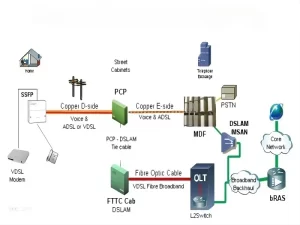
Image description: A comparison diagram showing FTTC’s fiber-to-cabinet setup with copper wiring to homes versus FTTP’s uninterrupted fiber path.
Speed Realities: Lab Tests vs. Real-World Use
Providers often advertise “up to” speeds for both technologies, but real-world performance diverges sharply. FTTC typically delivers 50-80 Mbps downstream, adequate for most households streaming HD content. However, speeds fluctuate based on distance from the cabinet—a user 500 meters away might see a 30% drop compared to someone next to the node. Upload speeds also lag, often capped at 20 Mbps due to copper’s asymmetrical nature.
FTTP, however, routinely achieves 300 Mbps to 1 Gbps symmetrically (equal upload/download speeds) in practice. This isn’t just about faster Netflix loads; it enables emerging needs like cloud gaming, 8K video editing, and smart home ecosystems. A 2023 Ofcom study found FTTP users experienced 94% less latency during peak hours compared to FTTC subscribers—a critical factor for gamers and remote workers.
The Cost Equation: Short-Term Savings vs. Future-Proofing
FTTC’s lower installation costs make it appealing for budget-conscious users. In the UK, for instance, FTTC packages average £25-£35/month versus FTTP’s £45-£60 range. But this “savings” narrative overlooks hidden long-term expenses. Copper networks require more maintenance—a 2022 Openreach report showed FTTC faults occur 3x more frequently than FTTP outages. Each technician visit costs providers £80-£120, expenses often indirectly passed to consumers through price hikes.
Meanwhile, countries investing in FTTP infrastructure see measurable ROI. Australia’s NBN network reported a 22% reduction in customer complaints after transitioning neighborhoods to FTTP, while Sweden’s fiber-heavy approach has given 89% of households access to gigabit speeds. For homeowners, FTTP can also increase property values—a Knight Frank study linked full fiber access to 3% higher home prices in urban areas.
Environmental and Regulatory Considerations
Sustainability debates further complicate the choice. Copper production consumes 60% more energy per meter than fiber manufacturing, and FTTC’s energy-hungry DSLAM cabinets account for 40% of broadband networks’ carbon footprint. Conversely, FTTP’s passive optical networks (PONs) use 30% less power per subscriber. With the EU mandating carbon-neutral telecoms by 2040, providers like Deutsche Telekom are accelerating FTTP rollouts to meet targets.
Regulatory shifts also play a role. The U.S. Federal Communications Commission now requires ISPs to disclose “typical” speeds rather than theoretical maximums—a move that’s exposing FTTC’s limitations. In contrast, South Korea’s mandate for nationwide FTTP by 2025 reflects a growing global preference for fiber-first policies.
Making the Smart Choice for Your Needs
The FTTC vs. FTTP decision hinges on individual priorities. Casual users in areas with reliable FTTC infrastructure may find it sufficient for now. However, power users, smart homes, and businesses should view FTTP as a strategic investment. As 5G integration and IoT devices proliferate, FTTP’s scalability ensures readiness for next-gen technologies that copper simply can’t support.
Before deciding, audit your usage: Do you frequently upload large files? Does your household stream on multiple devices simultaneously? Check local rollout plans—governments worldwide are subsidizing FTTP deployments, potentially reducing upgrade costs. Remember, while FTTC keeps you connected today, FTTP future-proofs your connection for tomorrow’s digital landscape.
Final Thoughts: Beyond the Speed Test Numbers
Choosing between these technologies isn’t just about megabits and ping rates—it’s about aligning your internet infrastructure with your digital lifestyle. As telehealth, VR meetings, and AI-driven devices become mainstream, the gap between FTTC and FTTP will widen. The question shifts from “Which is better?” to “How much connectivity do I need to thrive in an increasingly connected world?” In this light, FTTP emerges not as a luxury, but as the new baseline for sustainable, high-performance connectivity. The era of compromise with copper is ending; full fiber isn’t just an upgrade—it’s an inevitability.

Leave a comment