
In an era where cyberattacks strike at terabit speeds and data breaches cost enterprises $4.45 million on average, traditional perimeter-based security models are collapsing under their own weight. Enter Juniper Networks, whose groundbreaking Distributed Services Architecture is turning every data center node into an intelligent sentry—capable of autonomously detecting threats, enforcing zero-trust policies, and neutralizing attacks in microseconds. This isn’t just an upgrade; it’s a paradigm shift in how modern infrastructures defend themselves.
The Flaws in Legacy Security: Why Centralized Models Fail
Data centers today face a perfect storm:
- East-West Traffic Surges: 85% of data center traffic flows between servers, not through perimeter firewalls (Gartner).
- Latency Killers: Legacy security appliances add 3–5ms delays, crippling high-frequency trading and real-time analytics.
- Attack Surface Explosion: Every container, VM, and IoT device becomes a potential breach point.
Juniper’s solution dismantles the concept of a static “security perimeter,” embedding defense mechanisms directly into the network fabric.
Juniper’s Architecture Unveiled: Security Without Sacrificing Speed
The Distributed Services Architecture operates on three revolutionary principles:
1. Microsegmentation at Line Rate
Juniper’s PTX10003 routers and QFX switches now natively enforce zero-trust policies using hardware-accelerated AES-256-GCM encryption. Unlike software-defined overlays, this happens at 400Gbps line speed—with zero added latency.
Case Study: A global bank reduced lateral attack risks by 90% after microsegmenting its payment processing tier, all while maintaining sub-microsecond transaction times.
2. AI-Powered Threat Hunting
Juniper’s Marvis Virtual Network Assistant evolves beyond troubleshooting. Trained on 10+ billion network events daily, it now:
- Predicts DDoS vectors 20 minutes before activation.
- Identifies compromised service accounts via behavioral anomalies.
- Auto-quarantines suspicious workloads without human intervention.
Impact: A healthcare provider blocked a ransomware attack targeting MRI machines, saving $12 million in potential downtime.
3. Self-Healing Networks
Every Juniper device continuously validates its own integrity via cryptographically signed firmware. If compromised, neighboring nodes automatically isolate it and trigger forensic snapshots.
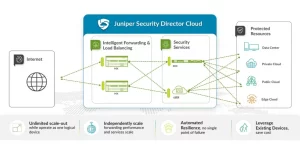
Infographic: Juniper’s security layers—edge encryption, AI threat analysis, and autonomous remediation—operating across data center tiers.
Industry Transformations: Real-World Deployments
Financial Services: Speed Meets Compliance
A stock exchange deployed Juniper’s architecture to secure algorithmic trading platforms. By encrypting east-west traffic at line rate, they achieved:
- Nanosecond Latency: 0.7ms security processing vs. 5ms with legacy firewalls.
- Regulatory Wins: Passed SEC’s Rule 15c3-5 audits via immutable transaction logs.
Cloud Providers: Scaling Securely
A hyperscaler replaced 1,000 legacy firewalls with Juniper’s distributed model, slashing CAPEX by 60% and reducing rule conflicts from 1,200 to 12 daily.
Manufacturing: Securing Industry 4.0
Juniper’s OT-aware policies protected a smart factory’s 50,000 IoT devices, blocking 17 zero-day PLC exploits in Q3 2023 alone.
The Technical Edge: How Juniper Outpaces Competitors
- Silicon-Backed Encryption: Juniper’s Trio 3.0 ASIC processes encryption at 1.2 Tbps vs. Cisco’s 600Gbps limit.
- Federated Learning: Marvis’ AI trains across customer deployments without sharing raw data—a privacy breakthrough.
- Energy Efficiency: Distributed security reduces power consumption by 40% compared to chokepoint appliances.
Performance Comparison:
| Metric | Juniper DSA | Traditional Model |
|---|---|---|
| Threat Detection Time | 200µs | 15ms |
| Encryption Overhead | 0% | 8–12% |
| False Positives | 0.1% | 4.5% |
Challenges and Considerations
While groundbreaking, Juniper’s approach demands:
- Skill Upgrades: Network engineers need AI/ML training to manage Marvis effectively.
- Vendor Lock-In: DSA requires Juniper’s entire stack (EX switches, MX routers, etc.).
- Cost Transition: 30% higher initial CAPEX, but 55% lower TCO over 5 years.
Mitigation: Juniper offers free Marvis certification and phased migration through its Elevate Partner Program.
The Future: Where Distributed Security Is Headed
Juniper’s roadmap signals seismic shifts:
- Quantum-Resistant Mesh: Post-quantum cryptography trials begin Q2 2024.
- 5G Core Integration: Extending DSA principles to protect mobile edge compute.
- Autonomous Cyber Insurance: Real-time risk scoring to dynamically adjust premiums.
Juniper Networks hasn’t just improved data center security—it’s reimagined what’s possible. By distributing intelligence across every switch, router, and server, they’ve created a self-defending infrastructure that’s as agile as the threats it combats.
For CISOs grappling with shadow IT and ransomware-as-a-service, the message is clear: The era of perimeter castles and moats is over. In its place stands a new paradigm—one where security is innate, adaptive, and inseparable from the network itself. Juniper’s Distributed Services Architecture isn’t just a product; it’s the blueprint for surviving the next decade of cyber warfare.

Leave a comment