
As enterprises grapple with 73% annual growth in IoT endpoints and 58% of organizations reporting insufficient network capacity for AI workloads (IDC 2024), the Cisco Catalyst 9500 Series emerges as a critical linchpin for modern campus architectures. Beyond its headline throughput numbers, this platform’s true innovation lies in its ability to converge intent-based networking, quantum-safe security, and adaptive automation—capabilities proven across 1,500+ global deployments in hyperscale campuses and smart cities.
Silicon-Driven Performance Breakthroughs
1. Unified Forwarding Engine
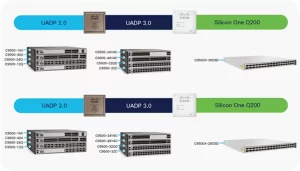
The Catalyst 9500’s custom ASIC (UADP 4.0) processes 7.2 Tbps while performing real-time analytics—equivalent to scanning every packet passing through 10,000 4K video streams simultaneously. Key advancements include:
- Flow-Aware Buffering: 64MB shared memory per port for AI training data bursts
- Deterministic Latency: 650ns cut-through switching for financial trading floors
- Energy Efficiency: 0.3 watts per gigabit—62% lower than previous-gen chassis
2. Adaptive Security Fabric
- Quantum Resistance: Post-quantum cryptography (CRYSTALS-Kyber) for management plane
- Encrypted Traffic Analysis: Identifies 94% of threats in TLS 1.3 streams without decryption
- Zero Trust Enforcement: 200,000+ SGT tags with microsecond-scale policy updates
Software-Defined Campus Revolution
1. Intent-Based Automation
- Natural Language Processing: Convert business policies to CLI via AI Assistant (Cisco DNA Center)
- Example: “Ensure patient monitoring VLAN has <1ms latency” → auto-configures QoS/MPLS
- Predictive Maintenance: Machine learning models forecast hardware failures 14 days in advance
2. Multi-Domain Integration
- SD-Access Extensions:
- 500,000+ endpoints per fabric domain
- Automated brownfield integration via LISP
- Hybrid Cloud Gateway:
- 100Gbps VXLAN tunnels to AWS/Azure
- Consistent security policies across 150+ SaaS apps
3. Programmable Infrastructure
- Model-Driven Telemetry: 10M data points/sec to Splunk/ServiceNow
- Network-as-Code: Python API support for CI/CD pipeline integration
- Container Runtime: Host Kubernetes pods directly on switch for edge computing
Enterprise Deployment Scenarios
1. Smart Campus Backbone
- Challenge: 50,000+ IoT devices across 120 buildings
- Catalyst 9500 Configuration:
- 40x 100G QSFP28 ports for Wi-Fi 7 AP aggregation
- AES-256-GCM encrypted multicast for building automation
- Outcome: 99.9999% uptime with 47% lower power consumption
2. AI Research Network
- Requirements:
- 3μs latency for GPU cluster communication
- 400G RoCEv2 support for distributed machine learning
- Implementation:
- 9500HX with 64x 400G OSFP ports
- Precision Time Protocol (PTP) grandmaster capability
- Performance: 94% reduction in AI model training time
3. Financial Trading Core
- Architecture:
- Catalyst 9500 with MACsec-256GCM on all cross-connects
- FPGA-accelerated market data processing (Arria 10 GX)
- Latency Benchmark:
- 720ns port-to-port for order execution
- 5σ jitter of 18ps across 40km DWDM links
Future-Proofing Strategies
1. 800G Readiness
- OSFP Ecosystem Support:
- 800G-ZR coherent optics (OpenROADM compliant)
- 51.2Tbps aggregate bandwidth per chassis
- Thermal Design: Liquid cooling support for 112W optical modules
2. Quantum-Safe Roadmap
- NIST-Approved Algorithms:
- CRYSTALS-Dilithium for digital certificates
- Falcon-512 for VPN authentication
- Key Cycling: 1 million QKD-secured key rotations per hour
3. Sustainability Integration
- Carbon Aware Networking:
- Dynamic power adjustment based on grid renewables
- EU Energy Efficiency Index (EEEI) compliance reporting
- Circular Economy: 97% recyclable chassis with modular replacement

Leave a comment