
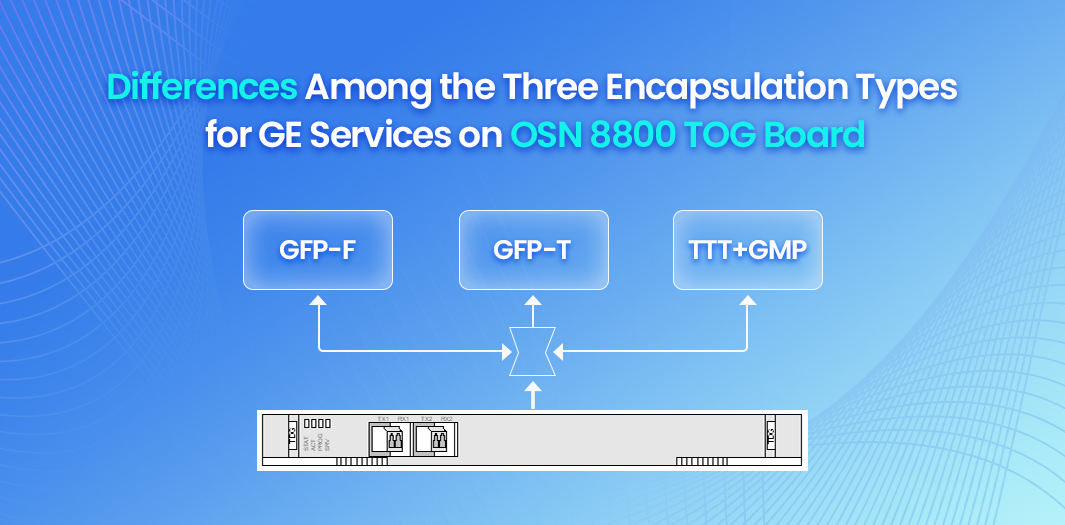
There are three main methods for transmitting GE services over OTN: GFP-F (corresponding to GE service), GFP-T, and TTT+GMP. The GE signal received from the client side is mapped and encapsulated into OPU/ODU using one of these three methods and transmitted over the OTN network. When the GE service is received at the other end, it is demapped from the OPU/ODU based on the reverse process to regenerate the GE signal.
1. GE to OPU/ODU Encapsulation Mapping Methods
- GFP-F Method
When GE services are transmitted via GFP-F, the IPG (Inter-Packet Gap) of GE frames is removed first to form a GFP-F frame. GFP Idle frames are then inserted to ensure rate adaptation.
The GE rate is 1.25 Gbit/s, while the OPU0 rate is:
238/239 × 1.244160 ≈ 1.2390 Gbit/s
Without removing the IPG, OPU0 cannot accommodate the GE rate.
When the GE signal is recovered, the IPG is regenerated using the local OTN clock. As a result, the recovered GE signal’s clock is aligned with the OTN equipment rather than the original GE source, meaning clock cannot be passed through in this method.
- GFP-T Method
GFP-T encodes both data and IPG, preserving the client’s clock information.
It accepts an 8B/10B encoded data stream and converts it to 64B/65B. During the conversion, when the 8B data block is not ready (i.e., FIFO is empty), a 65B_PAD is inserted to maintain asynchronous rate adaptation.
This approach ensures clock transparency by preserving the original client-side timing.
- TTT+GMP Method
TTT+GMP still uses the GFP-T frame format but implements rate adaptation differently.
Instead of relying on OPU0 stuffing location like GFP-T, it adjusts the amount of stuffing based on the buffer state. Then, using the sigma-delta algorithm, stuff bytes are evenly distributed into the OPU0.
This method improves stuffing uniformity and further enhances clock transparency.
| Method | Clock Transparency | SyncE Support | Latency | Jitter | Recommended For |
| GFP-F | No | No | Medium | Minimal | Non-sync networks, low clock accuracy needs |
| GFP-T | Yes | Limited | Low | Low-frequency, high-amplitude | Basic sync needs, short/mid OTN hops |
| TTT+GMP | Yes (best) | Yes | Low | Very low, uniform stuffing | Multi-hop OTN, high clock accuracy, SyncE use |
2. Comparison Between TTT+GMP and GFP-T
The figure (not shown here) illustrates the possible stuffing patterns in GFP-T and TTT+GMP.
TTT+GMP ensures stuffing is as uniform as possible.
GFP-T cannot guarantee stuffing continuity.
If we consider each stuffing byte as clock jitter:
GFP-T introduces low-frequency, high-amplitude jitter.
In multi-stage OTN cascading scenarios, the jitter from GFP-T may degrade clock performance, potentially failing to meet SyncE clock performance standards (G.8262).
3. Summary
- GFP-F: Ethernet IPG is terminated, breaking auto-negotiation and causing the recovered Ethernet clock to be unrelated to the source; cannot support synchronous Ethernet.
- GFP-T: Introduces clock jitter; over multiple hops, clock performance may degrade. However, GFP-T decodes per byte and requires less buffering than GFP-F, resulting in slightly lower latency.
- TTT+GMP: Designed to support clock transparency and can meet synchronous Ethernet requirements over multi-hop transmission.
All three methods can ensure lossless transmission of service data. If the current network requires clock transparency or low latency, it is recommended to use TTT+GMP or GFP-T, depending on which encapsulation methods are supported by the board.
If you have any questions pls contact csd@telecomat.com

Leave a comment