
Overview
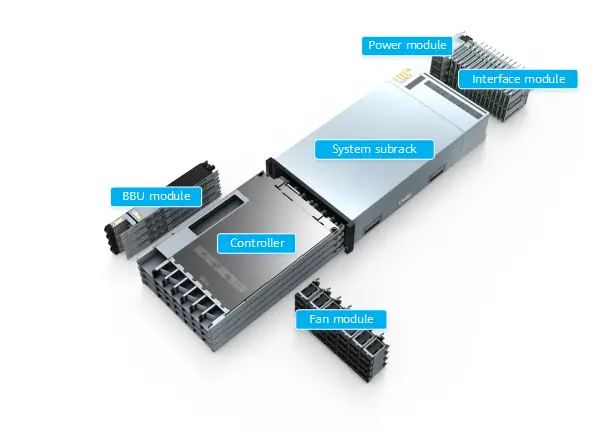
The controller enclosure uses a modular design and consists of a system subrack, controllers, BBUs, power modules, management modules, and interface modules.
Each controller enclosure houses two or four controllers that have CPUs, physical memory, front-end ports, and expansion ports.

OceanStor Dorado 8000 V6(SAS)
OceanStor Dorado 8000 V6(SAS) with 4 U independent controller enclosure, 256GB to 1024 GB per controller cacheNOTE:
4 U controller enclosures using DC power modules do not support delivery as bay. That is, if a 4 U controller enclosure is delivered as bay, it can only use AC power modules. If a 4 U controller enclosure is not delivered as bay, it can use AC or DC power modules.
Overall Structure
Overall structure of a controller enclosure
NOTE:
- When a controller enclosure is equipped with two controllers, the controllers are installed in the first and third slots from top to bottom, and assistant cooling modules are installed in the second and fourth slots. Controllers communicate with each other using internal heartbeat links, which do not need cable connections.
- Slots are used to accommodate and secure disks, interface modules, controllers, fan modules, and power modules.
Front View
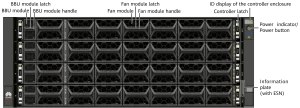
Front view of a controller enclosure
NOTE:
- Each controller has seven fan modules.
- The controllers are A, C, B, D in a top-down sequence.
- The information plate is used to record device information. You can pull out the information plate near the mounting ear of the device to view the device model.
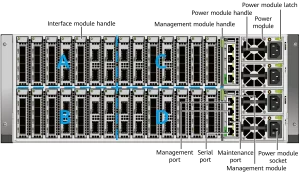
Rear view of a controller enclosure (with 12 Gbit/s SAS expansion modules, using the AC power module as an example)
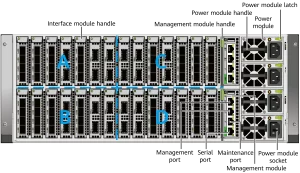
Rear view of a controller enclosure (with 100 Gbit/s RDMA back-end interface modules, using the AC power module as an example)
NOTE:
- The maintenance port is used for special management and maintenance only by Huawei technical support engineers in emergency. Do not connect the management network port and maintenance network port to the same LAN or switch to prevent network loops. The initial IP address of the maintenance port is 172.31.128.101 or 172.31.128.102. The default subnet mask is 255.255.0.0. You are advised to connect only the management port to the network.
- Only serial cables can be inserted into serial ports. Do not insert network cables into serial ports.
The management modules are mandatory for a 4 U controller enclosure. They are used for management and maintenance and their slot numbers are SMM 0 and SMM 1 from top to bottom.
- The upper slots are IOM H0, IOM H1, IOM H2, IOM H3, IOM H4, IOM H5, IOM H6, IOM H7, IOM H8, IOM H9, IOM H10, IOM H11, IOM H12, and IOM H13.
- The lower slots are IOM L0, IOM L1, IOM L2, IOM L3, IOM L4, IOM L5, IOM L6, IOM L7, IOM L8, IOM L9, IOM L10, IOM L11, IOM L12, and IOM L13
Slot numbers of interface modules
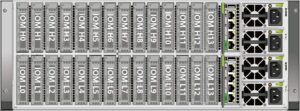
The rules for installing interface modules on a controller enclosure are as follows:
- For reliability purposes, it is recommended that interface modules should be installed in pairs. That is, the same interface module should be installed in the upper slot and corresponding lower slot separately.
- The scale-out interface modules are installed and configured in the following sequence: IOM H3/L3 > IOM H10/L10.
- Install back-end interface modules first and then front-end interface modules.
- Configuration rules for back-end interface modules:
- When only 12 Gbit/s SAS interface modules are used, they can be installed only in slots IOM H5, IOM L5, IOM H6, IOM L6, IOM H7, IOM L7, IOM H8, and IOM L8. The sequence of installation is IOM H6/L6 > IOM H7/L7 > IOM H5/L5 > IOM H8/L8.
- When only back-end 100 Gbit/s RDMA interface modules are used, they are installed in the following sequence: IOM H6/L6 > IOM H7/L7 > IOM H5/L5 > IOM H8/L8 > IOM H4/L4 > IOM H9/L9 > IOM H2/L2 > IOM H11/L11 > IOM H1/L1 > IOM H12/L12 > IOM H3/L3 > IOM H10/L10.
NOTE:The SO 100 Gbit/s RDMA interface module used for adding controller enclosures can be installed only in slots IOM H3/L3 and IOM H10/L10. When connecting disk enclosures, do not use these slots unless other slots are not enough for disk enclosure connection.
5. Configuration rules for front-end interface modules:
-
- When the Fibre Channel (FC) front-end interconnect I/O module is used, you only need to configure one module in an upper slot and one in a lower slot.
- When an interface module other than the FC front-end interconnect I/O module is used, you must configure one module in each of the A, B, C, and D quadrants.
- For FC networking:
- When only 12 Gbit/s SAS interface modules are used, install the front-end interface modules in the following sequence: IOM H0/L0 > IOM H13/L13 > IOM H1/L1 > IOM H12/L12 > IOM H2/L2 > IOM H11/L11 > IOM H4/L4 > IOM H9/L9 > IOM H3/L3 > IOM H10/L10.
- When only back-end 100 Gbit/s RDMA interface modules are used, install the front-end interface modules in the following sequence: IOM H0/L0 > IOM H13/L13 > IOM H1/L1 > IOM H12/L12 > IOM H2/L2 > IOM H11/L11 > IOM H4/L4 > IOM H9/L9 > IOM H5/L5 > IOM H8/L8 > IOM H3/L3 > IOM H10/L10 > IOM H7/L7.
- For non-FC networking:
- If only 12 Gbit/s SAS interface modules are used:
- In a dual-controller system, install the front-end interface modules in the following sequence: IOM H0/L0 > IOM H1/L1 > IOM H2/L2 > IOM H4/L4 > IOM H3/L3.
- In a four-controller system, install the front-end interface modules in the following sequence: IOM H0/L0 > IOM H13/L13 > IOM H1/L1 > IOM H12/L12 > IOM H2/L2 > IOM H11/L11 > IOM H4/L4 > IOM H9/L9 > IOM H3/L3 > IOM H10/L10.
- If only back-end 100 Gbit/s RDMA interface modules are used:
- In a dual-controller system, install the front-end interface modules in the following sequence: IOM H0/L0 > IOM H1/L1 > IOM H2/L2 > IOM H4/L4 > IOM H5/L5 > IOM H3/L3.
- In a four-controller system, install the front-end interface modules in the following sequence: IOM H0/L0 > IOM H13/L13 > IOM H1/L1 > IOM H12/L12 > IOM H2/L2 > IOM H11/L11 > IOM H4/L4 > IOM H9/L9 > IOM H5/L5 > IOM H8/L8 > IOM H3/L3 > IOM H10/L10 > IOM H7/L7.
- If only 12 Gbit/s SAS interface modules are used:
6. The installation sequence of interface modules used for replication services is the same as that of front-end interface modules.
7. Interface modules of the same type must be installed in sequence.
8. Install different types of front-end interface modules in a sequence of Ethernet > RoCE > FC. Place interface modules in ascending order of their port rates.
9. Install AI accelerator cards in slots IOM H2/L2 and IOM H11/L11.
-
- If two controllers are deployed, the controller enclosure requires two AI accelerator cards, which are installed in slots IOM H2/L2.
- If four controllers are deployed, the controller enclosure requires four AI accelerator cards, which are installed in slots IOM H2/L2 and IOM H11/L11.NOTE:After installation, you must run the following commands to validate the AI accelerator cards:
- Log in to the CLI and run the change user_mode current_mode user_mode=developer command to enter the developer mode.
- Run the change cache ai_service switch=on command to enable AI acceleration.
10. The rules for installing SCM cards on a controller enclosure are as follows:
NOTE:
- When SmartCache is used, SCM cards must be installed on the controller enclosure. Each controller supports a maximum of two SCM cards.
- In a dual-controller system, a controller enclosure can have a maximum of four SCM cards, which must be installed symmetrically in the upper and lower slots.
- In a four-controller system, a controller enclosure can have a maximum of eight SCM cards, which must be installed symmetrically in the A, B, C, and D quadrants.
If 12 Gbit/s SAS interface modules are used:
-
- In a dual-controller system, follow this order when installing SCM cards into slots: IOM H2/L2 > IOM H4/L4 > IOM H0/L0 > IOM H1/L1 > IOM H3/L3.
- In a four-controller system, follow this order when installing SCM cards into slots: IOM H2/L2/H11/L11> IOM H4/L4/H9/L9 > IOM H0/L0/H13/L13 > IOM H1/L1/H12/L12> IOM H3/L3/H10/L10.
If BE 100 Gbit/s RDMA interface modules are used:
-
- In a dual-controller system, follow this order when installing SCM cards into slots: IOM H2/L2 > IOM H4/L4 > IOM H0/L0 > IOM H1/L1 > IOM H5/L5 > IOM H3/L3.
- In a four-controller system, follow this order when installing SCM cards into slots: IOM H2/L2/H11/L11 > IOM H4/L4/H9/L9 > IOM H0/L0/H13/L13 > IOM H1/L1/H12/L12 > IOM H5/L5/H8/L8 > IOM H3/L3/H10/L10.

Leave a comment