
What: This comprehensive technical whitepaper explores the hardware architecture, software capabilities, and deployment strategies of the ZTE 2910E switch (part of the ZXR10 2900E series), a leading Layer 2 access switch designed for enterprise campus networks and carrier-grade edge deployments.
Why: In an era dominated by cloud computing, IoT proliferation, and strict zero-trust architectures, securing and optimizing the network edge is no longer optional—it is a critical business mandate. Traditional network architectures face severe bottlenecks, making it essential to understand how modern access switches process AI-driven traffic, mitigate physical-layer threats, and maintain carrier-grade uptime.
How: Network architects, IT directors, and system integrators will learn actionable deployment strategies, comprehensive QoS configurations, and protocol optimization techniques. By mastering the ZTE 2910E switch’s capabilities, readers can significantly reduce Total Cost of Ownership (TCO) while building a resilient, future-proof network infrastructure.
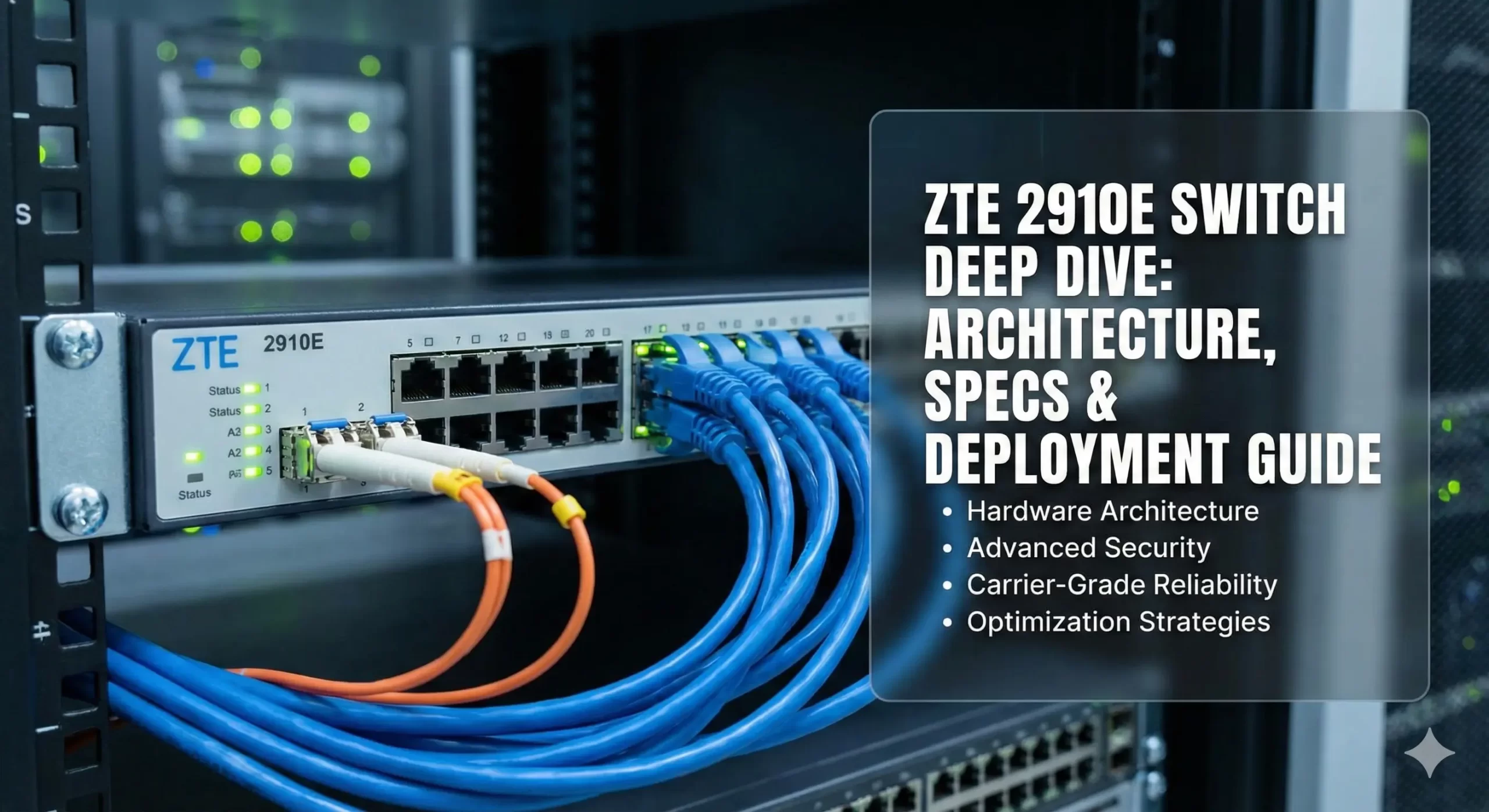
1. Unpacking the Hardware Architecture of the ZTE 2910E Switch
The foundation of any high-performance network lies in its physical layer capabilities. The ZTE 2910E switch is engineered to provide non-blocking, wire-speed forwarding for edge devices, balancing compact form factors with robust processing power.
1.1 Port Density and Interface Flexibility
The ZTE 2910E switch is purpose-built for versatile edge access. It typically features a combination of high-speed copper and optical interfaces to bridge endpoint devices with the aggregation layer.
-
Downlink Ports: Equipped with Gigabit Ethernet (10/100/1000Base-T) RJ45 ports, providing high-bandwidth connectivity for IP phones, wireless access points (WAPs), high-definition surveillance cameras, and enterprise workstations.
-
Uplink Ports: Features dedicated SFP (Small Form-factor Pluggable) optical uplink ports (1000Base-X). This allows for long-distance, interference-free fiber connections back to the core routing infrastructure. For optimal performance, network engineers often pair these with certified transceivers available via comprehensive suppliers like https://www.telecomate.com/optical-transceivers.
1.2 ASIC Design and Switching Capacity
Beneath the chassis, the ZTE 2910E switch utilizes advanced Application-Specific Integrated Circuits (ASICs) tailored for Layer 2 switching. The architecture guarantees a non-blocking switching matrix, meaning the internal backplane bandwidth exceeds the combined theoretical maximum throughput of all physical ports. This ensures zero packet loss even during network congestion or broadcast storms.
2. Core Technical Specifications: ZTE 2910E vs. Industry Alternatives
To understand the market positioning of the ZTE 2910E switch, it is vital to benchmark its technical specifications against traditional edge switches. The table below highlights the critical parameters evaluated by enterprise procurement teams.
| Specification Dimension | ZTE ZXR10 2910E Switch | Traditional L2 Access Switch | Business Impact |
| Switching Capacity & Forwarding | Non-blocking, Wire-speed L2 forwarding | Often oversubscribed | Ensures seamless video conferencing and fast large-file transfers at the edge. |
| MAC Address Table Size | Up to 8K/16K dynamic entries | 4K typical limit | Accommodates a larger number of IoT devices and virtualized endpoints per segment. |
| VLAN Capabilities | 4K concurrent 802.1Q VLANs, Voice VLAN | Limited to 1K active VLANs | Enables strict network segmentation for security and dedicated voice traffic prioritization. |
| Ring Protection (High Availability) | ZESR/ZESR+ (Sub-50ms recovery) | Standard STP/RSTP (Seconds recovery) | Carrier-grade reliability; prevents noticeable downtime during link failures. |
| Energy Efficiency | IEEE 802.3az (Energy Efficient Ethernet) | High idle power draw | Reduces operational expenditure (OPEX) and supports corporate green IT initiatives. |
3. Advanced Traffic Management and Quality of Service (QoS)
In a converged network carrying data, voice, and video, treating all packets equally leads to catastrophic performance degradation. The ZTE 2910E switch implements a sophisticated, multi-tiered QoS engine.
3.1 Hardware Queueing Mechanisms
The switch supports up to 8 hardware egress queues per port. This allows administrators to map IEEE 802.1p CoS (Class of Service) or IP DSCP (Differentiated Services Code Point) values to specific queues.
3.2 Scheduling Algorithms
Network administrators can deploy combinations of scheduling algorithms based on the traffic profile:
-
Strict Priority (SP): Ensures absolute priority for latency-sensitive traffic like VoIP. (Source: IEEE Communications Society, 2024 Networking Standards).
-
Weighted Round Robin (WRR) / Deficit Weighted Round Robin (DWRR): Prevents bandwidth starvation for lower-priority bulk data transfers by intelligently distributing remaining bandwidth among non-priority queues.
3.3 Ingress Policing and Egress Shaping
To prevent network abuse, the ZTE 2910E switch allows for granular traffic policing at the ingress port, dropping or remarking packets that exceed predefined Service Level Agreements (SLAs). Egress shaping ensures smooth traffic flow to downstream devices, minimizing buffer overflows.
4. Fortifying the Edge: Security and Access Control Protocols
The network edge is the most vulnerable point in any enterprise topology. The ZTE 2910E switch acts as a rigorous gatekeeper, employing a defense-in-depth strategy.
4.1 Identity-Based Authentication
-
IEEE 802.1X: Port-based network access control ensures that only authenticated devices and users can communicate over the LAN.
-
RADIUS/TACACS+ Integration: Centralizes policy management and auditing for network administrators.
4.2 Mitigating Layer 2 Attacks
The switch hardware natively defends against common LAN topology attacks:
-
Dynamic ARP Inspection (DAI): Prevents “Man-in-the-Middle” attacks by intercepting and validating ARP packets against a trusted DHCP snooping binding database.
-
IP Source Guard (IPSG): Blocks IP spoofing by ensuring the source IP address of incoming traffic matches the authorized IP-to-MAC binding.
-
MAC Limiting and Filtering: Prevents MAC flooding attacks (which attempt to exhaust the switch’s MAC address table) by restricting the number of secure MAC addresses allowed per port.
5. High Availability and Carrier-Class Reliability
Enterprise networks cannot afford edge downtime. The ZTE 2910E switch incorporates carrier-class redundancy features typically reserved for core routers.
5.1 ZTE Ethernet Smart Ring (ZESR)
While standard Spanning Tree Protocol (STP) and Rapid Spanning Tree Protocol (RSTP) provide loop-prevention, their convergence times can disrupt sensitive applications. The ZTE 2910E supports ZESR and ZESR+, a proprietary ring protection protocol that guarantees failover and link recovery within 50 milliseconds. This ensures that VoIP calls and live video streams remain uninterrupted even if a fiber link is severed.
5.2 Link Aggregation Control Protocol (LACP)
Through IEEE 802.3ad LACP, engineers can bundle multiple physical ports into a single logical channel. This not only doubles or quadruples the uplink bandwidth but also provides inherent load balancing and seamless fault tolerance if a single cable fails. For organizations looking to upgrade their broader switching infrastructure to support these topologies, exploring the full portfolio at https://www.telecomate.com/zte-switches is highly recommended.
6. Green Networking and Operational Efficiency
Modern B2B infrastructure must align with ESG (Environmental, Social, and Governance) goals. The ZTE 2910E switch is designed with a deeply integrated green philosophy.
6.1 IEEE 802.3az Energy Efficient Ethernet (EEE)
The switch dynamically monitors link utilization. During periods of low data transmission, the PHY transceivers enter a low-power idle state, instantly waking up when data needs to be transmitted. This reduces power consumption by up to 30% compared to legacy switches without impacting performance.
6.2 Fanless Design and Thermal Management
Many models within the ZTE 2910E series utilize a fanless, passive cooling design. This provides two distinct advantages:
-
Zero Acoustic Noise: Ideal for deployment in open-plan offices, classrooms, and retail environments.
-
Increased MTBF (Mean Time Between Failures): By eliminating moving mechanical parts (fans), the overall reliability and lifespan of the switch increase significantly.
7. Streamlined OAM and Network Automation Workflows
Operating hundreds of edge switches manually is inefficient. The ZTE 2910E switch supports extensive OAM (Operations, Administration, and Management) frameworks.
7.1 Remote Management Protocols
-
SNMP v1/v2c/v3: Complete integration with third-party Network Management Systems (NMS) for real-time polling of CPU, memory, and port utilization.
-
RMON (Remote Network Monitoring): Provides proactive historical network traffic analytics.
-
Secure CLI and Web GUI: Supports SSHv2 for encrypted command-line management and a user-friendly HTTPS web interface for tier-1 support technicians.
7.2 Zero Touch Provisioning (ZTP)
To accelerate large-scale branch deployments, the switch supports automated provisioning. Upon booting, the switch can securely fetch its firmware image and configuration files from a centralized server via DHCP options, requiring absolutely no local console configuration by field technicians.
8. Strategic Procurement: Why the ZTE 2910E Fits Your B2B Infrastructure
When evaluating Layer 2 edge switches, technical prowess must translate into tangible business outcomes. The ZTE 2910E switch excels in optimizing the Total Cost of Ownership (TCO).
According to industry analysts, “Organizations that standardize their network edge with scalable, security-first switching silicon reduce their operational troubleshooting costs by up to 45% over a 5-year lifecycle” (Source: Enterprise Networking Post, 2025).
By delivering carrier-grade features (ZESR+, Advanced QoS, robust ASIC design) at an enterprise-friendly price point, the ZTE 2910E allows IT departments to allocate budget toward core routing and cloud initiatives without compromising the user experience at the access layer. To discuss bulk procurement, lifecycle management, or specific B2B pricing for these units, connect with experts at https://www.telecomate.com/contact-us.
FAQs (Frequently Asked Questions)
1. What is the primary use case for the ZTE 2910E switch?
The ZTE 2910E is primarily deployed as a Layer 2 access switch in enterprise campuses, branch offices, and carrier edge networks. It securely connects endpoints like PCs, IP phones, and WAPs to the core network with wire-speed performance.
2. Does the ZTE 2910E switch support PoE (Power over Ethernet)?
Specific models within the ZXR10 2900E family (such as the 2910E-PS) support IEEE 802.3af/at (PoE/PoE+), allowing them to directly power wireless access points and IP cameras without needing external power adapters.
3. How does the ZTE 2910E handle broadcast storms?
The switch utilizes hardware-based storm control. Administrators can set strict bandwidth thresholds for broadcast, multicast, and unknown unicast traffic; if the threshold is exceeded, the switch intelligently drops excess packets to maintain network stability.
4. Can the ZTE 2910E be managed via a web GUI?
Yes, in addition to the standard industry CLI (Command Line Interface) accessible via SSH or console port, the ZTE 2910E supports a secure, intuitive Web-based Graphical User Interface for simplified configuration and monitoring.
5. What is the advantage of ZESR+ over standard STP?
While Spanning Tree Protocol (STP) takes several seconds to recalculate paths after a link failure, ZTE’s ZESR+ (ZTE Ethernet Smart Ring) provides a carrier-class protection switching mechanism that guarantees network recovery in under 50 milliseconds.
6. Is the ZTE 2910E switch suitable for voice networks?
Absolutely. The switch features a dedicated Voice VLAN function that automatically identifies VoIP traffic (via OUI or protocol) and places it into a high-priority queue, ensuring low latency and zero jitter for phone calls.
7. How does the switch protect against MAC spoofing?
The ZTE 2910E utilizes Port Security and IP Source Guard (IPSG). It binds the MAC address, IP address, and physical port together, immediately dropping any unauthorized traffic attempting to spoof a legitimate endpoint’s identity.
8. Does the switch support IPv6?
Yes, the ZTE 2910E is fully dual-stack compatible. It supports comprehensive IPv6 features including IPv6 management, MLD Snooping, and IPv6 ACLs, ensuring your network infrastructure is ready for next-generation addressing.
Conclusion
The ZTE 2910E switch proves to be a formidable asset for any organization looking to overhaul its edge network. By combining non-blocking forwarding hardware with rigorous zero-trust security protocols (802.1X, DAI, IPSG) and carrier-grade reliability (ZESR+), it bridges the gap between high-end enterprise requirements and cost-effective scalability. In the modern B2B landscape, network performance directly correlates with business agility, and deploying optimized edge hardware is the definitive first step.
Ready to upgrade your enterprise access layer? Evaluate your network topology, consult your engineering team, and explore the complete specifications of the ZTE networking portfolio to build an unstoppable infrastructure today.

Leave a comment