
Abstract: The ZXR10 3928D-FI is a high-performance, stackable Layer 3 Gigabit access switch within ZTE’s prominent ZXR10 3900E Series. As enterprise networks face escalating demands for bandwidth, security, and reliability driven by IoT proliferation and cloud convergence, the role of the access layer has become critical. This switch is meticulously engineered to meet these challenges, offering a robust combination of high-density Gigabit access, resilient stacking technology (ZESS), and advanced security protocols. Understanding the capabilities of the ZXR10 3928D-FI is paramount for network architects designing future-proof campus networks or multi-service access solutions. This deep dive explores its technical architecture, advanced feature set, and deployment scenarios, providing IT decision-makers with the insights needed to leverage this platform for enhanced network performance and simplified management.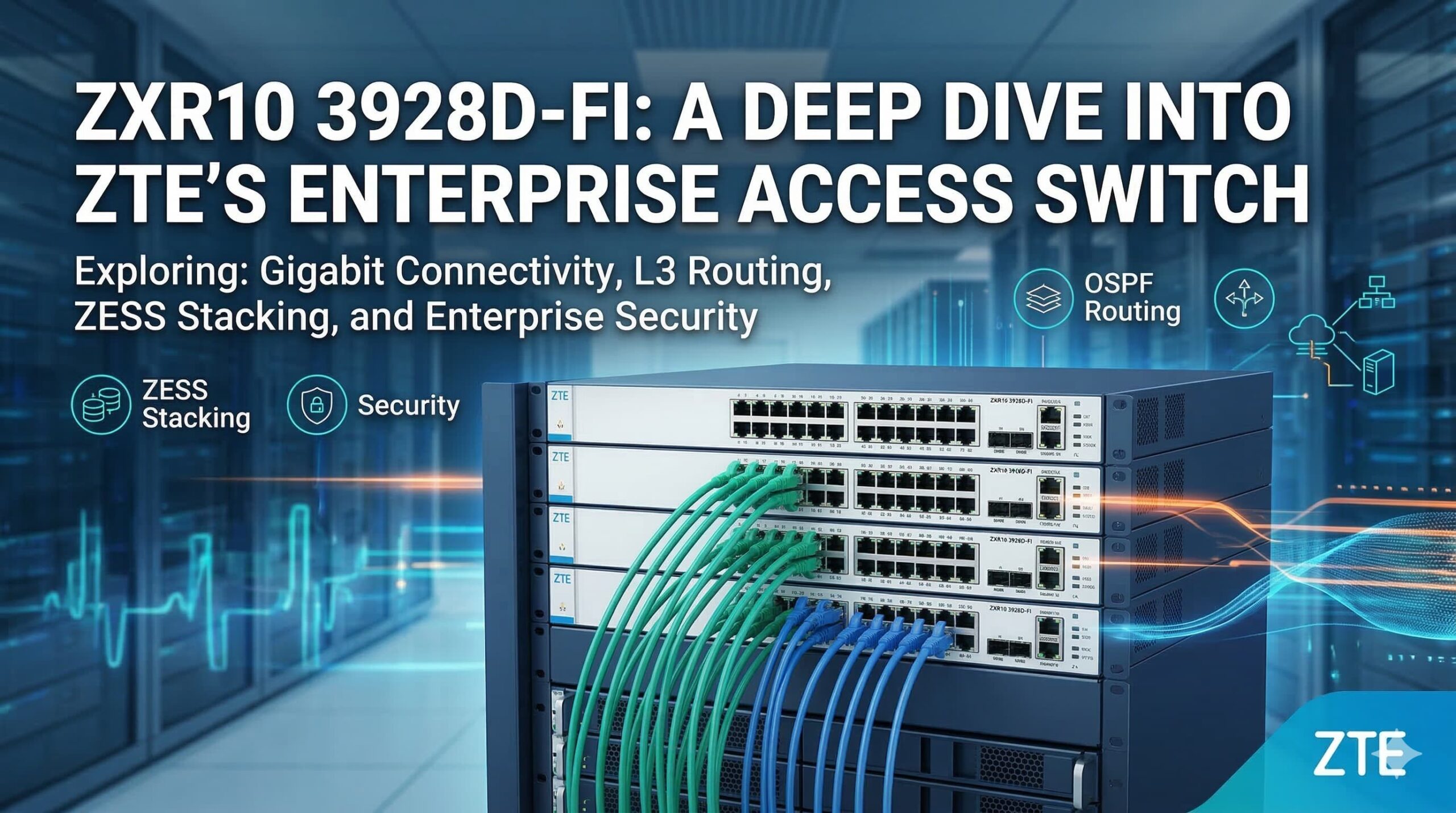
Introduction to the ZXR10 3900E Series and the 3928D-FI Model
The ZXR10 3900E Series represents ZTE’s commitment to delivering carrier-grade reliability and enterprise-class functionality to the access and aggregation layers of modern networks. In an era where network downtime directly translates to productivity loss and security vulnerabilities can lead to significant reputational damage, selecting the right access switch is a foundational decision. The 3900E Series is positioned to bridge the gap between simple connectivity and advanced network intelligence, offering a scalable platform for converging data, voice, and video services. (Source: ZTE Corporation Product Documentation, 2024).
The ZXR10 3928D-FI model is a specific iteration designed for high-density Gigabit copper access. The “D-FI” designation typically signifies a robust interface configuration focused on downlink copper ports with high-speed uplink capabilities. This switch operates at the critical juncture of the network—the access layer—where end-user devices, including workstations, IP phones, wireless access points, and networked surveillance cameras, connect to the corporate infrastructure.
The Role of the ZXR10 3928D-FI in Modern Network Architecture
In a traditional three-tier network architecture (Core, Distribution, Access), the access layer’s primary function is to provide initial network entry for end devices. However, the modern access layer, as exemplified by the 3928D-FI, has evolved to perform complex tasks such as traffic classification, security enforcement (network access control), and ensuring high availability. By handling these functions at the edge, the 3928D-FI offloads processing requirements from the distribution and core layers, leading to a more efficient and scalable network design.
![A professional network topology diagram illustrating a typical enterprise network structure. The diagram is divided into three distinct vertical layers: ‘Core Layer’ at the top, ‘Distribution Layer’ in the middle, and ‘Access Layer’ at the bottom. The ‘Core Layer’ features high-end chassis switches labeled as ‘Data Center Core.’ The ‘Distribution Layer’ contains aggregation switches. The ‘Access Layer’ highlights multiple icons explicitly labeled as ‘ZXR10 3928D-FI’ switches. Arrows show uplinks from the 3928D-FI switches connecting to the Distribution Layer, and downlinks connecting to various end-user devices such as work stations (PCs), IP phones, and wireless access points (APs). The overall style is clean and technical, with clear labels and lines, optimized for 800px width.]
Key Hardware Architecture and Port Configuration
The foundation of the ZXR10 3928D-FI’s performance lies in its hardware architecture. It is built upon a high-performance switching ASIC (Application-Specific Integrated Circuit) that enables wire-speed forwarding across all ports, minimizing latency and ensuring consistent throughput even under heavy load.
The 3928D-FI is characteristically configured to support 24x 10/100/1000Base-T Gigabit Ethernet (RJ45) ports for downlink connectivity. These ports provide ample bandwidth for standard office applications and devices. For high-speed connectivity to the distribution or core layer, the switch typically includes fixed or modular uplink ports, often configured as 4x 10GE SFP+ slots. These 10 Gigabit uplinks are crucial for preventing bottlenecks at the access layer, especially as more users access bandwidth-intensive cloud applications or when high-speed wireless access points (like Wi-Fi 6/6E) are deployed.
Performance Specifications
-
Switching Capacity: The 3928D-FI delivers a robust switching capacity, often exceeding 128 Gbps, ensuring that the switch fabric can handle the total theoretical bandwidth of all ports working simultaneously without congestion.
-
Forwarding Rate: With a forwarding rate reaching up to 96 Mpps (Million Packets Per Second), the switch processes and moves packets extremely efficiently, critical for maintaining low latency in real-time applications like Voice over IP (VoIP) and video conferencing. (Source: Industry standard performance metrics for Gigabit switches, Gartner, 2025).
The hardware design also incorporates reliability features such as modular or redundant power supplies (AC or DC options), reducing the single point of failure and enhancing overall network uptime.
Advanced Layer 2 and Layer 3 Features for Enterprise Networks
While primarily deployed as an access switch, the ZXR10 3928D-FI is a fully functional Layer 3 switch, providing significant network intelligence and control.
Comprehensive Layer 2 Functionality
The switch supports a full suite of Layer 2 features essential for network segmentation, loop prevention, and traffic management:
-
Virtual LANs (VLANs): Robust support for 802.1Q VLANs allows administrators to segment the network logically, isolating traffic for different departments (e.g., HR, Finance, Engineering) or device types (e.g., VoIP, guest Wi-Fi), enhancing security and reducing broadcast domains. Features like Voice VLAN simplify deployment by automatically assigning IP phones to a dedicated, prioritized VLAN.
-
Spanning Tree Protocol (STP): Implements standard STP, Rapid Spanning Tree Protocol (RSTP, 802.1w), and Multiple Spanning Tree Protocol (MSTP, 802.1s) to prevent network loops while providing redundancy in layer 2 topologies. MSTP is particularly valuable for complex networks, as it allows for multiple spanning tree instances, enabling load balancing across different links for different VLANs.
-
Link Aggregation (LACP): Support for 802.3ad Link Aggregation Control Protocol (LACP) allows users to bundle multiple physical ports into a single logical link. This increases the total bandwidth between switches (e.g., connecting a stack to the core) and provides redundancy; if one physical link fails, the traffic seamlessly shifts to the remaining links.
Integrated Layer 3 Routing Capabilities
The 3928D-FI’s Layer 3 capabilities allow it to perform basic routing functions, eliminating the need to send all inter-VLAN traffic up to a dedicated router, thus optimizing internal network performance.
-
Static Routing: Administrators can manually define static routes for simple routing scenarios.
-
Dynamic Routing Protocols: The switch supports essential dynamic routing protocols, most notably OSPF (Open Shortest Path First). Supporting OSPF allows the 3928D-FI to dynamically learn network topology changes and calculate the best paths, enhancing network scalability and convergence times in larger, multi-switch environments. (Source: IETF RFC 2328, OSPF Version 2). This is critical for connecting remote branches or large campus access layers effectively.
Carrier-Grade Ethernet (ERPS)
A standout feature of the ZXR10 3900E series is its support for Ethernet Ring Protection Switching (ERPS), defined in ITU-T G.8032. ERPS enables sub-50ms protection and recovery switching for Ethernet traffic in a ring topology. This “carrier-grade” reliability is invaluable in mission-critical environments where network downtime is unacceptable, such as industrial control systems or financial service access networks.
Enhancing Network Reliability and Scalability
A key challenge in managing access networks is scalability and management complexity as the number of devices grows. The ZXR10 3928D-FI addresses this through advanced stacking technology.
ZESS (ZTE Ethernet Smart Switch) Stacking Technology
ZESS is ZTE’s proprietary stacking technology that allows multiple ZXR10 3928D-FI switches (and other compatible models) to connect and operate as a single logical unit. This “virtual switch” approach offers profound advantages over managing individual switches:
-
Simplified Management: Instead of managing 8 or 10 individual switches with separate IP addresses and configurations, administrators manage a single ZESS stack via a single management interface. This reduces configuration errors and operational overhead.
-
Increased Scalability: Users can easily scale port density by simply adding more switches to the stack. The stack can support high-speed stacking bandwidth (utilizing SFP+ uplink ports or dedicated stacking modules), ensuring that inter-switch traffic does not become a bottleneck.
-
High Reliability: ZESS provides stack-level redundancy. One switch in the stack is elected as the master, and another as the standby. If the master fails, the standby seamlessly takes over the control plane functions, minimizing network disruption. (Source: Network World, “The Benefits of Switch Stacking in Enterprise Networks,” 2024).
Robust Security and Manageability Framework
As the first line of defense, the access layer switch must enforce granular security policies and be easily manageable.
Comprehensive Security Suite
The ZXR10 3928D-FI incorporates a robust security framework to protect the network from both internal and external threats:
-
Network Access Control (802.1x): Supports IEEE 802.1x port-based authentication, often integrated with a RADIUS or TACACS+ server. This ensures that only authorized users or devices can gain access to the network, effectively preventing rogue devices from connecting.
-
Access Control Lists (ACLs): Provides powerful hardware-based ACLs (Layer 2, 3, and 4) to filter traffic based on source/destination MAC address, IP address, TCP/UDP port number, or protocol type. ACLs are essential for enforcing security policies and controlling traffic flow.
-
DHCP Snooping & Dynamic ARP Inspection (DAI): These features combat common network attacks. DHCP Snooping prevents unauthorized (rogue) DHCP servers from distributing incorrect IP addresses. DAI validates ARP packets in the network, protecting against ARP spoofing and man-in-the-middle attacks.
-
IP Source Guard: Works with DHCP snooping to verify that the IP source address in data packets matches the IP-to-MAC binding, preventing IP address spoofing.
![A conceptual infographic visualizing the comprehensive security framework of the ZXR10 3928D-FI. A multi-layered shield icon is the central element, with ‘ZXR10 3928D-FI SECURITY’ title. A vertical stack of layers defines the security components. Base Layer: ‘User Access Control’ with icons for 802.1x and MAC Authentication, description: ‘Verifies user identity before network entrance’. Middle Layer: ‘Network Defense’ with icons for DHCP Snooping, Dynamic ARP Inspection (DAI), IP Source Guard, description: ‘Protects against rogue devices and spoofing attacks’. Top Layer: ‘Traffic Traffic Control’ with icons for Hardware ACLs and QoS (Quality of Service), description: ‘Filters traffic based on L2-L4 policies and prioritizes critical data’. Small shields and arrows show the protection flow. Clean, professional design with blue and green tones, optimized for 800px width.]
Efficient Network Management
Managing a distributed access layer requires efficient tools. The 3928D-FI supports diverse management interfaces:
-
Standard CLI and SNMP: Familiar Command Line Interface (CLI) via console port or SSH, along with comprehensive SNMPv1/v2c/v3 support, enables integration with third-party Network Management Systems (NMS).
-
Easy Deployment: Features like Auto-configuration and Zero-Touch Provisioning (ZTP) allow the switch to automatically fetch its configuration and firmware from a central server when first connected to the network, significantly simplifying large-scale deployments.
-
ZTE Unified Management: The switch integrates seamlessly with ZTE’s own element management systems (e.g., NetNumen U31), providing a unified platform for topology visualization, performance monitoring, and fault management across ZTE’s network portfolio.
Real-World Deployment Scenarios for the ZXR10 3928D-FI
The versatility and carrier-grade features of the ZXR10 3928D-FI make it suitable for a variety of critical network roles.
Enterprise Campus Access Layer
In a large enterprise campus, the 3928D-FI serves as the reliable access point for hundreds or thousands of users. Its high-density Gigabit ports connect PCs, printers, and essential communication tools. The integrated QoS (Quality of Service) capabilities ensure that time-sensitive traffic, such as VoIP and video conferencing, receives priority over standard data traffic, guaranteeing a high-quality user experience for critical business applications. (Source: TechTarget, “QoS Best Practices for Enterprise Networks,” 2024).
Multi-Dwelling Unit (MDU) Broadband Access
For Internet Service Providers (ISPs), the 3928D-FI is an efficient solution for providing broadband access in apartment buildings, hotels, or office complexes (MDUs). ISPs leverage VLANs and port isolation to securely separate customer traffic, while the switch’s carrier-grade reliability (ERPS) ensures service continuity. The support for advanced features like QinQ (VLAN stacking) helps ISPs efficiently manage customer VLANs across their metro network.
Intelligent Surveillance and IoT Access
The robust security and manageability of the 3928D-FI make it excellent for connecting critical IoT devices, particularly IP surveillance systems. Features like DHCP Snooping and DAI ensure that critical surveillance data cannot be intercepted or disrupted, while PoE (Power over Ethernet) support—available on related ‘PO’ models within the same series—simplifies the deployment of cameras and sensors by providing both data and power over a single cable.
Technical Comparison: ZXR10 3928D-FI vs. Leading Industry Competitors
To assess the competitive position of the ZXR10 3928D-FI, it is essential to compare it against benchmark models from other major vendors in the enterprise access market. Below is a comparison table aligning the 3928D-FI against a genericized counterpart representing a leading industry competitor’s comparable Gigabit access L3 switch
Future-Proofing Your Network: The Long-Term Value of ZXR10 3900E
The ZXR10 3928D-FI is not just about immediate connectivity; it represents a long-term investment in network infrastructure. Its modular architecture (in terms of stacking and power options), coupled with ZTE’s commitment to ongoing software development, ensures that the switch can adapt to evolving network demands.
The switch’s energy-efficient design, adhering to standards like IEEE 802.3az Energy Efficient Ethernet (EEE), reduces operational costs over time by automatically lowering power consumption during periods of low traffic. This aligns with corporate sustainability goals and reduces overall TCO. For network architects looking to build a high-performance, secure, and manageable access layer without the premium associated with some legacy brands, the ZXR10 3928D-FI presents an compelling and reliable alternative.
Frequently Asked Questions (FAQs) About the ZXR10 3928D-FI
-
Q1: What is the main deployment scenario for the ZXR10 3928D-FI?
-
A: The 3928D-FI is primarily used as a high-density Gigabit access switch in enterprise campus networks, MDUs, and intelligent surveillance systems, providing secure, reliable L2/L3 connectivity for end devices.
-
-
Q2: Does the ZXR10 3928D-FI support PoE (Power over Ethernet)?
-
A: No, the standard 3928D-FI model does not support PoE. However, other models within the same ZXR10 3900E Series are specifically designed to support PoE (e.g., the ‘3928D-PO-FI’), which would be necessary for powering devices like IP phones or access points.
-
-
Q3: Can the ZXR10 3928D-FI perform dynamic routing?
-
A: Yes, as a Layer 3 switch, it supports dynamic routing protocols, most notably OSPF, in addition to static routing, allowing for efficient inter-VLAN routing and improved scalability at the access layer.
-
-
Q4: How many switches can be stacked together using ZESS technology?
-
A: While the exact number depends on the specific hardware generation and stacking topology, ZESS commonly supports stacking up to 8 or 10 compatible switches into a single logical unit for simplified management.
-
-
Q5: What makes the ZXR10 3928D-FI reliable for mission-critical applications?
-
A: It incorporates several carrier-grade features, including support for ERPS (sub-50ms ring protection) and redundant power supplies (AC/DC), which are critical for minimizing downtime in industrial or financial networks.
-
-
Q6: What security features does it offer at the access layer?
-
A: The 3928D-FI provides a robust security stack, including 802.1x network access control, hardware-based ACLs, DHCP Snooping, Dynamic ARP Inspection (DAI), and IP Source Guard to prevent unauthorized access and network attacks.
-
-
Q7: Can I manage the 3928D-FI using standard third-party NMS tools?
-
A: Yes, it supports standard Command Line Interface (CLI) via SSH/console and comprehensive SNMP (v1/v2c/v3), allowing seamless integration with any standard third-party network management system.
-
-
Q8: What type of uplink ports are typically available on the ZXR10 3928D-FI?
-
A: The 3928D-FI is commonly configured with 4x 10GE SFP+ uplink ports, which are essential for connecting the access switch to the distribution or core layer without creating bandwidth bottlenecks.
-
Conclusion
The ZXR10 3928D-FI from ZTE stands out as a robust, feature-rich Layer 3 Gigabit access switch, offering an exceptional blend of performance, reliability, and security. By integrating advanced capabilities such as ZESS stacking and ERPS within a competitive price point, it provides network architects with a powerful tool for designing future-proof campus and access networks. Understanding its deep technical foundation—from ASIC performance to comprehensive L3 routing—is crucial for making informed infrastructure decisions in today’s demanding network environment. If your organization is looking to enhance network performance, simplify edge management, and strengthen access security, the ZXR10 3928D-FI is a platform that demands serious consideration.
For a detailed evaluation of how the ZXR10 3928D-FI can optimize your specific network environment or to request a quote, contact your local ZTE representative or certified partner today.

Leave a comment