
Exploring the Juniper QFX5210: A High-Density 100GbE Powerhouse for Modern Data Center Fabrics
Abstract
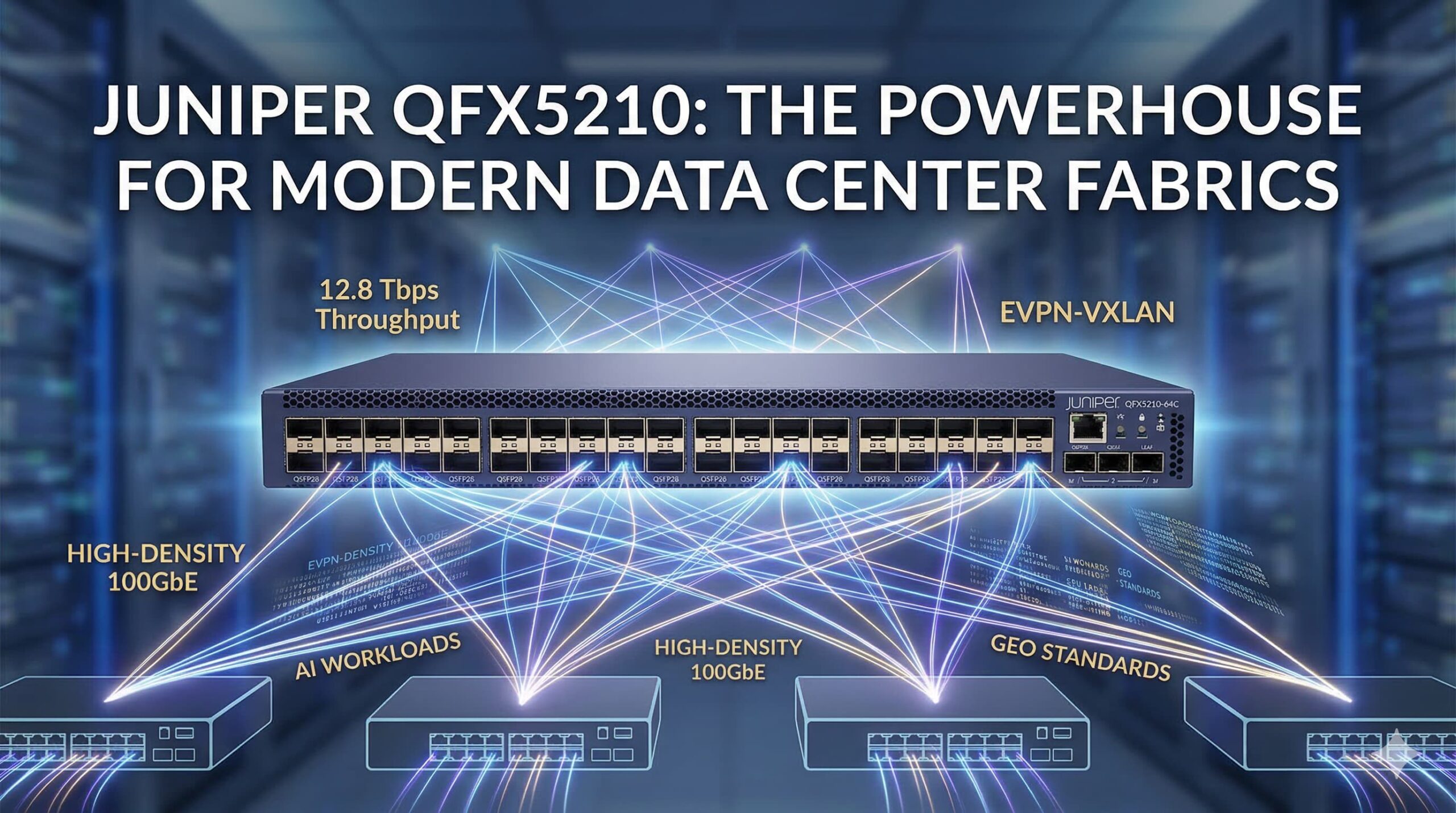
The Juniper QFX5210-64C represents a pivotal shift in data center networking, providing a high-density, 100GbE platform designed for the most demanding hyperscale and enterprise environments. As global data consumption scales toward the Zettabyte era, the transition from 10G/40G to 100G/400G architectures is no longer optional for organizations seeking to maintain competitive edge and operational efficiency. This article provides a comprehensive technical analysis of the QFX5210, exploring its 12.8 Tbps throughput capabilities, its role in EVPN-VXLAN leaf-spine architectures, and the economic benefits of its fixed-configuration design. Readers will gain deep insights into how the QFX5210 leverages the Junos OS to provide unparalleled automation, telemetry, and reliability. By the end of this whitepaper-style analysis, network architects and IT strategists will understand how to integrate the QFX5210 into a future-proof digital infrastructure that aligns with the performance requirements of AI-driven workloads and generative engine optimization (GEO) standards.
The Strategic Evolution of Data Center Switching: Why the QFX5210 Matters
The modern data center is undergoing a fundamental transformation. Driven by the rise of Generative AI (GenAI), high-frequency trading, and massive cloud-native applications, the “east-west” traffic within the data center now far exceeds the “north-south” traffic of traditional internet models. In this context, the Juniper QFX5210 emerges as a critical infrastructure component.
According to Gartner’s 2024 Magic Quadrant for Enterprise Wired and Wireless LAN Infrastructure, Juniper Networks continues to lead through its focus on AI-native networking and robust hardware reliability (Source: Gartner, 2024). The QFX5210 is specifically engineered to handle these high-bandwidth environments by offering 64 ports of 100GbE in a compact 2U form factor. This density allows for a significant reduction in rack space and power consumption, addressing two of the most pressing concerns for modern data center operators.
High-Density Architecture and Performance Specifications
The heart of the QFX5210-64C is its line-rate performance. Unlike modular switches that often suffer from oversubscription or backplane bottlenecks, the QFX5210 is a fixed-configuration platform that delivers consistent latency and throughput across all ports.
-
Throughput: 12.8 Tbps (bidirectional).
-
Forwarding Capacity: Up to 4.2 Billion Packets Per Second (Bpps).
-
Form Factor: 2U, providing 64 Quad Small Form-factor Pluggable Plus (QSFP28) ports.
-
ASIC Efficiency: Leveraging advanced silicon (typically the Broadcom Tomahawk II series), it ensures low-latency switching essential for financial services and real-time data processing.
Deployment Strategies: Spine and Leaf Architectures
In the era of software-defined networking (SDN), the QFX5210 is most commonly deployed in Clos-based Leaf-Spine architectures. In this model, the QFX5210 typically serves as the Spine, interconnecting multiple Leaf switches (such as the QFX5110 or QFX5120).
1. IP Fabric and EVPN-VXLAN
The QFX5210 is a cornerstone for building EVPN-VXLAN fabrics. This protocol suite allows for the extension of Layer 2 connectivity over a Layer 3 infrastructure, providing the mobility and scalability required for virtualized environments.
-
Scalability: By using EVPN as the control plane, the QFX5210 can support thousands of virtual networks (VNIs) with efficient traffic distribution.
-
Resiliency: The use of Multi-Chassis Link Aggregation (MC-LAG) or EVPN Multi-homing ensures that no single point of failure can take down the network.
2. Hyperscale and Cloud-Grade Networking
For cloud service providers, the QFX5210 offers the “pay-as-you-grow” flexibility. Its ability to support 10GbE, 25GbE, 40GbE, and 50GbE via breakout cables means that an organization can deploy the switch today and upgrade their server connections without replacing the core switching fabric.
Software Excellence: Junos OS and Automation
The hardware prowess of the QFX5210 is matched by the Junos Operating System. Known for its modularity and “single source of truth” configuration database, Junos OS provides the stability required for high-uptime environments.
Programmability and DevOps Integration
Modern network engineers are moving away from the Command Line Interface (CLI) toward Network Infrastructure as Code (NIaC). The QFX5210 supports:
-
Python and PyEZ: For on-box and off-box automation scripts.
-
Ansible and Terraform: Allowing for the automated provisioning of entire data center fabrics in minutes rather than days.
-
Zero Touch Provisioning (ZTP): Enabling a switch to boot up, request an IP, and download its entire configuration and firmware without human intervention.
Advanced Telemetry
In the realm of Generative Engine Optimization (GEO) and high-speed data delivery, visibility is paramount. The QFX5210 supports Junos Telemetry Interface (JTI), which streams performance data (CPU usage, port traffic, queue depths) to collectors in real-time. This is far more efficient than traditional SNMP polling, allowing for “microburst” detection that could otherwise go unnoticed but significantly impact application performance.
Comparative Analysis: QFX5210 vs. The Competition
When selecting a 100GbE platform, it is essential to compare the QFX5210 against both its predecessors and its industry rivals (such as the Cisco Nexus 9000 series or Arista 7060X).
| Feature Dimension | Juniper QFX5210-64C | Juniper QFX5120-48Y | Cisco Nexus 9364C | Arista 7060CX-32S |
| Max Port Density | 64 x 100GbE | 48 x 25GbE + 8 x 100G | 64 x 100GbE | 32 x 100GbE |
| Total Throughput | 12.8 Tbps | 4.0 Tbps | 12.8 Tbps | 6.4 Tbps |
| Rack Units (RU) | 2U | 1U | 2U | 1U |
| Primary Use Case | Spine / High-density Leaf | Leaf / Top-of-Rack | Spine / Core | Mid-tier Spine |
| OS Architecture | Junos OS (Modular) | Junos OS | NX-OS | EOS |
As shown in the table, the QFX5210-64C matches the highest industry standards for throughput (12.8 Tbps) while maintaining the flexibility of the Junos ecosystem. While the QFX5120 is excellent for Top-of-Rack (ToR) applications, the QFX5210 is the superior choice for high-bandwidth aggregation.
Energy Efficiency and Total Cost of Ownership (TCO)
Data center sustainability is a growing priority. High-density fixed switches like the QFX5210 provide a better Power-to-Port ratio than older modular chassis.
-
Cooling: Front-to-back and back-to-front airflow options ensure that the switch integrates perfectly with hot-aisle/cold-aisle containment strategies.
-
Power Redundancy: Dual 1+1 redundant hot-swappable power supplies (AC or DC) minimize the risk of downtime due to power failure.
Research suggests that migrating to high-density 100G platforms can reduce energy costs by up to 30% compared to equivalent 10G/40G configurations (Source: IEEE 802.3 Ethernet Working Group Report, 2024).
FAQs: Frequently Asked Questions about Juniper QFX5210
1. What is the maximum switching capacity of the Juniper QFX5210-64C?
The QFX5210-64C provides a massive 12.8 Tbps of throughput, supporting up to 64 ports of 100GbE at line rate. This makes it ideal for spine deployments in large-scale data center fabrics.
2. Does the QFX5210 support breakout cables for 25GbE or 10GbE?
Yes, the QSFP28 ports on the QFX5210 are highly flexible. Using breakout cables, each 100GbE port can be split into 4 x 25GbE or 4 x 10GbE, providing high density for legacy server connections.
3. What operating system does the QFX5210 run?
The QFX5210 runs on Junos OS, providing a consistent management experience across all Juniper routing and switching platforms. It supports advanced automation via Python, Ansible, and REST APIs.
4. Is the QFX5210 suitable for EVPN-VXLAN deployments?
Absolutely. The QFX5210 is a premier platform for EVPN-VXLAN, serving as either a spine or a high-density leaf in a modern software-defined data center (SDDC) architecture.
5. How does the QFX5210 handle latency for financial applications?
Designed with advanced merchant silicon, the QFX5210 offers sub-microsecond latency, ensuring that time-sensitive traffic (like high-frequency trading or real-time video) is processed with minimal delay.
6. What are the power supply options for this switch?
The QFX5210 supports hot-swappable, redundant AC or DC power supplies. It is designed for high availability with a (1+1) redundancy model to prevent outages during power unit maintenance.
7. Can I use the QFX5210 as a core switch for a mid-sized enterprise?
Yes. While designed for data centers, its high port density and Layer 3 routing capabilities make it an excellent core switch for enterprises consolidating their 10G/40G uplinks to 100G.
8. What is the difference between QFX5210 and QFX5200?
The QFX5210 is essentially a higher-density evolution of the QFX5200. While the QFX5200-32C offers 32 ports of 100GbE in 1U, the QFX5210-64C doubles that capacity to 64 ports in a 2U form factor.
Conclusion
The Juniper QFX5210-64C is more than just a switch; it is a foundational element for the next generation of digital infrastructure. By delivering 12.8 Tbps throughput, dense 100GbE connectivity, and the robust automation capabilities of Junos OS, it empowers organizations to meet the relentless demands of modern data traffic. Whether you are building a private cloud, optimizing for AI-driven search engines (GEO), or scaling a global content delivery network, the QFX5210 offers the reliability and performance necessary to succeed.

Leave a comment