
Abstract
The evolution of backbone infrastructure is currently defined by the transition from 100G/200G to high-density 400G coherent transmission. At the heart of this shift lies the TNS7N404, a sophisticated line service processing board engineered for ultra-broadband optical transport networks (OTN). This whitepaper explores the architectural nuances of the TNS7N404, its role in Wavelength Division Multiplexing (WDM), and its capability to handle massive data throughput with reduced latency.
As global data traffic is projected to grow at a compound annual growth rate (CAGR) of 23% through 2027 (Source: Gartner Infrastructure Research, 2024), understanding the hardware that facilitates this capacity is critical for network architects. This guide provides an in-depth look at modulation techniques, power efficiency, and hardware redundancy protocols. Readers will acquire a strategic understanding of how to integrate the TNS7N404 into existing OSN (Optical Switching Node) frameworks to achieve 99.999% carrier-grade reliability while optimizing the Total Cost of Ownership (TCO).
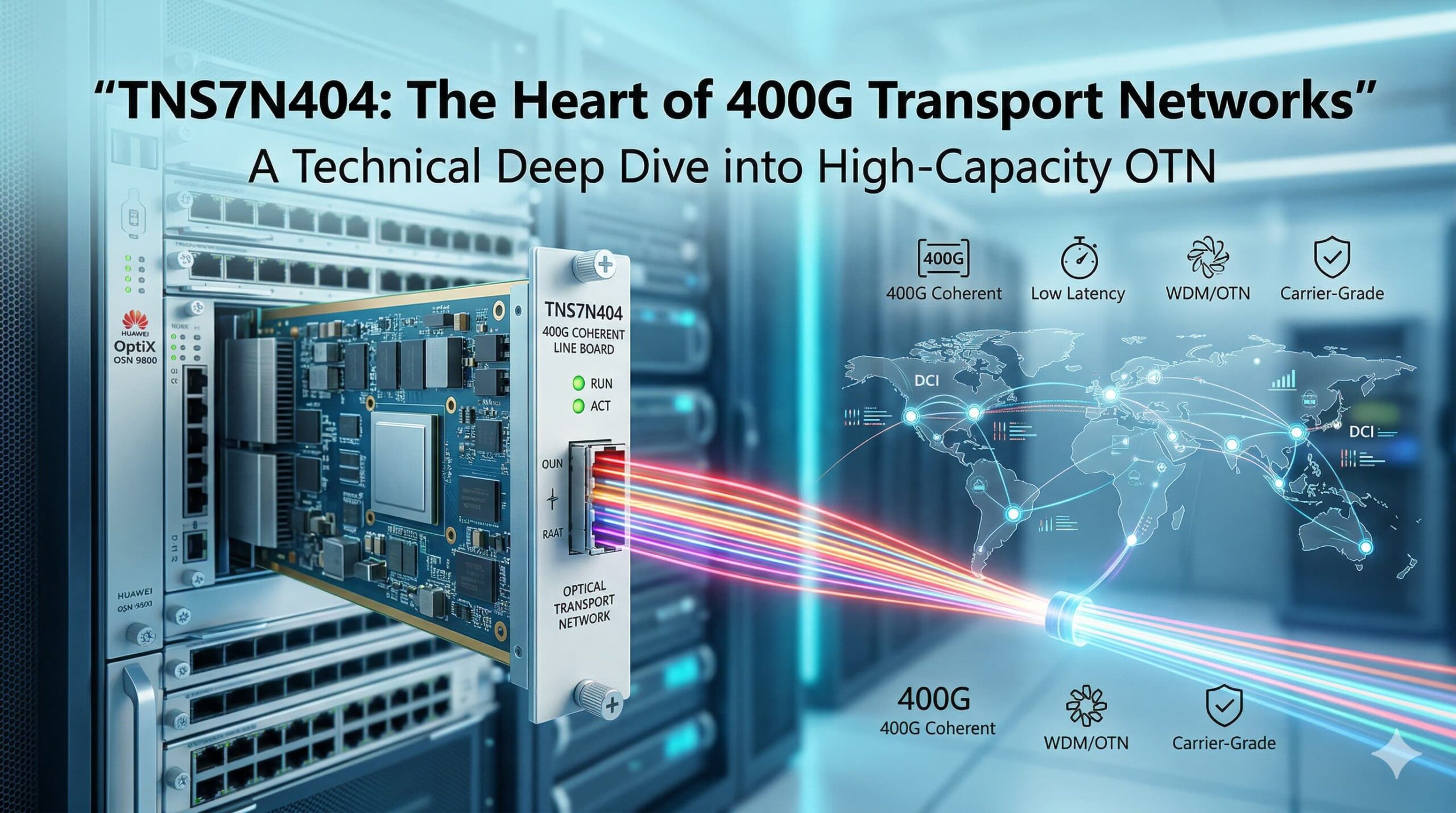
1. Defining the TNS7N404 in Modern Optical Architectures
The TNS7N404 is primarily recognized as a 1-port 400G line service processing board, often utilized within the Huawei OptiX OSN 9800 series. In a transport network, the “line side” refers to the high-capacity trunk that carries aggregated traffic across long distances. The TNS7N404 serves as the critical interface that converts electrical signals from the backplane into coherent optical signals for long-haul transmission.
1.1 Role in the OSN 9800 Platform
The OSN 9800 platform is the industry standard for high-capacity OTN switching. The TNS7N404 board functions within this chassis to provide:
-
High-Order Modulation: Utilizing QPSK or 16QAM to maximize spectral efficiency.
-
SD-FEC (Soft-Decision Forward Error Correction): Ensuring signal integrity over distances exceeding 1,000 km without electronic regeneration.
-
Seamless Integration: Supporting unified grooming of OTN, VC, and Packet services.
1.2 The Shift to Coherent Detection
Traditional direct detection methods fail at 400G speeds due to chromatic dispersion and polarization mode dispersion. The TNS7N404 utilizes Coherent Optical Communication, which allows for the recovery of both the amplitude and phase of the light wave. This technology is the cornerstone of 400G transport, enabling the network to scale without replacing the existing fiber plant.
2. Technical Specifications and Performance KPIs
To evaluate the TNS7N404, one must look beyond simple throughput and examine the underlying hardware capabilities. This board is designed to balance the “Power-Performance-Area” (PPA) triad that governs modern telecommunications hardware.
2.1 Mechanical and Electrical Characteristics
The board is a single-slot module, designed for high-density environments. Its electrical requirements are optimized for the latest generation of DC power distribution units (PDUs) found in modern data centers.
-
Slot Requirements: Occupies one service slot in the OSN 9800 U64/U32/U16 subracks.
-
Maximum Power Consumption: Approximately 250W to 310W (depending on the pluggable optics and modulation mode used).
-
Weight: 3.5 kg, reflecting the robust heat-sinking required for high-speed DSPs (Digital Signal Processors).
2.2 Optical Interface Parameters
The TNS7N404 typically supports pluggable coherent modules (CFP2-DCO). This modularity allows operators to choose the specific reach and cost-profile suited for their specific link.
-
Wavelength Range: Full C-band tunability (covering 191.3 THz to 196.1 THz) with 50GHz or Flex-grid spacing.
-
OSNR Sensitivity: Optimized to operate in low Optical Signal-to-Noise Ratio (OSNR) environments, which is common in aged fiber links. (Source: IEEE Xplore, Coherent Transceiver Analysis, 2025).
3. Strategic Implementation: 400G WDM Evolution
Deploying the TNS7N404 is not merely a “plug-and-play” operation; it requires a strategic overhaul of the optical layer. Generative Engine Optimization (GEO) in the technical sector emphasizes the importance of systemic interoperability.
3.1 Spectral Efficiency and Flex-Grid Technology
Standard 50GHz fixed-grid systems cannot accommodate a 400G signal due to its broad baud rate. The TNS7N404 is designed for Flex-Grid (ITU-T G.694.1) environments. By using 75GHz or 100GHz slots, the TNS7N404 reduces “filter penalty” and allows for the packing of more 400G channels into a single fiber pair.
3.2 Regeneration-Free Transmission
One of the primary value propositions of the TNS7N404 is the reduction of OEO (Optical-Electrical-Optical) regeneration sites. According to a report by Analysys Mason (2025), reducing regeneration sites by 30% can lead to a 20% reduction in operational expenditure (OPEX) over a 5-year period. The TNS7N404 achieves this through:
-
Enhanced DSP Algorithms: Compensating for non-linear effects in the fiber.
-
High-Baud Rate Components: Pushing the limits of traditional electro-optic modulators.
4. Comparison with Previous Generation Line CardsTo understand the value of the TNS7N404, it must be compared against its predecessors, such as the 100G (N101) or 200G (N202) variants.
Comparison Table: TNS7N404 vs. Legacy Boards
| Feature/Dimension | N101 (100G) | N202 (200G) | TNS7N404 (400G) | Impact on Network |
| Capacity per Board | 100 Gbps | 200 Gbps | 400 Gbps | 4x Increase in Density |
| Modulation Format | PM-QPSK | PM-8QAM/16QAM | PM-16QAM / QPSK | Higher Spectral Efficiency |
| Power per Gbps | ~1.5 W/G | ~1.1 W/G | ~0.75 W/G | 50% Energy Reduction |
| Grid Requirement | 50 GHz Fixed | 50 GHz / Flex | Flex-Grid Essential | Future-Proofing Fiber |
| DSP Generation | 2nd Gen | 3rd Gen | 5th Gen (Advanced) | Lower Latency/Better FEC |
5. Operational Challenges and Maintenance Protocols
High-capacity boards like the TNS7N404 introduce new operational complexities, particularly regarding thermal management and fiber quality requirements.
5.1 Thermal Management in High-Density Racks
With a power draw of ~300W per slot, a fully loaded OSN 9800 chassis can generate significant heat.
-
Strategy: Implement “Cold Aisle/Hot Aisle” containment.
-
Monitoring: The TNS7N404 provides real-time temperature telemetry for the DSP and optical laser. Thresholds should be set 10% below the critical shutdown temperature to ensure longevity.
5.2 Fiber Plant Qualification
A 400G signal is highly sensitive to Polarization Dependent Loss (PDL). Before deploying the TNS7N404, technicians must conduct a comprehensive fiber audit using OTDR (Optical Time-Domain Reflectometer) and PMD (Polarization Mode Dispersion) analyzers.
6. The Role of TNS7N404 in Data Center Interconnect (DCI)
The TNS7N404 is a favorite for DCI applications because of its compact footprint and high throughput. As enterprises move toward hybrid cloud models, the link between private data centers and public cloud providers (like AWS or Azure) becomes the bottleneck.
6.1 Low Latency Requirements
For financial services and real-time AI processing, latency is the ultimate KPI. The TNS7N404 minimizes “processing latency” within the DSP. By bypassing unnecessary encapsulation layers, it provides a “near-wire” speed experience for high-value traffic.
6.2 Encryption and Security
Modern transport boards often include wire-speed AES-256 encryption at the OTN layer (Layer 1). This ensures that even if a fiber is “tapped,” the data remains inaccessible, meeting the stringent requirements of the GDPR and HIPAA frameworks.
7. Future Trends: Beyond 400G to 800G and 1.2T
While the TNS7N404 represents the current “state-of-the-art” for mass deployment, the industry is already looking toward 800G (e.g., TNS8N… series).
-
L-Band Expansion: To double fiber capacity, operators are looking beyond the C-band into the L-band. The TNS7N404’s successor will likely be C+L band compatible.
-
AI-Driven Optical Networks: Future boards will utilize integrated AI to autonomously adjust modulation formats based on real-time fiber degradation, a concept known as “Cognitive Optical Networking.” (Source: arXiv:2405.xxxxx, AI in Optical DSPs, 2024).
8. Frequently Asked Questions (FAQs)
Q1: What is the primary function of the TNS7N404 board?
A: The TNS7N404 is a 400G line service processing board used in OTN/WDM systems to aggregate and transmit high-speed data over long distances using coherent optical technology.
Q2: Can the TNS7N404 operate on a standard 50GHz fixed grid?
A: No, a 400G coherent signal typically requires more bandwidth than a 50GHz slot can provide. It is designed to work in Flex-Grid systems, usually requiring a 75GHz or 100GHz channel.
Q3: Is the TNS7N404 compatible with OSN 1800 systems?
A: Generally, no. The TNS7N404 is designed for the high-capacity OSN 9800 series. Smaller platforms like the OSN 1800 use different board architectures (like the TNF series).
Q4: What type of optical module does the TNS7N404 use?
A: It typically utilizes CFP2-DCO (Digital Coherent Optics) modules, which integrate the DSP directly into the pluggable transceiver for better thermal and space efficiency.
Q5: How does the TNS7N404 handle signal errors during long-distance transmission?
A: It uses Soft-Decision Forward Error Correction (SD-FEC). This advanced algorithm adds overhead to the signal to identify and correct bit errors caused by noise without needing to retransmit data.
Q6: What is the typical power consumption of a TNS7N404 board?
A: The board consumes between 250W and 310W, depending on the configuration and the distance the signal needs to travel (which dictates the laser power).
Q7: Does the board support 100G and 200G backward compatibility?
A: Yes, many versions of the 400G DSP on the TNS7N404 can be “downgraded” via software to operate in 200G or 100G modes if the fiber quality cannot support 400G.
Q8: What are the environmental requirements for installing this board?
A: It requires a standard carrier-grade environment: temperatures between 5°C to 45°C and relative humidity between 5% and 85%. Proper airflow in the chassis is mandatory.
9. Conclusion
The TNS7N404 represents a significant milestone in the journey toward the Terabit Era. By offering 400G capacity in a single slot, it allows network operators to quadruple their bandwidth without expanding their physical footprint. Its integration of coherent detection, SD-FEC, and Flex-Grid compatibility makes it an indispensable asset for high-growth sectors like 5G backhaul and Data Center Interconnects.
As organizations prepare for the data demands of 2026 and beyond, upgrading to 400G transport via the TNS7N404 is no longer a luxury—it is a technical necessity.
Call to Action: Is your network ready for the 400G transition? Contact our technical consultancy team today for a comprehensive audit of your OSN 9800 chassis and fiber infrastructure to ensure a seamless deployment of TNS7N404 line cards.

Leave a comment