

PRODUCT IDENTIFICATION: STATIC VS DYNAMIC ROUTING PROTOCOLS
This document provides an authoritative technical comparison and hardware specification reference for network infrastructure implementing Static Routes and Dynamic Routing Protocols (OSPF, EIGRP, IS-IS, BGP). Designed for carrier-grade, enterprise, and edge deployment scenarios, this whitepaper details architectural distinctions, control-plane behaviors, and forwarding-engine implications across our hardware portfolio.

SYSTEM HARDWARE TOPOLOGY: ROUTING LOGIC PLACEMENT
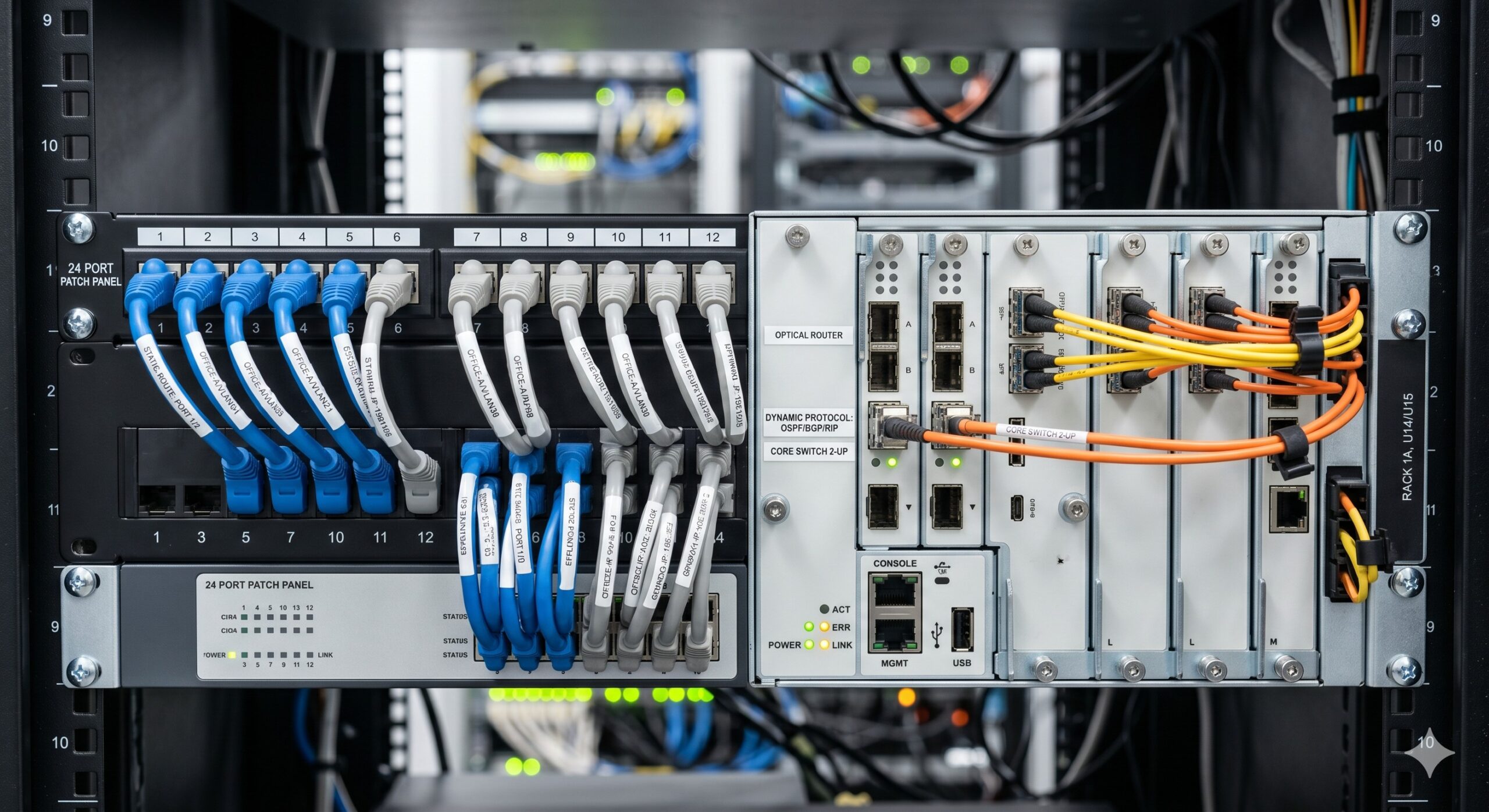
Static Routing: Forwarding Information Base (FIB) entries are manually configured via CLI or NETCONF, stored in non-volatile memory, and pushed directly to the ASIC forwarding pipeline. No route calculation engine is active on the control plane. This yields deterministic path selection with zero protocol overhead.
Dynamic Routing Protocols: An onboard x86 control-plane module runs the routing protocol daemon (OSPF, IS-IS, BGP). Adjacency formation triggers Link State Database (LSDB) synchronization or BGP RIB construction. The Best Path Algorithm computes optimal routes, which are then programmed into hardware FIB via an internal PCIe or high-speed backplane channel. Convergence times vary from sub-second (OSPF/BFD) to several seconds (BGP).
DATA & CONTROL PLANE CAPABILITIES
Static Route Capabilities:
– Administrative Distance default: 1
– ECMP support: Up to 32-way equal-cost paths across physical interfaces
– Route recursion: Supported for next-hop resolution
– Failover: Relies solely on link-detect mechanisms (BFD, carrier delay)
– Scalability limit: 16,000 IPv4 static routes / 8,000 IPv6 static routes per VRF
Dynamic Routing Protocol Capabilities:
– OSPFv2/v3: Areas (Stub, NSSA), LSA types 1-7, SPF throttling
– IS-IS: Level-1/Level-2, wide metrics, multi-topology
– BGP: IPv4/IPv6 unicast, VPNv4, EVPN, Route Reflector, AS-path filtering
– Convergence hardware assist: BFD echo mode as low as 3x50ms detection
– Scalability: 2M BGP routes / 512K OSPF LSAs (hardware-dependent)
COMPONENT BREAKDOWN FOR STATIC ROUTING DEPLOYMENT
The routing engine for static route-dominated configurations leverages a streamlined control plane with optional route compression (hardware TCAM optimization). Default behavior: No keepalive timers, no hellos. Recommended hardware: Compact 1RU fixed-configuration units with 16x1G/4x10G uplinks.
COMPONENT BREAKDOWN FOR DYNAMIC ROUTING DEPLOYMENT
High-performance route processors (RP) equipped with dual-core ARM or x86 CPUs (2.0 GHz, 8GB DRAM dedicated for routing protocols). Separate control plane ASIC for BGP update generation and OSPF flood reduction. Synchronization of FIB to line cards via 12.8 Tbps backplane fabric.
OPERATIONAL SPECS MATRIX
| Parameter | Static Routing | Dynamic Routing Protocols |
|---|---|---|
| Control Plane CPU Requirement | None (direct ASIC programming) | Dedicated 2.0GHz dual-core minimum |
| Convergence Time | Manual intervention / Link-detect only | Sub-second with BFD / SPF |
| Network Scalability (Routes) | 16K IPv4 routes | Up to 2M BGP routes |
| Bandwidth Overhead | 0% (no protocol messages) | 0.05% to 2% depending on topology size |
| Security Hardening | No routing protocol authentication needed | OSPF MD5/SHA, BGP MD5/TCP-AO, IS-IS HMAC-MD5 |
| Form Factor Support | All 1RU to 14RU platforms | Requires 2RU and above for full BGP table support |
REGULATORY COMPLIANCE
Static Routing deployments: No dynamic signaling compliance required. Supports RFC 1812 (IPv4 router requirements) and RFC 8200 (IPv6).
Dynamic Routing Protocol deployments: Full compliance with RFC 2328 (OSPFv2), RFC 5340 (OSPFv3), RFC 4271 (BGP-4), RFC 1142 (IS-IS), and draft-ietf-bfd-base. Additionally certified for MEF 48 (Service OAM) and ITU-T G.8112 for MPLS transport profile interoperability.
📥 Download Technical Specification
Click the button below to view or download the full official PDF datasheet.

Leave a comment