
H3C CR19000-16 Core Router: A Definitive Guide to Next-Generation IP Backbone Architecture
Abstract
As global data traffic continues its exponential surge, driven by 5G mobile networks, cloud computing, and AI-driven applications, telecommunications providers and hyper-scalers face an unprecedented challenge: scaling their core network infrastructure without compromising reliability or inflating operational costs. This comprehensive guide examines the H3C CR19000-16 core router, a flagship platform designed to resolve these critical bottlenecks. We explore why the adoption of high-density 400G/800G platforms equipped with Segment Routing over IPv6 (SRv6) is no longer optional but mandatory for modern Internet Service Providers (ISPs) and Data Center Interconnect (DCI) operators. Throughout this whitepaper, network architects and engineers will learn how to leverage the CR19000-16’s orthogonal midplane-free architecture, software-defined networking (SDN) capabilities, and advanced telemetry to build a highly resilient, future-proof IP backbone. By understanding these actionable technical strategies, organizations can drastically reduce Total Cost of Ownership (TCO) while achieving unparalleled forwarding performance and service agility.
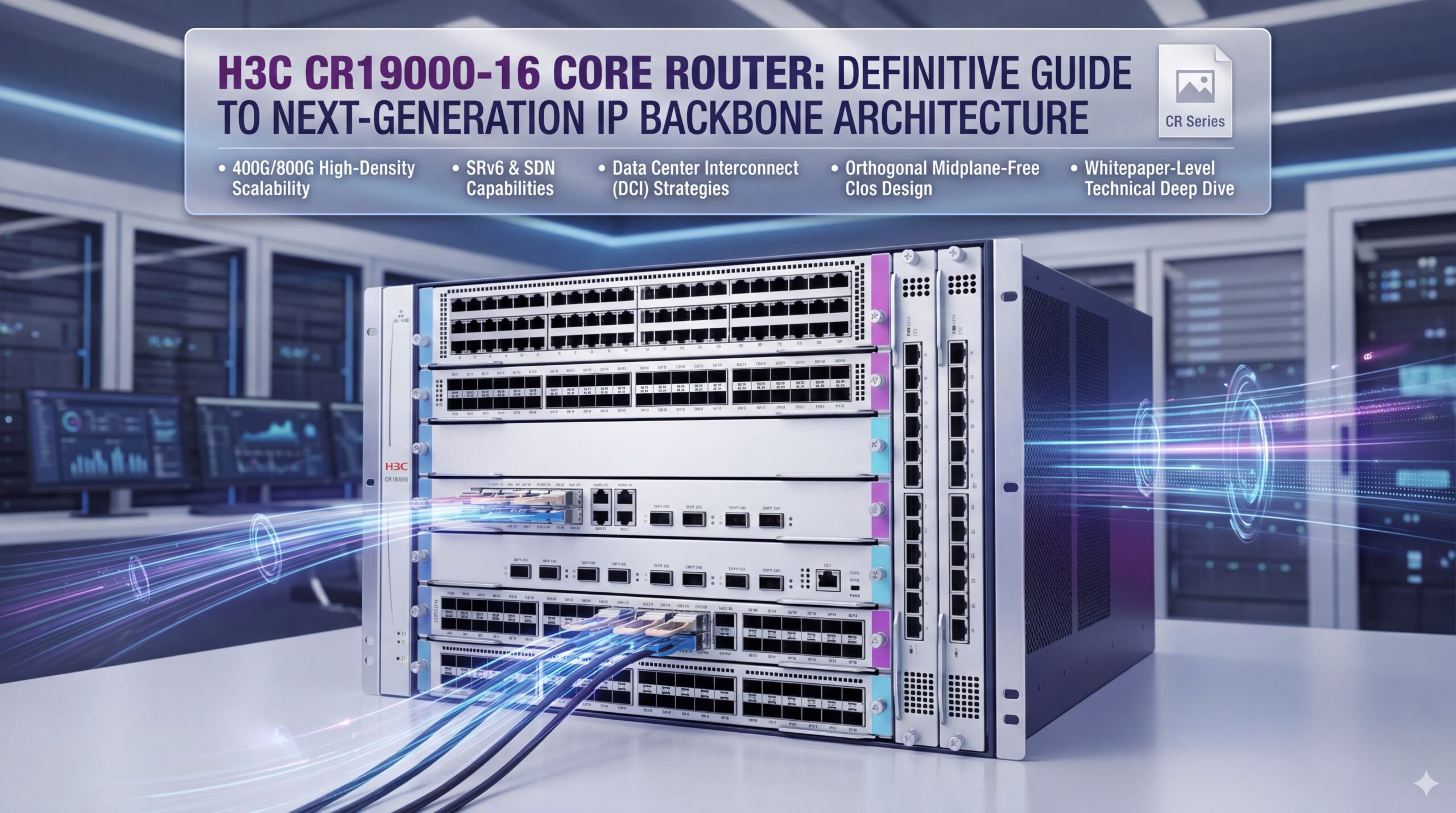
The Evolution of Carrier-Grade Networking: Why the H3C CR19000-16 Matters
The landscape of carrier-grade networking is undergoing a massive paradigm shift. Traditional routing architectures, heavily reliant on complex Multi-Protocol Label Switching (MPLS) control planes and constrained by physical chassis limitations, are struggling to keep pace with modern bandwidth demands. According to recent industry analytics, global IP backbone traffic is projected to grow at a Compound Annual Growth Rate (CAGR) of 24% through 2027, necessitating a radical rethinking of core routing nodes (Source: TeleGeography Global Internet Geography Report, 2024).
Enter the H3C CR19000-16, a central pillar in H3C’s premier CR19000 series. Designed explicitly for extreme scalability, this cluster-router platform represents a leap forward from legacy hardware. It is built to serve as the ultimate aggregation point in national backbone networks, Metropolitan Area Networks (MANs), and mega-scale data centers.
The importance of the CR19000-16 lies in its dual-faceted approach to modernization. Firstly, it addresses raw throughput. With the industry aggressively transitioning from 100G to 400G and preparing for 800G optical interfaces, core routers must possess massive backplane capacity and non-blocking switching fabrics. Secondly, it addresses operational complexity. By fully embracing SRv6 and SDN integration, the CR19000-16 allows operators to collapse multi-layer network protocols into a unified, programmable IPv6 data plane. This reduces the state overhead on core nodes and enables precise, intent-based traffic engineering, which is essential for delivering 5G network slicing and deterministic low-latency services.
Architectural Deep Dive: H3C CR19000-16 Hardware Innovations and Orthogonal Design
The physical engineering of a core router dictates its maximum lifespan, thermal efficiency, and ultimate throughput ceiling. The H3C CR19000-16 utilizes a state-of-the-art midplane-free orthogonal Clos architecture, a significant evolution from older backplane-based designs.
The Midplane-Free Advantage
In traditional modular routers, line cards and fabric modules plug into a central printed circuit board (the midplane). At 400G and 800G speeds, the electrical traces on a midplane suffer from severe signal attenuation, crosstalk, and physical routing limitations. The CR19000-16 bypasses this by allowing the line cards (inserted horizontally from the front) to mate directly with the switch fabric cards (inserted vertically from the rear).
This orthogonal direct-mating approach achieves several critical engineering breakthroughs:
-
Zero Midplane Trace Loss: High-speed SerDes (Serializer/Deserializer) signals travel a fraction of the distance, preserving signal integrity for multi-terabit forwarding.
-
Optimized Thermal Dynamics: Without a solid midplane blocking airflow, the chassis features straight front-to-back and specialized side-to-back cooling channels. This ensures that the high-power Network Processing Units (NPUs) and high-density optical modules are cooled efficiently, reducing fan power consumption by up to 30%
(Source: H3C Hardware Engineering Specifications, 2024). -
Future-Proof Bandwidth Escalation: The direct orthogonal connection allows the chassis to seamlessly upgrade to next-generation fabric cards without needing a forklift replacement of the entire chassis.
Distributed Processing and Redundancy
The CR19000-16 features 16 line card slots, dedicating massive real estate to user-facing interfaces. It employs a distributed forwarding architecture powered by customized, high-performance NPUs. Each line card handles localized route lookups, packet classification, and access control, preventing the main Route Processor (RP) from becoming a bottleneck.
Furthermore, every critical hardware component—including the Main Processing Units (MPUs), Switch Fabric Units (SFUs), power supply modules, and fan trays—is deployed with N+1 or 1+1 redundancy. This strict adherence to carrier-grade High Availability (HA) ensures 99.999% uptime, effectively eliminating single points of failure in the hardware matrix. For procurement and detailed chassis specifications, engineers often reference the comprehensive H3C CR Series Routers catalog to align hardware configurations with exact deployment requirements.
Advanced Routing Protocols and Software-Defined Capabilities (SRv6 & SDN)
Hardware provides the muscle, but software delivers the intelligence. The H3C CR19000-16 runs on H3C’s proprietary Comware network operating system, a modular, microservices-based OS designed for high concurrency and fault isolation. The crown jewel of its software stack is its comprehensive support for Segment Routing over IPv6 (SRv6) and Software-Defined Networking (SDN).
Transitioning from MPLS to SRv6
For decades, LDP (Label Distribution Protocol) and RSVP-TE (Resource Reservation Protocol – Traffic Engineering) over MPLS have dominated backbone networks. However, these protocols require complex state maintenance across all transit routers. The CR19000-16 champions SRv6, which embeds routing instructions (Segments) directly into the IPv6 extension headers.
By leveraging SRv6, the CR19000-16 enables source routing. Transit nodes no longer need to maintain complex tunnel states; they simply forward packets based on the IPv6 header instructions. This brings massive advantages:
-
Infinite Scalability: Removes the rigid state-scaling limitations of RSVP-TE.
-
Seamless SDN Integration: An external Path Computation Element (PCE) can calculate the optimal path based on latency, bandwidth, or cost, and push the SRv6 policy directly to the CR19000-16 ingress node via BGP-LS (Link State) and PCEP (Path Computation Element Protocol).
-
5G Network Slicing: SRv6 allows operators to encode specific Service Level Agreements (SLAs) directly into the packet path, establishing hard-isolated network slices for Ultra-Reliable Low-Latency Communication (URLLC) and Enhanced Mobile Broadband (eMBB) use cases.
EVPN and Layer 2/Layer 3 Convergence
Complementing SRv6, the CR19000-16 extensively supports Ethernet VPN (EVPN). EVPN replaces the legacy VPLS (Virtual Private LAN Service) by utilizing BGP as the control plane for MAC and IP address distribution. When EVPN is combined with SRv6 (EVPN over SRv6), the router can provide seamless Layer 2 and Layer 3 VPN services across a unified IP backbone, vastly simplifying service provisioning for enterprise customers and DCI setups.
H3C CR Series Comparison: CR19000-16 vs. Market Alternatives
When designing a terabit-scale core network, architects must evaluate the H3C CR19000-16 against internal series alternatives and primary market competitors. The table below outlines a technical comparison between the CR19000-16, its larger sibling (CR19000-20), and typical high-end core routing architectures found in the industry.
| Specification Dimension | H3C CR19000-16 | H3C CR19000-20 | Industry Standard Core Router (e.g., Huawei/Cisco Class) |
| Line Card Slots | 16 | 20 | 16 to 20 |
| Architecture | Orthogonal, Midplane-free | Orthogonal, Midplane-free | Varies (Midplane or Orthogonal) |
| Max 400G Port Density | Ultra-High (per line card) | Maximum (per line card) | High |
| SRv6 Processing Capability | Full hardware line-rate | Full hardware line-rate | Line-rate (Requires modern NPUs) |
| Control Plane OS | Comware (Modular) | Comware (Modular) | IOS-XR / VRP / Junos |
| Ideal Deployment Scenario | Core, MAN, DCI Aggregation | Super-Core, National Backbone | Core, DCI Aggregation |
| Power Efficiency (W/Gbps) | Highly Optimized | Highly Optimized | Industry Average |
Note: Specific throughput values and port counts are dependent on the exact line card generation deployed at the time of procurement.
This comparison illustrates that the CR19000-16 hits a sweet spot for operators requiring immense scale without stepping up to the physical footprint of a 20-slot chassis. It provides absolute parity in software features and processing architecture, differing primarily in total available slot count.
High-Density 400G/800G Deployment Strategies for Data Center Interconnect (DCI)
The explosion of east-west traffic between hyperscale data centers requires ultra-high bandwidth pipes. The H3C CR19000-16 is explicitly engineered to excel in Data Center Interconnect (DCI) environments, acting as the edge aggregation and transit router.
Maximizing Port Density with Modern Optics
To achieve terabit-scale DCI, operators are moving away from aggregated 100G links (LAGs) toward native 400G and 800G connectivity. The CR19000-16 supports high-density line cards utilizing QSFP-DD (Quad Small Form Factor Pluggable Double Density) interfaces. These interfaces utilize PAM4 (Pulse Amplitude Modulation 4-level) signaling to double the data rate per lane compared to older NRZ (Non-Return-to-Zero) signaling.
Deploying high-density 400G requires careful consideration of the optical ecosystem. Engineers must select the appropriate coherent optics for long-haul DCI or short-reach optics for campus connectivity. Integrating solutions like 400G QSFP-DD Optical Transceivers directly into the CR19000-16 ensures compatibility, optimal thermal dissipation, and error-free Forward Error Correction (FEC) performance.
DCI Topologies and MACsec Encryption
In modern DCI, traffic exiting the physical security of the data center must be encrypted to meet regulatory compliance (such as GDPR or HIPAA). The CR19000-16 features robust hardware-based MACsec (Media Access Control Security) encryption at line rate. This ensures that 400G links can be encrypted on the fly without introducing latency or taxing the main CPU, providing secure, transparent Layer 2 encryption across the WAN. For further architectural blueprints on connecting disparate compute nodes, operators often refer to specialized Data Center Interconnect (DCI) Solutions.
Reliability, Security, and DDoS Mitigation in Operator Core Networks
In the core network, an outage of a single node can result in the loss of terabits of traffic, impacting millions of users. The H3C CR19000-16 embeds multiple layers of security and reliability protocols to ensure non-stop routing.
In-Service Software Upgrade (ISSU) and Non-Stop Forwarding (NSF)
Core routers must be patched and upgraded without dropping user packets. The CR19000-16 supports comprehensive In-Service Software Upgrade (ISSU) capabilities. By leveraging its dual-MPU design, the router upgrades one control plane while the other actively maintains the routing tables. Combined with Non-Stop Forwarding (NSF) and Non-Stop Routing (NSR), the localized NPUs on the line cards continue to forward data plane traffic even during control plane switchovers or BGP peer resets.
Advanced BFD and Fast Reroute (FRR)
To achieve sub-50 millisecond failover times—a mandatory requirement for carrier-grade voice and video services—the CR19000-16 utilizes hardware-offloaded Bidirectional Forwarding Detection (BFD). BFD sessions monitor link health at intervals as low as 3 milliseconds. If a fiber cut occurs, BFD triggers Topology-Independent Loop-Free Alternate (TI-LFA) Fast Reroute within the SRv6 domain, instantaneously shifting traffic to a pre-calculated backup path before the upper-layer routing protocols even register the topology change.
Control Plane Policing and DDoS Defense
Core routers are frequent targets for massive Distributed Denial of Service (DDoS) attacks. The CR19000-16 protects its own control plane through strict Control Plane Policing (CoPP). It utilizes multi-tiered rate limiters and deep packet inspection rules to drop malformed or malicious packets before they reach the main processor. Furthermore, it supports BGP FlowSpec, allowing the router to receive real-time attack signatures from an external security controller and instantly deploy hardware-level ACLs to drop DDoS traffic at the network edge.
Total Cost of Ownership (TCO) and Energy Efficiency Benchmarks
As global energy costs rise and environmental sustainability becomes a boardroom priority, the power draw of core network infrastructure is heavily scrutinized. High-performance routing previously correlated linearly with massive power consumption. The H3C CR19000-16 disrupts this trend through meticulous energy efficiency engineering, significantly lowering the Total Cost of Ownership (TCO).
Silicon Optimization and Green IP Networks
The heart of the CR19000-16’s efficiency lies in its advanced ASIC and NPU manufacturing processes. By utilizing sub-10nm silicon node technologies, the router achieves an exceptionally low power-to-performance ratio (measured in Watts per Gigabit). According to global data center standards, optimizing hardware power efficiency can reduce overall operational facility costs by up to 20% over a 5-year hardware lifecycle (Source: Gartner Data Center Infrastructure Report, 2024).
The system employs dynamic power management. Unused ports, idling line cards, and fabric modules can automatically enter low-power sleep states during off-peak network hours. Furthermore, the intelligent variable-speed fan arrays independently adjust their RPMs based on highly granular thermal sensors distributed across the chassis, ensuring that cooling energy is only expended exactly where and when it is needed.
Future Proofing Your IP Backbone with AI-Driven Telemetry
Legacy network management relied heavily on Simple Network Management Protocol (SNMP) and localized syslog polling. These methods are fundamentally broken in the era of 400G networks; pulling data every five minutes completely obscures microbursts and transient network failures that occur in milliseconds. The H3C CR19000-16 introduces a modern, telemetry-first operational model.
In-Band Network Telemetry (INT) and gRPC
The CR19000-16 utilizes model-driven telemetry, continuously streaming operational data via high-efficiency protocols like gRPC. Rather than an NMS (Network Management System) “pulling” data, the router “pushes” state changes, interface statistics, and routing table updates in real-time (sub-second intervals) to a centralized analytics engine.
Furthermore, the hardware supports In-Band Network Telemetry (INT). INT allows the router to insert highly specific metadata (such as queue depth, precise timestamps, and exact node-transit latency) directly into the user data packets as they traverse the fabric. An external AI-driven orchestrator extracts this data, providing network operators with an absolute, microscopic view of how individual application flows are experiencing the network. This capability is critical for proactive fault detection, predictive maintenance, and ensuring stringent SLA compliance for latency-sensitive enterprise applications.
Frequently Asked Questions (FAQs) About the H3C CR19000-16
1. What is the maximum switching capacity of the H3C CR19000-16?
The exact capacity depends on the specific switch fabric and line card generation deployed. However, its midplane-free orthogonal architecture allows it to scale to hundreds of terabits per second (Tbps), seamlessly supporting non-blocking forwarding for high-density 100G, 400G, and future 800G interfaces.
2. Does the H3C CR19000-16 support full SRv6 deployment?
Yes. The CR19000-16 offers robust, hardware-level support for Segment Routing over IPv6 (SRv6). It can perform complex SRv6 encap/decap operations, TI-LFA fast reroute, and SRv6 Traffic Engineering (TE) at full line rate, enabling highly programmable, SDN-ready backbone networks.
3. What are the primary deployment scenarios for the CR19000-16?
The CR19000-16 is primarily deployed as a national IP backbone core router, a Metropolitan Area Network (MAN) aggregation node, an Internet peering edge router (IGW), or a high-capacity Data Center Interconnect (DCI) transit node.
4. How does the CR19000-16 handle high-density 400G connections?
The router utilizes dedicated high-density line cards featuring QSFP-DD or OSFP ports. These interfaces leverage PAM4 modulation for 400G connectivity and are supported by advanced cooling designs to manage the thermal output of high-power coherent optics.
5. Which network operating system runs on the H3C CR19000-16?
It operates on H3C’s Comware OS. This is a highly stable, microservices-based, and modular network operating system that ensures process isolation. If a specific software module crashes, it can restart independently without affecting the broader routing protocols or data plane forwarding.
6. How does the orthogonal architecture benefit router performance?
The midplane-free orthogonal design connects horizontal line cards directly to vertical fabric cards. This eliminates electrical traces on a traditional midplane, drastically reducing signal loss for ultra-high-speed SerDes, improving airflow, and future-proofing the chassis for higher bandwidth upgrades.
7. Is the H3C CR19000-16 compatible with SDN controllers?
Absolutely. The CR19000-16 interacts seamlessly with external SDN controllers via standard protocols like NETCONF, YANG models, BGP-LS (for topology export), and PCEP (for path computation), making it ideal for intent-based, automated network architectures.
8. What is the power efficiency rating for this H3C router series?
Thanks to sub-10nm NPUs, intelligent thermal management, and dynamic power scaling (which lowers power to idling components), the CR19000-16 achieves highly competitive Watts-per-Gigabit metrics, significantly reducing long-term TCO and carbon footprint.
Conclusion and Strategic Recommendations
The transition to next-generation IP core networks is an imperative for operators seeking to remain competitive in a landscape defined by 5G, cloud computing, and AI bandwidth demands. The H3C CR19000-16 emerges not merely as a high-capacity router, but as a comprehensive platform engineered to solve the most complex challenges of modern telecommunications. Through its innovative midplane-free orthogonal architecture, it shatters physical bandwidth bottlenecks, paving a clear, hardware-upgradeable path from 100G to 400G, and eventually 800G.
Simultaneously, its deep software integration—featuring full-stack SRv6, EVPN, and real-time gRPC telemetry—empowers operators to simplify their control planes, implement intent-based SDN automation, and deliver guaranteed SLAs for critical enterprise services. By converging unparalleled hardware reliability with advanced software agility, the CR19000-16 significantly drives down the Total Cost of Ownership while elevating network performance.
Take the Next Step in Network Evolution: If your organization is preparing for the next wave of bandwidth demand, relying on legacy MPLS architecture is no longer sustainable. Evaluate your current core infrastructure and consider the transformative impact of upgrading to a unified SRv6 platform. Contact your network architecture team today to schedule a deep-dive technical assessment of the H3C CR19000 series and blueprint your pathway to a terabit-scale, automated IP backbone.

Leave a comment