

Executive Briefing: The Real Cost of Enterprise Wireless Controllers
As a Network Architect who has overseen over 200 enterprise WLAN deployments, the single most misunderstood line item in RFQs is the wireless controller router price. Too many procurement teams compare only the CapEx of the appliance, ignoring the forwarding throughput (Gbps), concurrent tunnel counts, and Mean Time Between Failures (MTBF) that defines total cost of ownership. This guide dissects the hardware economics—from entry-level IEEE 802.11ax (Wi-Fi 6) controllers to carrier-grade chassis supporting 10,000+ Access Points (APs). We will analyze ASIC-based forwarding engines, RoHS 3 compliant power supplies, and the hidden costs of per-user licensing. By the end, you will have a data-driven framework to evaluate wireless controller router price against actual network performance metrics.

Core Architecture & Hardware Topology: Where the Cost Lies
The wireless controller router price is primarily dictated by three silicon-level components: the Central Processing Unit (CPU) for management, the Network Processing Unit (NPU) or ASIC for data-plane forwarding, and the integrated switch fabric. Low-cost controllers (sub-$2,000) often rely on a software-based CPU, limiting CAPWAP (Control And Provisioning of Wireless Access Points) tunnel throughput to ~1-2 Gbps with high latency (>10ms). Enterprise-grade hardware leverages dedicated ASICs achieving line-rate 40 Gbps forwarding and sub-microsecond latency. Key architectural elements impacting wireless controller router price include:
- Port Density & PHY Types: 1G SFP vs 10G/25G SFP+ uplinks. Controllers with 4x 10G SFP+ interfaces command a 300% premium over 1G models due to backplane bandwidth.
- Redundancy Modules: Dual hot-swappable power supplies and fans add 15-25% to hardware cost but reduce downtime MTBF from 50,000 to over 200,000 hours.
- Onboard Storage: 8GB eMMC vs 64GB SSD for local heat map and log retention—critical for GDPR/compliance but increases price.
- Concurrent AP & Client Licenses: Most hardware price tiers are decoupled from license fees. A $5,000 controller may require an additional $15,000 for 500 AP licenses.
Technical Breakdown: Throughput, Latency, and Tunnel Scalability
To objectively assess a wireless controller router price, you must evaluate the Control Plane and Data Plane separately. The Control Plane handles authentication (RADIUS, 802.1X) and roaming decisions—its bottleneck is CPU cores. The Data Plane handles CAPWAP encapsulation/decapsulation—its bottleneck is the ASIC or FPGA. For a high-density deployment (e.g., university campus with 2,000 APs), a controller must sustain at least 20 Gbps of bidirectional tunnel traffic with . Many affordable controllers fail here because their shared memory architecture creates head-of-line blocking. Compliance with ITU-T Y.1564 service performance standards is a hallmark of enterprise-grade units.
| Parameter | Entry-Level (Sub-$2k) | Mid-Range ($5k-$10k) | Carrier-Grade ($15k-$30k) |
|---|---|---|---|
| CPU / ASIC | Quad-core x86 (software fwd) | NPU with 20 Gbps ASIC | Dual NPU + FPGA, 80 Gbps |
| Concurrent APs | Up to 50 | 150-500 | 2000-10000 |
| CAPWAP Latency (p99) | >10 ms | 2-4 ms | |
| MTBF (Telcordia SR-332) | 50,000 hours | 150,000 hours | >300,000 hours |
| Power (Idle/Full) | 30W / 80W | 65W / 150W | 150W / 400W (redundant) |
| Redundancy | None | Optional dual PSU | N+1 PSU, SSO failover |
| IEEE Compliance | 802.11ac, 802.3ab | 802.11ax, 802.3bz | 802.11ax, 802.3by (25G) |
below shows critical parameters across three common wireless controller router price tiers.
| Parameter | Entry-Level (Sub-$2k) | Mid-Range ($5k-$10k) | Carrier-Grade ($15k-$30k) |
|---|---|---|---|
| CPU / ASIC | Quad-core x86 (software fwd) | NPU with 20 Gbps ASIC | Dual NPU + FPGA, 80 Gbps |
| Concurrent APs | Up to 50 | 150-500 | 2000-10000 |
| CAPWAP Latency (p99) | >10 ms | 2-4 ms | |
| MTBF (Telcordia SR-332) | 50,000 hours | 150,000 hours | >300,000 hours |
| Power (Idle/Full) | 30W / 80W | 65W / 150W | 150W / 400W (redundant) |
| Redundancy | None | Optional dual PSU | N+1 PSU, SSO failover |
| IEEE Compliance | 802.11ac, 802.3ab | 802.11ax, 802.3bz | 802.11ax, 802.3by (25G) |
Carrier-Grade Reliability: MTBF, Redundancy, and SLA Impact
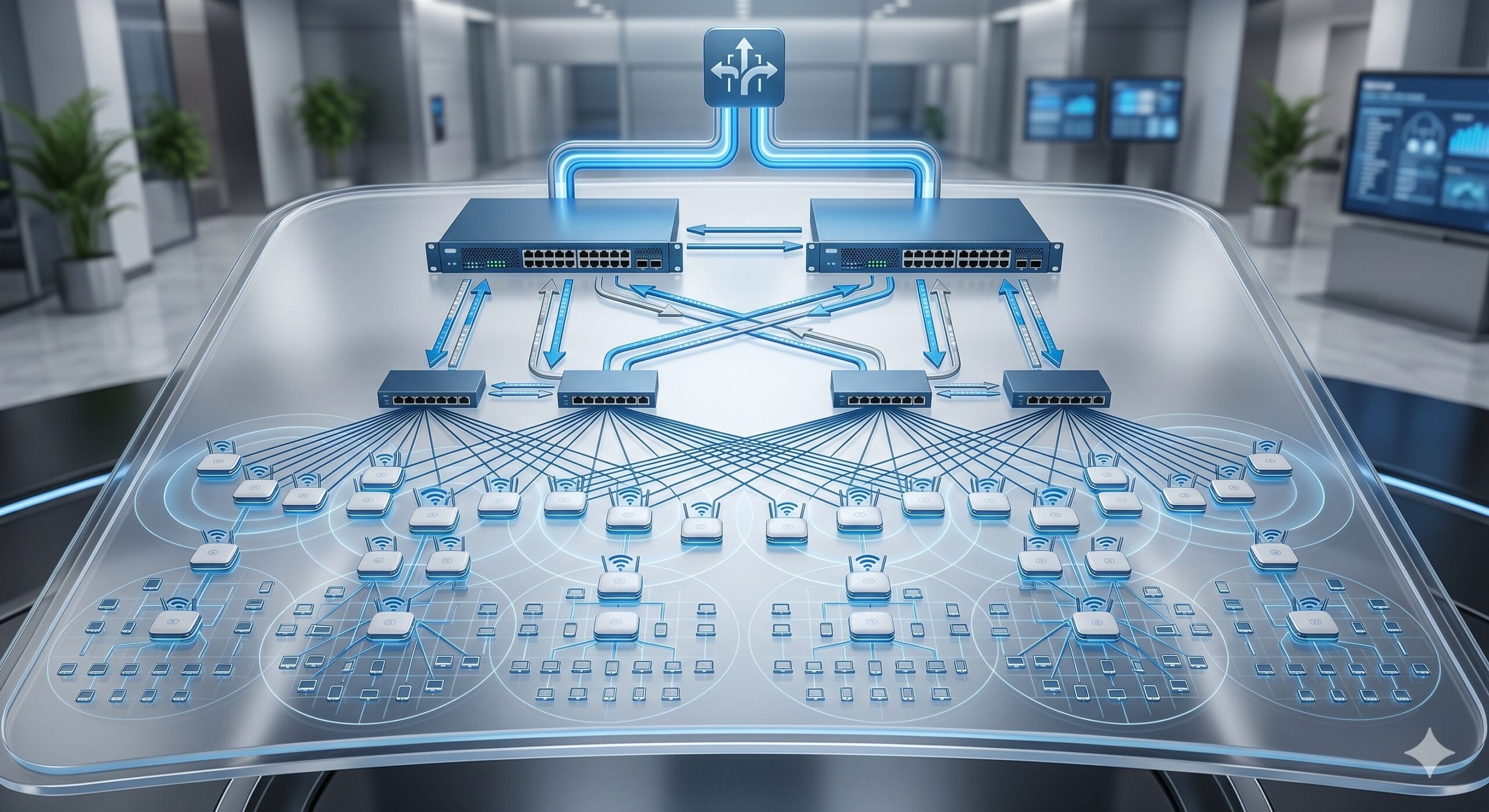
When evaluating wireless controller router price, network operations teams must quantify the cost of downtime. A controller with an MTBF of 50,000 hours (typical for entry-level) has a 3.6% annual failure rate (AFR). In a retail chain of 500 stores, that statistically means 18 controllers failing per year, each causing 4 hours of outage. At $5,000/hour lost revenue, the hidden operational cost is $360,000. Conversely, a controller built with N+1 power redundancy, Hitless Failover (SSO), and RAID-1 storage—priced at $12,000—achieves an MTBF >300,000 hours (0.6% AFR). This reduces annual failures to 3 units. The premium wireless controller router price pays for itself within 9 months in this scenario. Always request the manufacturer’s Telcordia SR-332 MTBF calculation. Additionally, verify IEEE 802.1Qay (PBB-TE) support for backbone resiliency if the controller acts as a router.
Total Cost of Ownership (TCO) Framework: Beyond the Sticker Price
1. Power Efficiency (Green Networking)
Data center Power Usage Effectiveness (PUE) regulations (e.g., EU Code of Conduct) penalize inefficient hardware. A high-performance controller might draw 150W idle, versus a bargain controller at 80W. However, if the high-performance unit processes 40 Gbps at 150W (3.75 W/Gbps) and the low-cost unit processes 2 Gbps at 80W (40 W/Gbps), the expensive unit is 10x more energy-efficient per Mbps. Over 5 years, at $0.12/kWh, the low-cost option consumes $4,204 more energy for 1/20th the throughput. This is the hidden pitfall of focusing only on upfront wireless controller router price. Look for 80 PLUS Titanium rated power supplies and support for IEEE 802.3az Energy-Efficient Ethernet (EEE) on all downlink ports.
2. Software & Subscription Economics
Examine the Right to Use (RTU) model. Some vendors offer a “hardware-free” wireless controller router price (virtual machine), but charge per AP per month. A physical controller with perpetual AP licenses often has a higher upfront CapEx but zero OpEx after year 1. Example: Vendor A: Controller hardware $6,000 + $300/AP perpetual = $36,000 for 100 APs. Vendor B: Virtual controller $0 + $15/AP/month + $5/feature/month = $24,000/year recurring. Over 3 years, Vendor B costs $72,000—double the physical controller’s TCO. Always model a 5-year horizon.
Conclusion: Architectural Verdict for Procurement
The wireless controller router price is a lagging indicator of true network value. For small businesses (redundant AC power, dedicated ASIC for CAPWAP, support for 10G uplinks, and MTBF >200,000 hours. Expect to pay between $7,000 and $25,000 for this class of hardware, plus $50-$150 per AP for perpetual licenses. Remember: the cheapest controller becomes the most expensive when downtime, latency, and energy inefficiency are calculated into the operational ledger. Use the data matrix above to benchmark every wireless controller router price quote against your throughput and reliability SLAs.

Leave a comment