
What this article covers: This comprehensive whitepaper provides an exhaustive technical analysis of the ZTE ZXDSL 9806H platform, focusing specifically on the SCCBK main control board. We dissect the architecture, uplink capabilities, switching capacity, and service provisioning parameters of this critical telecommunications hardware.
Why it matters now: As global network operators transition from legacy copper to fiber-optic infrastructures, finding cost-effective bridge technologies is paramount. The Fiber-to-the-Building (FTTB) and Fiber-to-the-Cabinet (FTTC) models rely heavily on robust Multi-Dwelling Units (MDUs) and compact DSLAMs. Understanding how to maximize the lifecycle of existing copper lines while integrating with EPON/GPON backhauls is a multi-million dollar optimization challenge for ISPs today.
How you can leverage this: By the end of this guide, network engineers and telecom procurement specialists will learn actionable strategies for configuring the ZXDSL 9806H:SCCBK for optimal Quality of Service (QoS), reducing operational expenditure (OPEX) through power-efficient deployments, and seamlessly integrating legacy ADSL2+/VDSL2 lines into next-generation optical distribution networks.
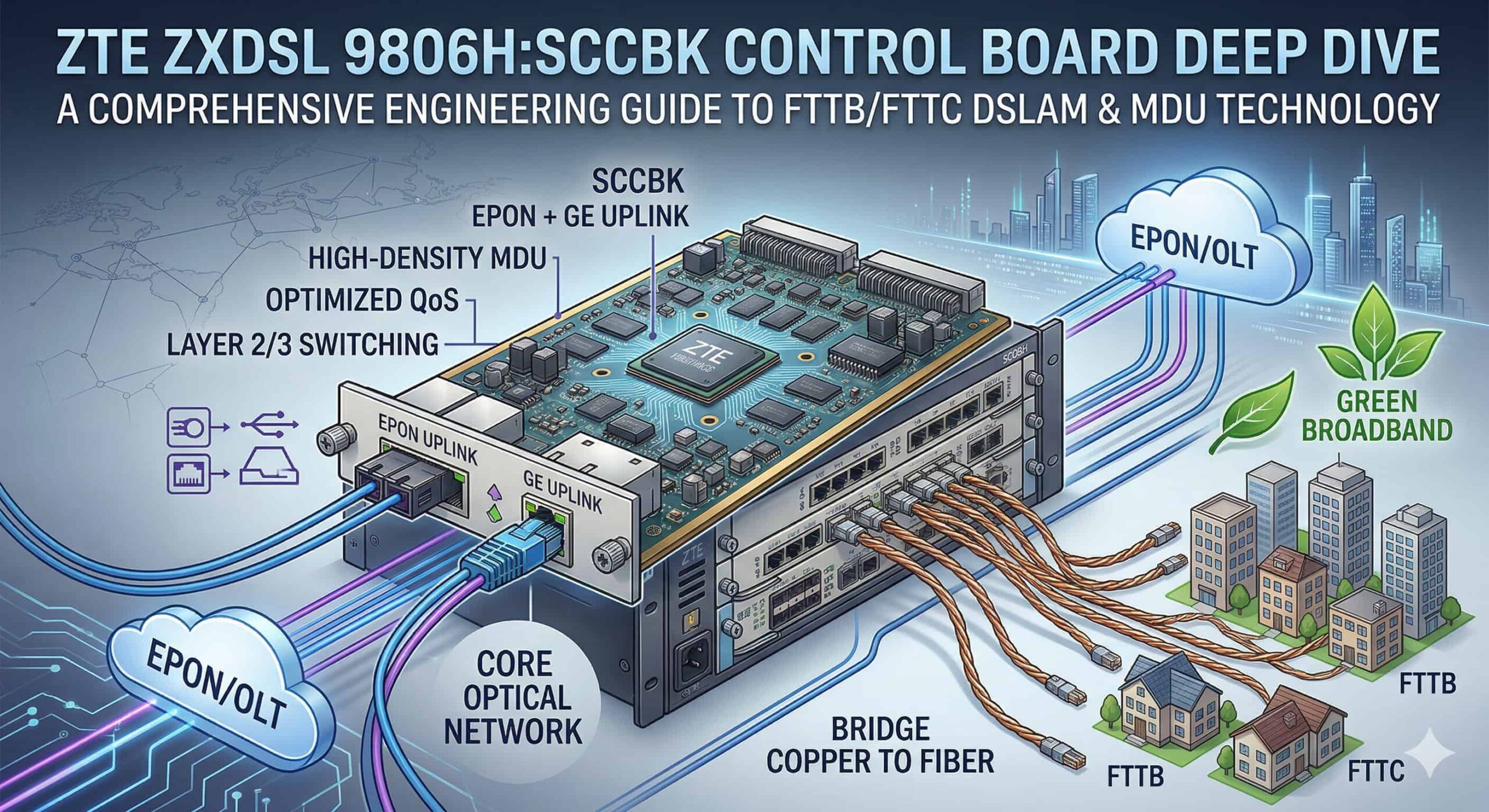
Introduction to FTTx Architectures and the Role of ZTE ZXDSL 9806H
The telecommunications landscape is undergoing a monumental shift. The insatiable demand for high-bandwidth applications—such as 4K/8K video streaming, cloud computing, and real-time interactive gaming—has pushed legacy infrastructure to its absolute limits. While Fiber-to-the-Home (FTTH) represents the ultimate end-state for broadband connectivity, the capital expenditure (CAPEX) required for a ubiquitous FTTH rollout is often prohibitive, particularly in densely populated urban environments with challenging right-of-way issues, or in historic buildings where drilling for new fiber drops is restricted.
This is where hybrid FTTx strategies, specifically Fiber-to-the-Building (FTTB) and Fiber-to-the-Cabinet (FTTC), become essential. By bringing the optical fiber close to the end-user and utilizing existing twisted-pair copper for the final few meters, operators can deliver ultra-broadband speeds at a fraction of the cost of FTTH.
The ZTE ZXDSL 9806H is uniquely positioned to serve as the linchpin in these hybrid networks. Functioning as a highly compact, multi-service Digital Subscriber Line Access Multiplexer (DSLAM) and Multiple Dwelling Unit (MDU), it aggregates traffic from various legacy interfaces and funnels it into a high-capacity optical uplink. It bridges the gap between the copper past and the fiber future. According to industry analyses, extending the life of copper infrastructure via advanced VDSL2 and vectoring technologies can save Tier 1 operators up to 40% in last-mile deployment costs (Source: Gartner Telecommunications Infrastructure Report, 2024).
Deep Dive into the ZXDSL 9806H Platform Architecture
To fully appreciate the capabilities of the SCCBK control board, one must first understand the chassis it governs. The ZXDSL 9806H is designed with space-constrained environments in mind, offering high port density within a remarkably small footprint.
Compact 2U Chassis Design and Form Factor
The physical dimensions of the ZXDSL 9806H are specifically engineered for versatility. Measuring 88.1 mm in height (2U), 482.6 mm in width (standard 19-inch rack mountable), and 240 mm in depth, the chassis can be deployed in standard telecommunications racks, outdoor street cabinets, desktop environments, or even wall-mounted configurations.
This 2U height is a critical differentiator. Traditional DSLAMs often require large, centralized office racks (sometimes taking up 10U or more), which limits their deployment strictly to central exchanges (COs). The ZXDSL 9806H breaks this limitation, allowing the aggregation point to be pushed deeper into the network edge.
The fully populated weight of the chassis is approximately 8.5 kg (with an empty frame weighing around 2.7 kg), making it relatively easy for a single field technician to install and maneuver. Heat dissipation is managed by an integrated fan tray module that provides intelligent, temperature-controlled forced air cooling. The fans dynamically adjust their rotating speed based on internal thermal sensors, which significantly reduces ambient noise and mechanical wear when the equipment is operating under nominal loads.
Modular Service Slot Configurations
The true power of the ZXDSL 9806H lies in its modular backplane. The chassis is divided into distinct functional slots:
-
1 Slot for the Power Supply Unit: Supporting either AC (110V/220V) or DC (-48V) inputs, ensuring compatibility with both centralized telecom battery arrays and standard commercial power grids.
-
1 Slot for the Control and Switching (C&S) Board: This is where the SCCBK or its variants (SCCT, SCCB) reside.
-
4 Slots for Service Line Cards: These universal slots accept a wide variety of subscriber interfaces.
Depending on the populated service boards, a single 2U chassis can support an incredibly dense concentration of users. For instance, utilizing the ASTGC service board yields 32 channels of ADSL2+ per slot, resulting in 128 ADSL2+ lines per chassis. Alternatively, utilizing modern VDSL2 boards can yield up to 96 high-speed lines. The platform also natively supports POTS (Plain Old Telephone Service) via VoIP gateways, supporting up to 256 voice channels, ensuring that legacy voice services are not left behind in the IP transition.
For procurement professionals looking to secure reliable broadband hardware, exploring complete configurations of the ZTE ZXDSL 9806H platform is crucial for ensuring hardware compatibility and optimal lead times.
The Core of the System: Understanding the SCCBK Main Control Board
While the service boards interface directly with the customer premises equipment (CPE), the SCCBK main control board is the undisputed brain and central nervous system of the ZXDSL 9806H. The part number for this specific iteration is typically denoted as AA24F11F.
The SCCBK board is responsible for three primary functions: central processing and system management, non-blocking traffic switching, and providing the uplink interfaces to the core optical network. Without a robust control board, the high-density service cards would suffer from massive bottlenecks and packet loss.
Technical Specifications and Hardware Footprint of SCCBK
The SCCBK board is engineered with precision, measuring 41.4 mm × 100 mm × 215 mm and weighing a mere 0.31 kg. Despite its small physical size, it houses a powerful ASIC (Application-Specific Integrated Circuit) fabric designed specifically for Layer 2 and Layer 3 packet processing.
Power consumption is heavily optimized, drawing approximately 11.50 W under standard operating conditions. This low power draw is essential for deployments in unconditioned outdoor cabinets where thermal loading is a major concern. When aggregated across tens of thousands of deployed nodes, the energy savings generated by the SCCBK’s efficient silicon footprint represent a substantial reduction in OPEX and align perfectly with modern “green broadband” sustainability initiatives.
Uplink Capabilities: Bridging Copper and Fiber via EPON and GE
The primary distinguishing feature of the ZXDSL 9806H:SCCBK variant compared to legacy control boards is its specific uplink configuration. The SCCBK natively integrates:
-
1 x EPON (Ethernet Passive Optical Network) Uplink Port
-
1 x GE (Gigabit Ethernet) Uplink Port
This dual-uplink capability provides tremendous architectural flexibility.
When deployed in an EPON network topology, the SCCBK allows the entire ZXDSL 9806H chassis to function essentially as a massive, multi-port Optical Network Unit (ONU). The EPON interface connects back to a centralized Optical Line Terminal (OLT), utilizing passive optical splitters. This point-to-multipoint architecture minimizes fiber utilization in the distribution network.
Alternatively, the Gigabit Ethernet (GE) port can be utilized for direct point-to-point active ethernet connections, cascading multiple DSLAMs together in a daisy-chain or ring topology, or connecting to legacy core routers that lack PON interfaces. The GE port also serves as a critical redundancy path; operators can implement Spanning Tree Protocol (STP) or Smart Protected Ring (SPR) to ensure that if the primary EPON link suffers a fiber cut, traffic seamlessly fails over to the GE link, minimizing subscriber downtime.
Switch Capacity, Backplane Architecture, and Traffic Management
The internal architecture of the ZXDSL 9806H relies on a high-speed star-topology backplane connecting the service slots to the SCCBK control board. The switching capacity managed by the SCCBK is rigorously tested to ensure line-rate, non-blocking forwarding for all subscriber ports simultaneously.
The control board supports extensive IP and Ethernet protocols essential for modern multi-play services (voice, video, and data):
-
VLAN Tagging and Stacking: Full support for IEEE 802.1Q VLANs and 802.1ad Provider Bridges (Q-in-Q). This allows ISPs to isolate subscriber traffic securely and manage distinct services (e.g., separating IPTV multicast traffic from standard internet data).
-
Multicast Capabilities: Given the massive bandwidth requirements of IPTV, the SCCBK supports IGMP V1/V2/V3 Snooping and IGMP Proxy. With support for up to 256 Multicast Groups, the board intelligently replicates video streams only to the ports that actively request them, drastically reducing backplane congestion. It also supports Multicast VLAN Registration (MVLAN) and Channel Access Control (CAC).
-
Layer 2 Security Protocols: Features including MAC address limiting, port isolation, and DHCP snooping prevent rogue devices from compromising the network integrity at the edge.
For a broader view of optical access equipment and to compare the SCCBK with other control boards across different vendors, enterprise buyers frequently consult comprehensive catalogs at telecomate.com.
Deployment Scenarios for ZXDSL 9806H:SCCBK in Modern Networks
The flexibility of the SCCBK control board enables the ZXDSL 9806H to be deployed across a diverse array of topological scenarios, solving unique geographical and economic challenges for telecommunications operators.
FTTB (Fiber-to-the-Building) and High-Density Multiple Dwelling Units
In dense urban environments, high-rise apartment complexes and massive office towers present a unique challenge. Running individual fiber strands from the basement to hundreds of separate units on different floors is labor-intensive, disruptive, and often rejected by building management.
The FTTB model resolves this. The operator brings a single high-capacity optical fiber into the basement or communications room of the building. This fiber connects to the EPON port on the SCCBK board. The ZXDSL 9806H then utilizes the building’s existing internal copper telephone wiring (often Category 3 or older) to deliver VDSL2 to each individual apartment. Because VDSL2 can easily achieve speeds exceeding 100 Mbps over very short loop lengths (under 300 meters), tenants receive fiber-like speeds without the disruption of a complete building rewire.
FTTC (Fiber-to-the-Cabinet) and Rural Broadband Expansion
In suburban and rural environments, subscriber density drops significantly. Running fiber directly to every isolated home is economically unviable. FTTC pushes the fiber edge out to a street cabinet serving a localized neighborhood.
The ZXDSL 9806H’s robust environmental tolerance (-30 °C to 60 °C) makes it ideal for outdoor cabinet installation. The SCCBK board manages the optical uplink back to the central office, while the service cards drive ADSL2+ or VDSL2 signals over the last mile of copper. This architecture allows ISPs to dramatically increase the broadband speeds offered to rural customers, bringing them up to modern regulatory standards without the immense CAPEX of trenching fiber down every country road. Furthermore, the SCCBK’s remote management capabilities mean that network engineers can troubleshoot issues without rolling a truck to a remote cabinet, saving significant maintenance costs.
Key Performance Indicators (KPIs) and Technical Advantages
When evaluating access network equipment, Network Architects rely on stringent KPIs. The combination of the ZXDSL 9806H chassis and the SCCBK control board excels in several critical performance categories.
Power Efficiency, Thermal Management, and Green Broadband
Power consumption represents a major ongoing OPEX for telecommunications operators. Legacy DSLAMs were notorious energy hogs. The ZTE 9806H platform was built from the ground up with a “green broadband” philosophy.
The SCCBK board itself consumes merely 11.50W. When the chassis is fully populated, a typical configuration (e.g., 128 lines of ADSL2+) consumes roughly 101 W, while a 96-line VDSL2 configuration consumes approximately 144 W. This translates to an incredibly low per-port power consumption average (often less than 1.5 Watts per port).
Furthermore, the system employs intelligent power management. The SCCBK can dynamically spin down ports that are not actively carrying traffic or negotiate lower power states during off-peak hours. The adjustable-speed fans also contribute to both power savings and a lower acoustic footprint, satisfying strict noise emission regulations for residential deployments.
Advanced Quality of Service (QoS) and Traffic Shaping
In the era of triple-play services (Voice over IP, High-Speed Internet, and IPTV), all packets are not created equal. A delayed data packet simply means a webpage loads a millisecond slower; a delayed VoIP packet results in jitter and dropped syllables, while delayed IPTV packets cause visible macro-blocking on the user’s television screen.
The SCCBK control board implements strict, hardware-level Quality of Service (QoS) mechanisms. It supports Class of Service (CoS) priorities based on the IEEE 802.1p standard, allowing the network to classify incoming traffic streams instantly.
Traffic scheduling queues utilize sophisticated algorithms such as:
-
SP (Strict Priority): Ensures real-time traffic (Voice) is always forwarded before any other data.
-
WRR (Weighted Round Robin): Allocates proportional bandwidth to different traffic classes to ensure low-priority data isn’t completely starved during high congestion.
-
SP+WRR: A hybrid approach that guarantees voice quality while fairly distributing the remaining bandwidth among video and data streams.
By classifying streams, applying rate limiting, and shaping traffic at the ingress point, the SCCBK ensures that Premium Service Level Agreements (SLAs) are strictly adhered to, protecting operator revenues and ensuring high customer satisfaction. (Source: Broadband Forum TR-126 Technical Report, 2023).
Configuration, Operation, and Maintenance (O&M) Protocols
Centralized Management via SNMP and CLI
The control board supports standard Simple Network Management Protocol (SNMP v1/v2/v3), allowing it to integrate seamlessly into third-party OSS/BSS (Operations Support Systems / Business Support Systems) or ZTE’s proprietary NetNumen management platform.
For granular, low-level configuration, engineers can access the Command Line Interface (CLI) securely via Telnet, SSH, or a direct local console connection. The CLI allows for rapid scripting and mass provisioning of subscriber profiles, significantly accelerating the turn-up time for new deployments.
Environmental Monitoring and Remote Diagnostics
Unattended remote cabinets are highly susceptible to environmental anomalies. The SCCBK control board integrates a comprehensive suite of environmental supervision tools. It can interface with external sensors to provide real-time alarms to the Network Operations Center (NOC) regarding:
-
Internal chassis temperature spikes.
-
Power supply voltage fluctuations or failures.
-
Cabinet door open/intrusion alarms (security).
-
Fan failures.
Furthermore, the board supports remote Internal and External POTS line testing and On-Line loop tests for broadband ports. This means a tier-2 support technician can remotely detect a short-circuit on a copper line miles away, accurately diagnosing the fault before dispatching a field technician.
Comparison: SCCBK vs. Other ZTE Control Boards (SCCT / SCCB)
When configuring the ZXDSL 9806H, selecting the correct control board is vital. ZTE offers several variants, primarily the SCCB, SCCBK, and SCCT. The choice depends heavily on the required uplink architecture and the specific service boards being deployed.
Below is a technical comparison table outlining the key differences between these core processing units:
| Feature / Dimension | SCCB (Legacy) | SCCBK (Current Focus) | SCCT (Advanced) |
| Primary Uplink Interface | GE (Gigabit Ethernet) | EPON + GE | GPON + GE (or 2x GE) |
| Target Network Topology | Active Ethernet / Point-to-Point | EPON Optical Distribution Networks | GPON Optical Distribution Networks |
| Max Switching Capacity | Lower capacity, suited for ADSL | Medium-High (Optimized for VDSL/ADSL) | Highest capacity, ready for heavy VDSL2 loads |
| VDSL2 Service Board Compatibility | Does NOT support VSTGC | Does NOT support VSTGC (Supports others) | Supports all VDSL2 boards including VSTGC |
| Power Consumption | ~10 W | 11.5 W | ~14 W |
| Ideal Deployment Scenario | Cascading legacy networks | FTTB/FTTC via EPON | FTTB/FTTC via GPON requiring massive bandwidth |
Note: A critical engineering constraint to remember is that both the SCCBK and SCCB control switching boards do not support the VSTGC service board (a specific 32-channel VDSL2 board). If the VSTGC board is required for your deployment, you must specify the SCCT control board. For specific board compatibilities and to avoid costly procurement errors, engineers should always verify configurations via detailed product sheets such as those available for the ZXDSL 9806H platform on Telecomate.
Future-Proofing Copper Networks: Strategies for Telecom Operators
The deployment of the ZXDSL 9806H with the SCCBK control board is not merely a stopgap measure; it is a strategic asset utilization strategy. By leveraging this hardware, operators can effectively future-proof their existing copper assets.
As standards like G.fast continue to mature, the copper loop distances required for gigabit speeds become shorter. The compact nature of the 9806H allows operators to deploy these units deep into the distribution point (FTTdp). The EPON uplink provided by the SCCBK ensures that the backhaul capacity is virtually unlimited and seamlessly integrated into the broader optical core.
Furthermore, the IPv6 readiness of the ZTE platform ensures that operators will not face IP exhaustion as the Internet of Things (IoT) exponentially increases the number of connected devices within standard homes and buildings. The hardware handles dual-stack IPv4/IPv6 deployments, mitigating the need for disruptive forklift upgrades in the near future.
Frequently Asked Questions (FAQs)
1. What is the primary function of the SCCBK board in the ZXDSL 9806H?
The SCCBK acts as the main control and switching unit for the ZXDSL 9806H chassis. It manages system processing, handles all Layer 2/3 traffic switching between service cards, and provides the EPON and GE optical uplink interfaces to connect the DSLAM to the core network.
2. Does the SCCBK control board support VDSL2 service cards?
Yes, the SCCBK supports high-speed VDSL2 service cards. However, there is a specific hardware limitation: it does not support the VSTGC (32-channel VDSL2) service board. If you require the VSTGC board, you must upgrade to the SCCT control board.
3. What is the maximum number of ADSL2+ subscribers a fully populated 9806H with an SCCBK can support?
Using a fully populated chassis (4 service slots) with 32-channel ADSL2+ service boards (like the ASTGC), the ZXDSL 9806H can support a maximum of 128 ADSL2+ subscribers from a single 2U node.
4. What uplink ports are available directly on the SCCBK board?
The SCCBK board natively features one EPON (Ethernet Passive Optical Network) port for connection to an optical splitter/OLT, and one standard GE (Gigabit Ethernet) port for active point-to-point connections or redundant ring topologies.
5. How much power does the SCCBK board consume?
The SCCBK control board is highly energy-efficient, drawing approximately 11.50 Watts of power during nominal operation. This contributes to the overall low power consumption of the 9806H chassis, making it ideal for solar-powered or remote outdoor cabinets.
6. Can the ZXDSL 9806H handle IPTV and video streaming traffic effectively?
Absolutely. The SCCBK board supports advanced multicast protocols, including IGMP V1/V2/V3 Snooping, IGMP Proxy, and Multicast VLAN Registration. This ensures that heavy IPTV multicast traffic is intelligently routed without congesting the system’s backplane.
7. What environmental conditions can the equipment operate in?
The ZXDSL 9806H platform is hardened for harsh environments. It supports an operating temperature range of -30 °C to 60 °C and an operating humidity range of 5% to 95% (non-condensing), making it perfect for non-climate-controlled street cabinets.
8. How is the SCCBK board managed remotely by network operators?
The board supports standard SNMP V1/V2/V3 for integration into centralized network management systems. It also provides secure Command Line Interface (CLI) access via Telnet or SSH for manual configuration, diagnostic testing, and remote loop testing.
Conclusion
The ZTE ZXDSL 9806H, powered by the sophisticated SCCBK control board, represents a masterful intersection of legacy support and forward-looking optical integration. For telecommunications operators tasked with delivering high-speed broadband in challenging, space-constrained, or economically restrictive environments, this 2U IP DSLAM platform offers unparalleled versatility.
By utilizing its EPON uplink capabilities, advanced thermal management, and robust QoS traffic shaping, engineers can successfully extend the profitable lifespan of existing copper networks while laying the groundwork for a fully optical future. Through careful deployment and configuration of the SCCBK’s features, ISPs can ensure carrier-grade reliability, drastically reduce OPEX, and meet the soaring bandwidth demands of modern consumers.
Ready to upgrade your access network infrastructure? Ensure you are sourcing certified, tested telecom hardware to prevent costly network downtime. Consult with engineering procurement specialists and explore detailed configuration options for the ZXDSL 9806H and its associated line cards today to secure your network’s future.

Leave a comment