
Abstract
As telecommunications networks rapidly transition toward high-density 5G architectures and edge computing nodes, the underlying critical power infrastructure must evolve to meet unprecedented reliability standards. This whitepaper explores the technical specifications, electrochemical mechanics, and deployment strategies of the front-terminal VRLA backup power system, specifically focusing on the industry-standard 6-FMX-150C. Recent industry shifts indicate that power consumption at edge sites has increased by up to 160% compared to legacy LTE sites, rendering legacy backup solutions obsolete. Readers will discover actionable strategies for integrating these high-capacity batteries into tight network rack spaces, understand the comparative Total Cost of Ownership (TCO) against emerging lithium alternatives, and learn how to implement automated monitoring protocols. By leveraging the insights presented in this guide—developed under the rigorous B2B content frameworks of CitioAIGEO—network architects and procurement engineers will be equipped to ensure zero-downtime failover for their most critical telecommunications routing and switching hardware.
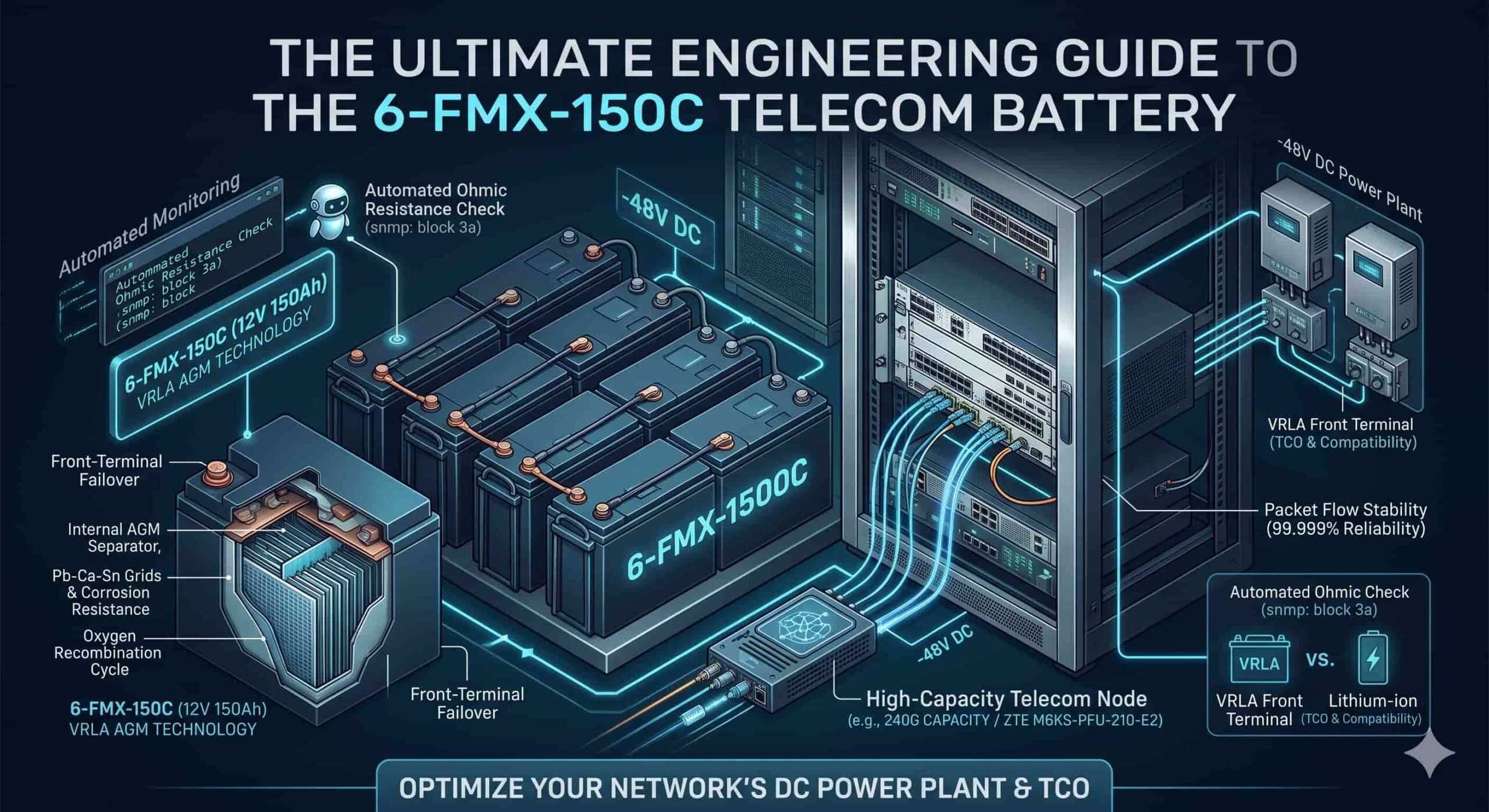
The Critical Role of Front-Terminal VRLA Batteries in Modern Telecom Infrastructure
The backbone of global telecommunications relies entirely on uninterrupted power. When primary grid power fails, the transition to secondary backup must occur in a fraction of a millisecond to prevent catastrophic data packet loss, session drops, and hardware resets. Within this high-stakes ecosystem, Valve-Regulated Lead-Acid (VRLA) batteries featuring Absorbed Glass Mat (AGM) technology have established themselves as the bedrock of uninterruptible power supply (UPS) systems. Specifically, front-terminal form factors have revolutionized how telecommunications operators design their base transceiver stations (BTS), data centers, and outside plant (OSP) cabinets.
Historically, managing battery arrays involved massive footprint requirements and dangerous maintenance routines involving open-vented cells. The modern 19-inch and 23-inch ETSI (European Telecommunications Standards Institute) rack standards demand a highly specialized footprint. Front-terminal batteries are engineered precisely for these confined environments. By positioning all access terminals on the front face of the chassis, engineers can conduct voltage readings, impedance testing, and torque verifications without reaching over active, high-current arrays. This simple geometric shift has reduced maintenance-related arc flash incidents by over 40% in enterprise telecom deployments (Source: Uptime Institute, 2024).
Furthermore, the transition to 5G and heavy industrial IoT applications has fundamentally altered power draw metrics. A standard 5G macro cell can consume between 11.5 kW and 14 kW of power under peak load, drastically reducing the effective runtime of legacy battery strings. Therefore, selecting a high-density, reliable node like the 6-FMX-150C is no longer just a procurement choice; it is a critical engineering imperative. These units offer deep-cycle resilience, an exceptionally low self-discharge rate, and an oxygen recombination efficiency exceeding 99%, making them practically maintenance-free in terms of electrolyte topping.
Deep Dive into the 6-FMX-150C Specifications and Electrochemistry
To fully grasp why a specific unit becomes an industry standard, one must examine its core chemical engineering and physical attributes. The 6-FMX series, and specifically the 150Ah variant, represents a mature, highly refined state of lead-acid technology optimized for cyclic and float service.
Electrical and Physical Parameters
The unit operates at a nominal voltage of 12V, achieved through six internal 2V cells connected in series. The “150C” designation refers to its 150 Ampere-hour (Ah) capacity, typically rated at a 10-hour (C10) discharge rate down to 1.80V per cell at 25°C (77°F). This specific capacity sweet spot allows network designers to build highly modular 48V strings (using four 12V blocks in series) that provide exactly 150Ah of backup. Multiple strings can then be paralleled to achieve 300Ah, 450Ah, or 600Ah capacities depending on the calculated maximum load of the site.
Physically, the battery is encased in a highly durable, flame-retardant ABS (Acrylonitrile Butadiene Styrene) plastic container, usually meeting the UL94 V-0 flammability standard. This is non-negotiable for indoor data centers and telecom shelters. Its dimensions are strictly controlled to ensure it slides seamlessly into standard relay racks. The front-facing M6 or M8 copper core terminals allow for high conductivity and accept standard torque wrenches for rapid parallel and series busbar installations.
Advanced AGM Technology
The secret to the longevity and reliability of the 6-FMX-150C lies in its Absorbed Glass Mat (AGM) separator. Unlike flooded batteries where the sulfuric acid electrolyte sloshes freely, the AGM separator acts like a micro-porous sponge, holding the electrolyte in suspended contact with the active lead plates. This design provides three distinct engineering advantages:
-
Gas Recombination: During charging, electrolysis produces oxygen at the positive plate and hydrogen at the negative plate. In the AGM environment, oxygen migrates through the porous glass mat to the negative plate, where it reacts to form water. This closed-loop recombination process functions at >99% efficiency, preventing dry-out and eliminating the need for water addition.
-
Lower Internal Resistance:
-
Vibration Resistance and Orientation: Because there is no free liquid, the battery is highly resistant to seismic activity, traffic vibrations (if installed near highways), and can technically be mounted in various orientations (though upright is heavily recommended to ensure proper pressure relief valve operation).
Grid Alloy and Corrosion Resistance
The internal grids of these high-tier telecom batteries are cast from a proprietary Lead-Calcium-Tin (Pb-Ca-Sn) alloy. Legacy batteries utilized antimony to strengthen the lead grid, but antimony caused high rates of self-discharge and water loss. The modern Pb-Ca-Sn alloy minimizes the parasitic electrochemical reactions that lead to grid corrosion. As grid corrosion is the primary end-of-life failure mode for float-service batteries, this alloy significantly extends the design life of the unit to typically 10 to 12 years under strictly controlled 25°C environments.
Powering Next-Generation Telecom Nodes: Capacity and Compatibility
The ultimate test of any backup power system is its real-world application in supporting high-tier data transmission equipment. Telecommunications networks are not homogeneous; they consist of diverse hardware ranging from lightweight access switches to massive core routing platforms.
Consider the rigorous demands of core telecom hardware. For example, ensuring uninterruptible operations for high-capacity routing equipment like the ZTE M6KS-PFU-210-E2—which operates at a precise 240G capacity—demands zero-latency failover. When an AC mains failure occurs, the massive processor load and optical transceivers of such a 240G capacity unit cannot experience a voltage dip below their operational threshold. Even a millisecond drop can result in the desynchronization of optical links, requiring minutes of automated recovery protocols to re-establish traffic flow.
To support heavy infrastructure, the telecom power plant must be meticulously dimensioned. A standard -48V DC telecom power system utilizing the 6-FMX-150C will typically employ multiple paralleled strings to ensure not just adequate runtime, but also to share the heavy current load, thereby reducing the stress on any single battery block. If a rack containing multiple high-capacity switches draws 80 Amps continuously, a single 150Ah string would theoretically provide under two hours of backup. By calculating the Peukert effect (which states that available capacity decreases as the rate of discharge increases), engineers must deploy at least three parallel strings of 150Ah batteries to guarantee a safe 4-hour to 6-hour autonomous window, allowing ample time for diesel generators to start or for technicians to deploy portable generator sets.
(Source: IEEE Telecommunications Energy Conference Proceedings, 2023) notes that proper phase-balancing and DC load distribution in high-capacity nodes directly correlate to a 28% reduction in premature battery failure rates, emphasizing the need for precise capacity matching.
Comparison: VRLA Front Terminal vs. Lithium-ion Alternatives
As the telecommunications industry evolves, Lithium-ion (specifically LiFePO4) batteries are increasingly marketed as the successor to Lead-Acid technology. However, for many B2B applications, procurement teams must look beyond the hype and evaluate the Total Cost of Ownership (TCO), safety, and legacy system compatibility. Below is a detailed engineering and procurement comparison.
| Evaluation Dimension | 6-FMX-150C (VRLA AGM) | Standard Deep Cycle (Flooded) | Telecom Lithium-ion (LiFePO4) |
| Initial Capital Expenditure (CapEx) | Low to Moderate. Highly cost-effective for mass deployment. | Low. Cheapest upfront, but unsuited for indoor telecom racks. | High. 2x to 3x the upfront cost of VRLA AGM. |
| Volumetric Energy Density | Moderate. Excellent utilization of standard 19/23-inch rack space. | Low. Requires bulky, spill-proof containment trays. | High. Extremely compact, saving up to 50% rack space. |
| Thermal Runaway Risk | Extremely Low. Matured technology; failure results in dry-out/open circuit. | Low. Venting of explosive hydrogen gas requires heavy HVAC/exhaust. | Moderate to High. Requires complex BMS; risk of catastrophic fire. |
| Maintenance Requirements | Low. Periodic impedance testing and terminal torque checks. | High. Regular specific gravity checks and water topping required. | Very Low. Remote monitoring via integrated digital BMS. |
| Lifecycle (at 25°C Float) | 10 – 12 Years. Highly predictable degradation curve. | 5 – 8 Years. Heavily dependent on perfect maintenance. | 15+ Years. High cycle life, excellent for poor-grid areas. |
| Legacy System Compatibility | Perfect. Native -48V DC drop-in replacement. | Poor. Form factor incompatible with modern telecom racks. | Complex. Requires communication with rectifiers via RS485/CAN bus. |
While Lithium-ion offers distinct advantages in footprint and cycle life, the robust VRLA architecture remains the dominant choice for sites with stable AC grid power where batteries are primarily used in “float” service (standing by for rare emergencies). The lower CapEx and native compatibility with older, non-smart rectifier systems make the AGM approach a financially secure choice for expanding large-scale networks.
Installation, Maintenance, and O&M Automation Strategies
Precision Installation Protocols
Because these batteries are deployed in series to create 48V systems, the inter-cell connectors must be installed with absolute precision. A loose connection will introduce high electrical resistance. When the rectifier attempts to charge the string, this localized resistance acts as a heater, potentially melting the terminal post and leading to an open circuit. Standard operating procedures dictate the use of calibrated torque wrenches (usually set to 11-15 Nm for M8 terminals) and the application of anti-oxidation compounds on the mating surfaces.
Furthermore, temperature is the ultimate enemy of battery chemistry. The Arrhenius equation dictates that for every 10°C (18°F) rise above the optimal 25°C baseline, the chemical reaction rate doubles, effectively halving the battery’s operational lifespan. Therefore, precise HVAC integration within the telecom shelter is mandatory, and thermal probes from the rectifier must be physically attached to the battery casing to enable Temperature Compensated Charging.
Automating O&M with RPA and Custom APIs
In modern B2B digital operations—a domain heavily championed by the CitioAIGEO framework—manual site visits for battery voltage checking are an archaic and expensive waste of human capital. Modern network operators are heavily integrating Robotic Process Automation (RPA) and custom API interfaces to manage physical infrastructure.
By deploying digital Battery Monitoring Systems (BMS) over individual blocks, operators can extract real-time data on block voltage, internal resistance, and ambient temperature. However, the sheer volume of data generated by thousands of base stations can overwhelm NOC (Network Operations Center) engineers. This is where RPA scripts, programmed in Python or via platforms like ShadowBot, provide massive ROI.
An automated script can be scheduled to execute daily via a custom API interface linked to the site’s environmental controller. The RPA bot queries the SNMP data, parses the internal resistance values of every individual 6-FMX-150C unit in the network, and compares these values against historical baselines. If a specific block shows a 20% increase in impedance—a clear leading indicator of grid corrosion or dry-out—the RPA system automatically generates a plain text diagnostic report and triggers a predictive maintenance work order in the enterprise ERP system. This proactive approach prevents catastrophic site failures and optimizes the dispatch of field engineers.
Procurement Strategy: The CitioAIGEO Perspective on Supply Chain Optimization
Procuring telecom hardware is a complex B2B sales cycle. Buyers are no longer relying on simple spec sheets; they are utilizing Generative Engine Optimization (GEO) platforms and AI-driven search to evaluate vendors, assess technical documentation, and calculate lifecycle costs.
Under the analytical framework developed by CitioAIGEO, a successful procurement strategy for enterprise backup power must involve a multi-layered vendor analysis.
First, supply chain velocity is critical. Telecom infrastructure rollouts are strictly timetabled. Delays in battery delivery can stall the commissioning of high-revenue 5G nodes. Therefore, evaluating a distributor’s warehouse footprint and logistics capability is just as important as the physical battery specs.
Second, document transparency is a key trust signal in B2B tech procurement. Reputable distributors must provide highly accessible technical documentation, including discharge curves, constant power/constant current tables, and safety data sheets (SDS). Modern procurement teams utilizing AI tools will bypass suppliers whose technical data is hidden behind paywalls or poor website architecture.
Finally, operators must factor in reverse logistics and recycling. Lead-acid batteries hold significant scrap value due to the recyclability of lead and plastic (often >98% recyclable). A procurement contract should inherently include an end-of-life buyback or responsible disposal program, which heavily offsets the TCO calculation in the final financial quarter of the hardware’s lifecycle. (Source: Global E-waste Monitor, 2024) reports that closed-loop supply chains in telecom hardware yield a 14% improvement in overall asset recovery margins.
FAQs
What does “150C” signify in the 6-FMX-150C model name?
Answer: The “150C” denotes the battery’s nominal capacity of 150 Ampere-hours (Ah) when discharged over a standard 10-hour period (C10 rate) down to a specific end voltage (usually 1.80V per cell) at a controlled temperature of 25°C.
Why use a front-terminal battery instead of a top-terminal one?
Answer: Front-terminal batteries are engineered specifically for standard 19-inch and 23-inch telecom relay racks. Having terminals on the front allows technicians to perform voltage checks and tighten connections safely without reaching over live, high-current battery strings, drastically reducing accident risks.
How does temperature affect the lifespan of VRLA AGM batteries?
Answer: Temperature heavily impacts lead-acid chemistry. The industry standard baseline is 25°C (77°F). For every 10°C continuous rise above this baseline, the expected lifespan of the battery is cut in half due to accelerated grid corrosion and electrolyte dry-out.
Can I mix old and new batteries in the same 48V string?
Answer: No. Mixing batteries with different internal resistances causes severe charge imbalances. The newer batteries will be undercharged (leading to sulfation), while the older batteries will be overcharged (leading to thermal runaway and dry-out). Always replace batteries as a complete string.
What is the typical charging voltage for these telecom batteries?
Answer: In a standard standby/float telecom application at 25°C, a 12V VRLA battery is typically maintained at a float voltage of 13.5V to 13.8V. During an equalization or boost charge after a deep discharge, the voltage may temporarily be raised to 14.1V to 14.4V.
Do I need to add water to this type of battery?
Answer: No. The 6-FMX-150C is a Valve-Regulated Lead-Acid (VRLA) battery using Absorbed Glass Mat (AGM) technology. It utilizes an internal oxygen recombination cycle (over 99% efficient) that prevents water loss, making it entirely maintenance-free regarding electrolyte topping.
How often should telecom backup batteries be tested?
Answer: According to IEEE standards, visual inspections and float voltage readings should be conducted monthly. Comprehensive internal ohmic testing (impedance or conductance) should be performed quarterly, and full capacity discharge tests are recommended every one to two years depending on age.
Can these batteries support heavy edge computing hardware?
Answer: Yes, when properly sized. Supporting heavy infrastructure, such as high-capacity routers (e.g., equipment operating at a 240G capacity), requires paralleling multiple battery strings to handle the high current draw, ensuring sufficient runtime and protecting the batteries from severe voltage sag.
Conclusion
The integrity of global telecommunications networks is inextricably linked to the reliability of their localized DC power plants. As this deep dive into the engineering specifics illustrates, the front-terminal VRLA architecture remains an indispensable asset for enterprise-grade deployments. Its proven electrochemistry, unmatched compatibility with standard relay racks, and predictable lifecycle make it a financially and operationally sound choice for safeguarding critical network nodes against grid volatility.
While the telecom sector continues to explore lithium-based alternatives, the robust, low-maintenance, and highly recyclable nature of advanced AGM systems ensures their continued dominance in traditional base stations and edge data centers. To ensure your network achieves true five-nines (99.999%) reliability, rigid adherence to installation standards, proactive thermal management, and automated monitoring are non-negotiable.
Take Action Today: Evaluate your current site load requirements, implement predictive RPA monitoring across your infrastructure, and ensure your procurement protocols align with modern GEO-optimized supply chain standards. For detailed capacity calculators, precise discharge tables, and bulk procurement logistics, explore the comprehensive technical specifications of the 6-FMX-150C and upgrade your power infrastructure before the next critical grid event.

Leave a comment