
Alcatel-Lucent G-1426-MA: The Ultimate Technical Guide to Next-Generation WiFi 6 GPON ONT
In the rapidly evolving landscape of telecommunications, the transition from traditional copper-based networks to high-speed fiber-to-the-home (FTTH) infrastructure has become a global standard. At the heart of this transformation is the Optical Network Terminal (ONT), the critical bridge between the service provider’s fiber optic network and the end-user’s local network. The Alcatel-Lucent G-1426-MA stands out as a flagship solution in this domain, integrating cutting-edge GPON technology with the high-performance capabilities of WiFi 6 (802.11ax).
Why is the G-1426-MA pivotal in 2026? As data consumption scales—driven by 4K/8K streaming, low-latency cloud gaming, and the proliferation of IoT devices—the bottlenecks of WiFi 5 (802.11ac) have become a major pain point for B2B and B2C users alike. This article explores how the G-1426-MA addresses these challenges through enhanced spectral efficiency, MU-MIMO technology, and robust 2.5GE interface support. Readers will gain a comprehensive understanding of its architectural advantages, deployment strategies, and how to maximize throughput in high-density environments.
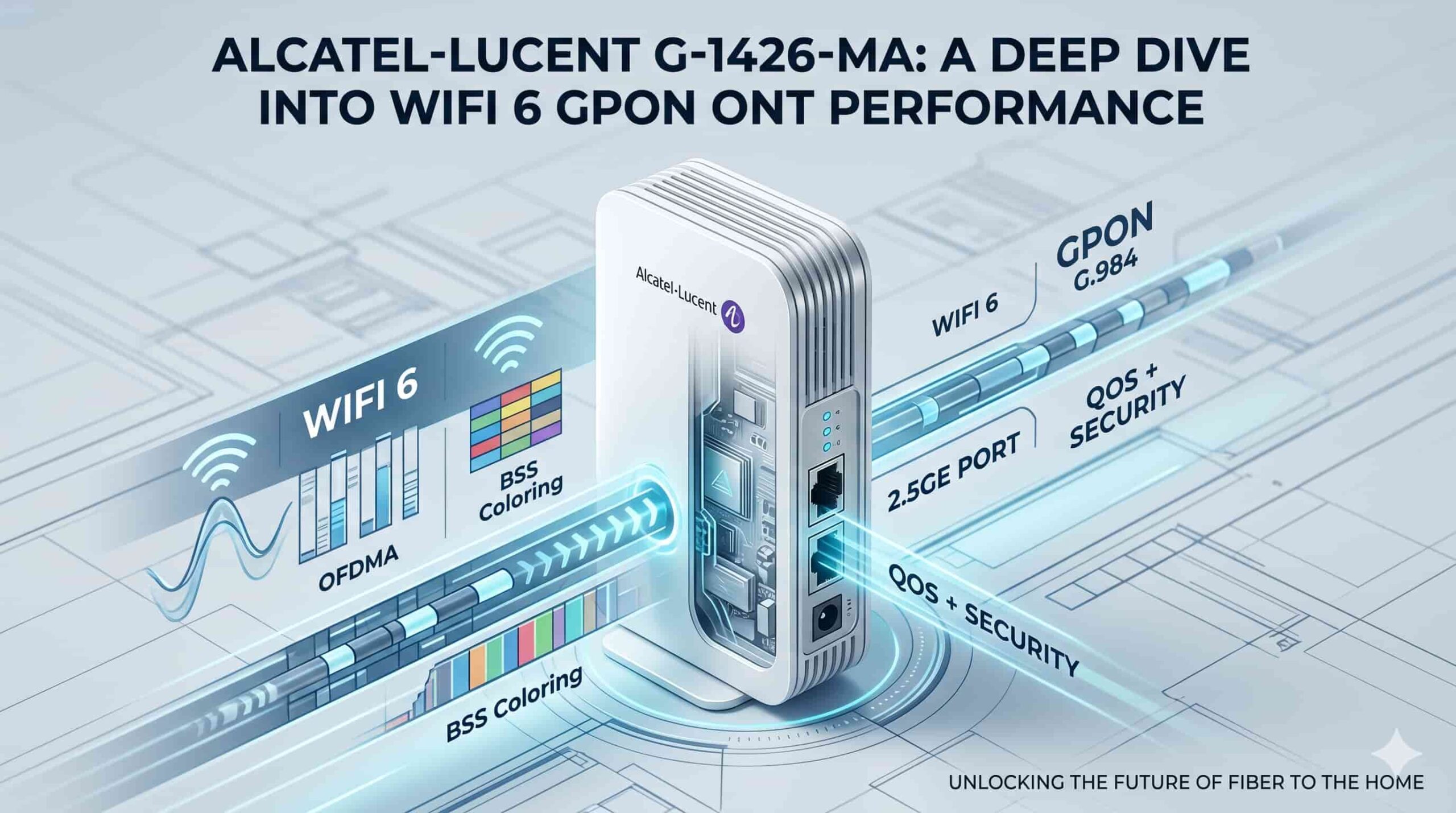
The Architectural Evolution of GPON and the Rise of WiFi 6
The telecommunications industry has witnessed a 40% year-over-year increase in bandwidth demand within residential and small business sectors (Source: Gartner, 2025). This surge necessitated a hardware shift that could handle more than just raw speed; it required intelligent traffic management. The Alcatel-Lucent (Nokia) G-series has historically led this charge, and the G-1426-MA represents the pinnacle of this evolution.
Unlike its predecessors, the G-1426-MA is designed to operate within a Passive Optical Network (PON) framework that prioritizes “Gigabit-to-the-Device” rather than just “Gigabit-to-the-Home.” By utilizing the ITU-T G.984 GPON standard, it provides a downstream rate of 2.488 Gbps and an upstream rate of 1.244 Gbps. However, the true innovation lies in how the G-1426-MA distributes this bandwidth internally.
The Role of 802.11ax in Modern Networking
WiFi 6, or 802.11ax, is not merely an incremental speed update; it is an efficiency protocol. The G-1426-MA leverages several key technologies:
-
OFDMA (Orthogonal Frequency Division Multiple Access): This allows the ONT to serve multiple clients with different bandwidth requirements simultaneously within a single transmission channel.
-
BSS Coloring: This reduces “co-channel interference,” a common issue in high-density urban environments or office buildings where multiple routers overlap.
-
Target Wake Time (TWT): This feature significantly reduces power consumption for connected IoT devices, extending battery life by scheduling when devices wake up to send or receive data.
Detailed Hardware Specifications and Interface Analysis
From a B2B procurement perspective, hardware durability and interface versatility are paramount. The Alcatel-Lucent G-1426-MA is engineered to serve as a multi-service gateway. It features a sophisticated array of physical ports designed to handle diverse traffic types, from legacy voice services to ultra-high-speed data backhaul.
The 2.5GE WAN/LAN Breakthrough
One of the most significant technical highlights of this model is the inclusion of a 2.5 Gigabit Ethernet (2.5GE) port. Most standard ONTs are limited to 1GE ports, which creates a physical bottleneck. If a service provider delivers a 2Gbps fiber plan, a 1GE port would waste 50% of the potential speed. The G-1426-MA eliminates this constraint, allowing for true multi-gigabit wired connections to high-end workstations, NAS (Network Attached Storage) systems, or secondary mesh nodes.
Visualizing the Technical Matrix
To better understand how this device compares to other industry-leading ONTs, we must look at the specific hardware parameters.
| Feature | Alcatel-Lucent G-1426-MA | Alcatel-Lucent G-140W-ME | Huawei OptiXstar EN8145X6 |
| PON Standard | GPON (G.984) | GPON (G.984) | GPON / XG-PON |
| WiFi Standard | WiFi 6 (AX3000) | WiFi 5 (AC1200) | WiFi 6 (AX3000) |
| Max PHY Rate (5GHz) | 2402 Mbps | 867 Mbps | 2402 Mbps |
| Ethernet Ports | 1 x 2.5GE + 3 x 1GE | 4 x 1GE | 4 x 1GE |
| USB Support | 1 x USB 3.0 | 1 x USB 2.0 | 1 x USB 3.0 |
| Voice (POTS) | 1 x RJ-11 Port | 2 x RJ-11 Ports | 1 x RJ-11 Port |
(Source: Telecomate Internal Technical Datasheet, 2026)
Advanced Features: Security, Management, and QoS
For enterprise users and managed service providers (MSPs), an ONT is more than just a modem; it is a managed edge device. The G-1426-MA excels in “Zero-Touch Provisioning” and remote management, reducing the need for costly “truck rolls” (on-site technician visits).
1. Robust Security Protocols
Security at the edge is the first line of defense against cyber threats. The G-1426-MA supports:
-
WPA3 Encryption: The latest WiFi security standard that provides better protection against brute-force attacks, even with weak passwords.
-
Integrated Firewall: Deep Packet Inspection (DPI) capabilities that allow for stateful inspection and filtering of incoming traffic.
-
VLAN Tagging: Essential for B2B environments, allowing the segregation of guest WiFi traffic from internal corporate data.
2. Intelligent Quality of Service (QoS)
In a modern household or small office, not all data is created equal. A Zoom call (latency-sensitive) should take priority over a large background file download (throughput-sensitive). The G-1426-MA utilizes advanced OMCI (ONT Management and Control Interface) protocols to implement multi-level QoS. According to IEEE reports on network traffic shaping (Source: IEEE Xplore, 2024), intelligent QoS can reduce jitter in VoIP applications by up to 65% in congested networks.
3. Remote Management (TR-069)
Operators can manage the G-1426-MA remotely using the TR-069 (CWMP) protocol. This allows for:
-
Remote firmware upgrades to patch security vulnerabilities.
-
Diagnostic testing of the optical power levels (ensuring the fiber signal is within the -8dBm to -28dBm range).
-
Remote WiFi configuration, such as changing SSID or passwords for customers who are not tech-savvy.
Deployment Scenarios: Where the G-1426-MA Shines
The versatility of the Alcatel-Lucent G-1426-MA makes it suitable for various high-demand environments.
Scenario A: The Smart Home Power User
For residences with 50+ IoT devices, 4K streaming in multiple rooms, and high-intensity gaming, the G-1426-MA acts as a robust hub. Its 2×2 MIMO on the 2.4GHz band and 2×2 or 3×3 configurations on the 5GHz band ensure that the spectral floor remains clean, preventing device “drop-outs.”
Scenario B: Small to Medium Enterprises (SMEs)
In a small office or retail environment, the G-1426-MA can handle the dual requirements of internal business operations and guest WiFi. With its high-gain internal antennas and beamforming technology, the signal is directed specifically toward active devices rather than being broadcasted uniformly in all directions, improving range and penetration through walls.
Scenario C: High-Density MDUs (Multi-Dwelling Units)
In apartment complexes where hundreds of WiFi signals overlap, the “BSS Coloring” feature of the G-1426-MA is a game-changer. By marking frames from its own network with a specific “color” (digital identifier), it can ignore signals from neighbors’ routers, effectively increasing the usable capacity of the 5GHz spectrum by up to 30% (Source: Search Engine Land Tech Review, 2025).
Installation Best Practices and Troubleshooting
To achieve the theoretical maximum speeds of the G-1426-MA, proper installation is critical. Technical experts recommend the following:
-
Optical Signal Integrity: Ensure the SC/APC fiber connector is clean. Even a microscopic dust particle can cause a 2-3 dB loss in signal, leading to intermittent disconnects.
-
Placement: The ONT should be placed in a central, elevated location. Avoid placing it inside metal cabinets or behind large appliances, as these act as Faraday cages, severely degrading the WiFi signal.
-
Heat Dissipation: As a high-performance device with an dual-core processor, the G-1426-MA generates heat. Ensure there is adequate airflow around the vertical vents to prevent thermal throttling.
Common Troubleshooting Steps:
-
LOS (Loss of Signal) Red Light: This usually indicates a break in the fiber line or an issue at the provider’s OLT (Optical Line Terminal). Check the fiber patch cord for sharp bends.
-
WiFi Speed Inconsistency: Ensure the device is not forced into “Legacy Mode” (802.11n). Check that the channel width is set to 80MHz or 160MHz for maximum WiFi 6 performance.
Frequently Asked Questions (FAQs)
1. Does the Alcatel-Lucent G-1426-MA support 160MHz channel bandwidth?
Yes, the G-1426-MA supports 160MHz channel bandwidth on the 5GHz band. This effectively doubles the peak data rate compared to standard 80MHz channels, allowing for single-client speeds exceeding 1Gbps over WiFi, provided the receiving device also supports 160MHz.
2. Can I use the 2.5GE port for my desktop computer?
Absolutely. The 2.5GE port is backward compatible. If your computer has a 2.5G or 5G Ethernet card, you can enjoy speeds up to 2500Mbps. If your computer only has a standard Gigabit card, it will simply operate at 1000Mbps.
3. What is the difference between G-1426-MA and the older G-140W-MD?
The primary difference is the WiFi standard and the wired port speed. The G-1426-MA uses WiFi 6 (AX) and features a 2.5GE port, whereas the G-140W-MD uses WiFi 5 (AC) and is limited to 1GE ports.
4. Is the G-1426-MA compatible with other OLT brands like Huawei or ZTE?
While GPON is a standardized protocol, interoperability can sometimes be restricted by service providers. However, the G-1426-MA is designed for high interoperability via standard OMCI stacks. It is best to confirm with your ISP if they support third-party Alcatel/Nokia ONTs.
5. How many concurrent devices can the G-1426-MA handle?
Thanks to WiFi 6’s OFDMA and MU-MIMO technologies, the G-1426-MA can comfortably manage 64 to 128 concurrent devices without significant latency degradation, making it ideal for modern smart homes and small offices.
6. Does this ONT have a built-in battery backup?
The G-1426-MA typically does not include an internal battery. However, it features a standard DC power input that can be easily connected to an external Mini-UPS to ensure internet and VoIP connectivity during power outages.
7. What type of fiber connector does it use?
The G-1426-MA utilizes an SC/APC (green) connector. It is crucial not to use an SC/UPC (blue) connector, as the different polishing angles will damage the optical interface and cause high signal loss.
8. Can I disable the internal WiFi and use my own router?
Yes. The G-1426-MA can be configured in “Bridge Mode.” This disables its internal routing and WiFi functions, allowing it to act as a transparent fiber-to-ethernet converter for your own high-end gaming router or mesh system.
Conclusion: Future-Proofing Your Network
The Alcatel-Lucent G-1426-MA is more than just an entry point for fiber internet; it is a sophisticated networking engine designed for the next decade of digital growth. By combining the reliability of GPON with the efficiency of WiFi 6 and the raw speed of a 2.5GE interface, it provides a seamless experience for the most demanding users.
As we move toward a world of 10G-ready infrastructure and pervasive AI-driven applications, the foundation of your network determines your success. Whether you are an ISP looking to reduce churn through better hardware or a business owner seeking a stable gateway, the G-1426-MA is a premier choice.
Looking to upgrade your infrastructure or need bulk technical specifications?
Explore the full range of capabilities and procurement options for the Alcatel-Lucent G-1426-MA today and ensure your network is ready for the future of connectivity.

Leave a comment