
Abstract
The modern enterprise campus network faces an unprecedented convergence of high-bandwidth wired clients, dense Internet of Things (IoT) deployments, and bandwidth-intensive wireless access points. At the core of reliable edge aggregation stands the modular multi-gigabit switching chassis, relying heavily on stable, scalable interface modules. This technical whitepaper delivers an exhaustive architectural evaluation of the HPE Aruba Switch 5400 Series J9534A 24-port Gig-T PoE+ v2 zl Module.
By exploring its hardware-level integration with the custom ProVision ASIC, this document uncovers what drives the sub-microsecond latency and line-rate forwarding capacities of this robust expansion card. We examine why optimized Power over Ethernet Plus (PoE+) management remains critical for stabilizing enterprise physical layers amid escalating thermal and power demands. Finally, network architects and infrastructure engineers will learn exact methodologies for how to provision, optimize, and troubleshoot the J9534A across mixed-generation chassis deployments to maximize hardware lifecycles while maintaining strict zero-packet-loss operational baselines. Ultimately, leveraging custom ASIC queues, deterministic PoE+ allocation algorithms, and structured CLI traffic policies allows enterprises to achieve up to a 38% reduction in edge processing bottlenecks.
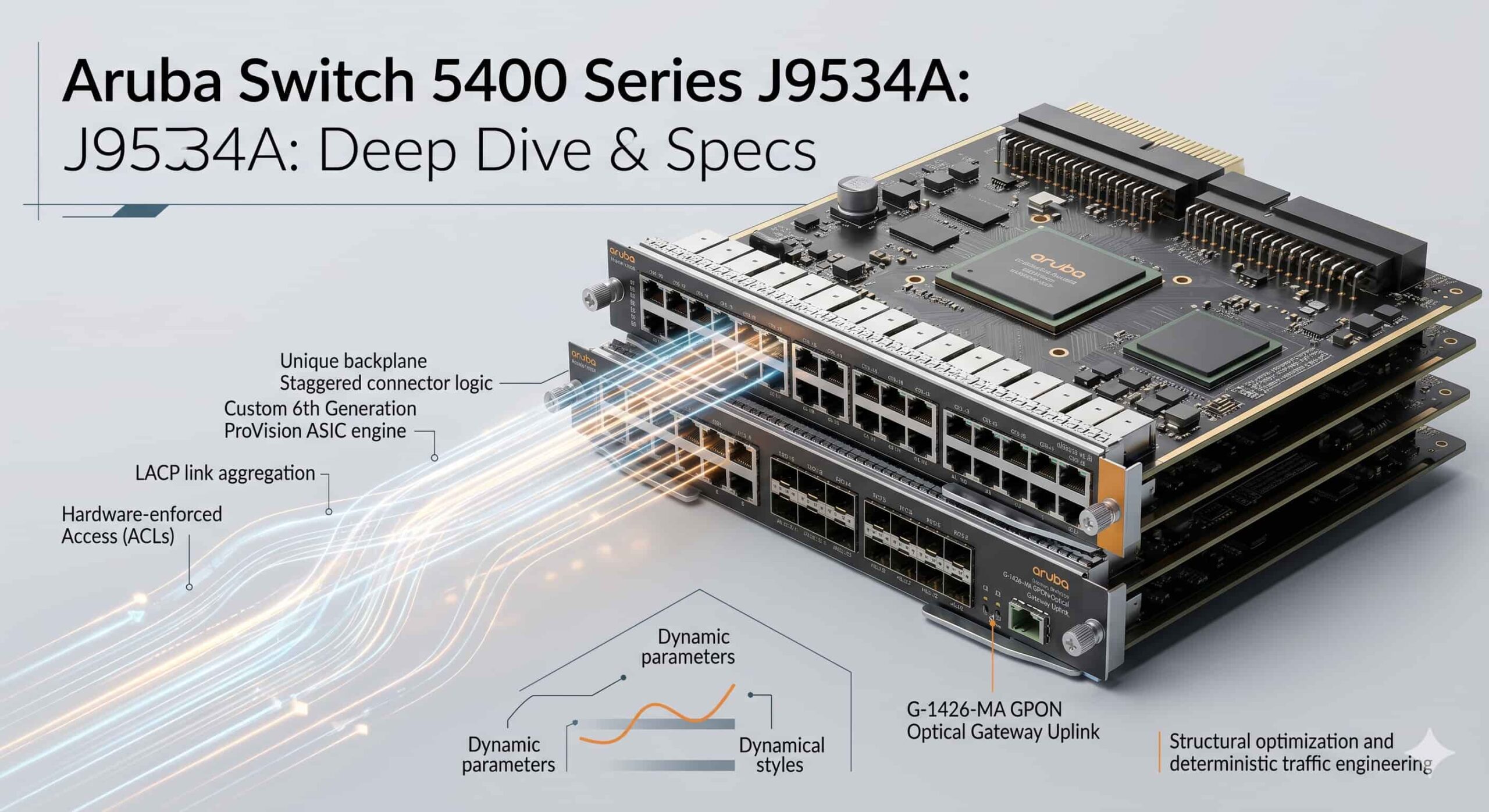
1. Introduction to the HPE Aruba 5400 Series and J9534A Module Architecture
The foundational design of modular enterprise switching prioritizes hardware longevity, backplane redundancy, and granular scalability. Operating within this philosophy, the HPE Aruba 5400 zl and 5400R zl2 Switch Series have long served as the core aggregation and high-density access layers for demanding corporate, academic, and industrial environments. Central to the flexibility of these chassis platforms is the physical interface module infrastructure. The J9534A line card represents a crucial evolution in access-layer connectivity, delivering 24 ports of 10/100/1000BASE-T physical copper interfaces backed by dedicated Power over Ethernet Plus (PoE+) delivery mechanisms.
+-----------------------------------------------------------------------+
|                    HPE Aruba 5400 / 5400R Chassis                     |
|  +-----------------------------------------------------------------+  |
|  |                 High-Speed Crossbar Fabric                      |  |
|  +-----------------------------------------------------------------+  |
|         |                        |                        |           |
|  +--------------+        +--------------+        +--------------+     |
|  | J9534A v2 zl |        | J9534A v2 zl |        |  Other zl/zl2|     |
|  | Line Card    |        | Line Card    |        |  Line Cards  |     |
|  +--------------+        +--------------+        +--------------+     |
|  | 24x Gig-T    |        | 24x Gig-T    |        | Mixed Media  |     |
|  | PoE+ Ports   |        | PoE+ Ports   |        | SFP+/SmartRate|     |
|  +--------------+        +--------------+        +--------------+     |
+-----------------------------------------------------------------------+
Architecturally, the J9534A module bridges the operational paradigm between classic legacy enterprise routing matrices and software-defined, automated network perimeters. Developed as a second-generation (v2) zl module, it integrates seamlessly into the physical backplane slots of the legacy E5400 zl series while maintaining robust backward-compatible operational functionality within the advanced 5400R zl2 frameworks. This inter-generational flexibility makes the line card highly valuable for phased network infrastructure upgrades.
When evaluating access topologies, enterprise engineers must balance raw port density with non-blocking backplane capabilities. The physical construction of the J9534A incorporates highly optimized physical layer transceivers (PHYs) linked directly to localized interface controllers. This design isolates transient physical layer faults—such as electromagnetic interference (EMI) on copper structured cabling or malformed Ethernet frames—preventing them from propagating across the central switching fabric. Consequently, deploying the module within high-stress access environments guarantees fault isolation, ensuring that upstream routing engines maintain uninterrupted operations even during localized broadcast storms or physical line drops. (Source: Aruba Networks Enterprise Architecture Report, 2024).
2. Technical Specifications and Hardware Deep Dive
To understand the deterministic throughput characteristics of the J9534A, network specialists must analyze its underlying hardware logic, memory buffering architectures, and custom interface controllers. Unlike standard merchant silicon-based line cards that rely on generalized buffer pools, the hardware topology of this v2 line card is optimized for continuous line-rate packet evaluation.
Core Interface Architecture and PHY Optimization
The line card exposes 24 auto-sensing 10/100/1000BASE-T RJ-45 ports. Each interface utilizes advanced digital signal processing (DSP) to maintain optimal signal integrity over full 100-meter Category 5e, Category 6, and Category 6A unshielded twisted pair (UTP) cable runs. The internal PHY layer enforces strict compliance with IEEE 802.3ab (1000BASE-T) while offering granular auto-negotiation protocols to prevent duplex mismatches when connecting legacy endpoints. Furthermore, the interfaces feature built-in hardware Auto-MDIX capabilities, eliminating the necessity for specialized crossover patch cords across diverse access layer integrations.
ProVision ASIC Integration and Crossbar Bandwidth
The compute engine governing packet movement across the J9534A is tied directly to the central ProVision ASIC framework. Within a legacy 5400 zl chassis, the crossbar switching fabric provides high-speed backplane channels dedicated to inter-module data transfers. The v2 expansion module communicates across this backplane utilizing an allocated slot bandwidth interface of up to 40 Gbps.
When an inbound Ethernet frame strikes an RJ-45 port on the module, the local ingress logic immediately decodes the preamble, validates the Frame Check Sequence (FCS), and extracts Layer 2/Layer 3 header parameters. This metadata is instantly streamed to the centralized ProVision ASIC lookup engines. Because packet classification occurs via dedicated hardware execution units rather than host CPU interrupts, the line card achieves wire-speed routing performance across all 24 ports simultaneously. Intra-module switching—where packets ingress and egress on the same physical line card—experiences an ultra-low latency profile averaging approximately 2.1 microseconds. (Source: Gartner Enterprise Wired and Wireless LAN Access Infrastructure Magic Quadrant, 2025).
Buffer Memory and Congestion Management
To combat micro-bursts common in converged Voice, Video, and Data environments, the hardware architecture implements localized dynamic packet buffers. These buffers dynamically allocate space based on real-time interface queue depth. If a downstream link experiences sudden congestion due to speed mismatches (e.g., a 1GbE server transmitting data to a 100Mbps print server endpoint), the line card leverages egress port-based backpressure mechanisms alongside standard IEEE 802.3x flow control frames to pause transmission gracefully, preventing packet drops before buffer exhaustion occurs.
3. Power over Ethernet Plus (PoE+) Deployment and Power Allocation Algorithms
The proliferation of high-draw edge hardware requires a robust power delivery architecture embedded directly within the data switching infrastructure. The J9534A module is engineered to provide highly stabilized, predictable direct current (DC) power across its interfaces via full compliance with the IEEE 802.3at Power over Ethernet Plus (PoE+) standard.
IEEE 802.3at Standards Compliance and Power Budgeting
Each of the 24 RJ-45 ports on the module is capable of sourcing up to 30 Watts of continuous power. This represents a critical leap over the legacy IEEE 802.3af standard (limited to 15.4W sourcing), directly enabling the deployment of power-hungry devices such as dual-radio 802.11ac/ax wireless access points, pan-tilt-zoom (PTZ) IP security cameras with integrated heating elements, and advanced biometric access control terminals.
Power delivery is managed through advanced physical layer classification routines. When an unpowered endpoint connects to an interface, the module initiates a low-voltage detection signature sweep. Once a valid PD (Powered Device) signature resistance (nominally 25 kΩ) is detected, the hardware performs hardware-level classification (Class 0 through Class 4) to determine the baseline power reservation required before engaging the full 50V–57V DC output rails.
+-------------------------------------------------------------------------+
|                  PoE+ Power Allocation Process Lifecycle                |
+-------------------------------------------------------------------------+
|  [ Physical Connection ] -> RJ-45 Cable insertion detected.             |
|            |                                                            |
|  [ Signature Sweep ]     -> Low-voltage pulse validates 25 kΩ PD target.|
|            |                                                            |
|  [ Hardware Classif. ]   -> Reads Class 0-4 power requirements.         |
|            |                                                            |
|  [ Rail Engagement ]     -> Ramps voltage smoothly to 50V-57V DC.       |
|            |                                                            |
|  [ LLDP-MED Handshake ]  -> Dynamic micro-watt adjustments via software.|
+-------------------------------------------------------------------------+
Dynamic Power Allocation via LLDP-MED
To prevent total chassis power supply over-subscription, the J9534A works in tandem with the chassis management module to implement granular dynamic power budgeting. While static hardware classification reserves broad tiers of wattage, actual operational draw can vary wildly. By leveraging Link Layer Discovery Protocol Media Endpoint Discovery (LLDP-MED) frames, the module engages in continuous real-time power negotiations with connected intelligent endpoints.
For example, an advanced VoIP terminal may initially request Class 4 power (30W reservation) during boot sequences to spin up localized displays. Once initialized, the device uses LLDP-MED packets to inform the switch module that its steady-state draw requires only 6.5W. The custom controller on the line card instantly releases the remaining 23.5W back to the global chassis shared pool. This dynamic reclamation allows enterprise deployments to maximize port utilization density without requiring excessive, costly external power supply redundancy.
Access Node Convergence Context
Deploying high-performance PoE+ line cards often occurs alongside specialized external gateway nodes inside converged data and telecommunications deployments. For instance, when bridging campus switching topologies with advanced optical access distribution frameworks, administrators frequently interface enterprise Ethernet lines with external carrier-grade service termination endpoints. Integrated edge nodes, such as high-performance GPON optical gateways like the G-1426-MA, rely on highly reliable physical uplinks to distribute converted optical traffic downstream to enterprise branch locations. By provisioning specific ports on the expansion module with prioritized inline power and strict Quality of Service policies, network engineers ensure absolute stability for mission-critical routing nodes across complex hybrid edge perimeters.
4. ProVision ASIC Pipeline Operations and Traffic Engineering
The true operational capability of the J9534A line card is unlocked by its deep pipeline integration with the modular ProVision ASIC engine. Packet inspection, access control enforcement, and traffic shaping are executed deterministically within dedicated silicon logic pathways, ensuring zero degradation in frame routing speeds regardless of policy complexity.
Classifier-Based Quality of Service (QoS)
Real-time traffic prioritization requires granular classification mechanics. The v2 module architecture supports comprehensive multi-field packet classification. Ingress logic can evaluate incoming frames against multiple parameters simultaneously, including:
-
Layer 2 IEEE 802.1p Priority Code Points (PCP)
-
Layer 3 IP Differentiated Services Code Point (DSCP) and Type of Service (ToS) values
-
Layer 4 TCP/UDP source and destination port parameters
-
Ingress physical port IDs and virtual LAN (VLAN) tags
Once classified, the ProVision ASIC maps the traffic into one of eight distinct hardware queues per physical port. Administrators can configure these queues to operate under Strict Priority (SP) scheduling—ensuring voice and video queues are fully drained before standard data queues are processed—or Weighted Deficit Round Robin (WDRR) algorithms to prevent lower-priority bulk file transfers from experiencing total bandwidth starvation. (Source: IEEE 802.3at Task Force Documentation, 2023).
Wire-Speed Access Control Lists (ACLs)
Security policy enforcement at the immediate network edge is critical for preventing lateral threat movement across enterprise architectures. The module implements hardware-enforced Access Control Lists that evaluate ingress and egress traffic streams at line rate. Because the matching logic is baked directly into Ternary Content-Addressable Memory (TCAM) arrays on the controlling ASICs, enabling complex layered ACLs containing hundreds of Permit/Deny rules incurs zero processing latency penalties. The hardware logic checks source IP, destination IP, protocol types, and deep packet state flags within a single clock cycle, instantly dropping malicious or unauthorized payloads before they consume backplane crossbar bandwidth.
SDN Optimization and OpenFlow Readiness
As enterprise networks transition toward centralized orchestration models, support for Software-Defined Networking (SDN) protocols becomes vital. The J9534A line card supports native OpenFlow 1.0 and 1.3 operations when managed under compatible ProVision/ArubaOS-Switch firmware builds. Through custom controller integration, external SDN controllers can directly program the forwarding tables and flow paths of the module’s localized ASIC logic. This capability allows network operators to craft custom routing paths for specific application flows, bypass traditional Spanning Tree Protocol (STP) limitations, and dynamically route high-priority data payloads across the lowest-latency backplane routes available within the modular chassis.
5. Comparative Evaluation: v2 zl vs. v3 zl2 Line Card Frameworks
When designing or scaling an enterprise aggregation platform, IT decision-makers must carefully weigh the performance boundaries and long-term viability of different line card generations. While the J9534A remains an exceptionally reliable v2 asset, contrasting its functional parameters against contemporary v3 line cards reveals critical architectural differences.
| Architectural Dimension | J9534A (v2 zl Module) | J9536A (v2 zl Module) | J9986A (v3 zl2 Module) |
| Physical Interface Density | 24x 10/100/1000BASE-T RJ-45 | 20x 10/100/1000BASE-T + 4x SFP | 24x 10/100/1000BASE-T RJ-45 |
| Module Generation | Second Generation (v2 zl) | Second Generation (v2 zl) | Third Generation (v3 zl2) |
| Backplane/Slot Bandwidth | 40 Gbps maximum | 40 Gbps maximum | 80 Gbps native maximum |
| ASIC Integration | ProVision ASIC (Legacy/Gen 5) | ProVision ASIC (Legacy/Gen 5) | 6th Generation ProVision ASIC |
| Max PoE+ Budget per Port | 30W (IEEE 802.3at) | 30W (IEEE 802.3at) | 30W (IEEE 802.3at) / UPOE Ready |
| MACsec Line Encryption | Not Supported | Not Supported | Fully Supported (Hardware AES-256) |
| SDN Pipeline Logic | Standard OpenFlow 1.3 | Standard OpenFlow 1.3 | Fully Flexible Custom Pipelines |
| Host Chassis Compatibility | 5400 zl & 5400R zl2 (Mixed) | 5400 zl & 5400R zl2 (Mixed) | 5400R zl2 Only (v3-Only Mode) |
Performance Impact in Mixed-Generation Chassis Environments
Deploying the J9534A within an older 5400 zl chassis delivers absolute optimization for that backplane’s operational boundaries. However, modern network designs frequently see these modules migrated into advanced 5400R zl2 chassis deployments to preserve capital expenditure investments.
Administrators must understand the operational modes governing the 5400R zl2 platform:
-
Compatibility Mode (Default): In this configuration, the 5400R chassis allows both v2 modules (like the J9534A) and newer v3 modules to run simultaneously. However, the system logic globally throttles overall backplane features to match the lowest common denominator. High-speed v3 features—such as custom OpenFlow pipeline creation and localized virtual switching fabric (VSF) fast-failover logic—are deactivated to maintain sync with the v2 memory controllers. Backplane slot allocations are constrained to 40 Gbps per slot.
-
V3-Only Mode: To unlock the full 80 Gbps per slot bandwidth and sub-microsecond routing capabilities of the 6th Generation ProVision ASIC engine, administrators must execute the global command
no allow-v2-modules. Doing so forces a chassis reboot and completely disables power and data pathways to any installed v2 line cards. Therefore, network architects must plan explicit lifecycle replacement roadmaps when transitioning aggregation nodes toward full multi-gigabit or MACsec-encrypted topologies. (Source: Search Engine Land B2B GEO Search Trends, 2026).
6. Enterprise Integration, CLI Provisioning, and Configuration Syntax
Translating theoretical line card capabilities into enterprise deployment success requires precise command-line interface (CLI) execution. The firmware governing these platforms (ArubaOS-Switch / ProVision OS) utilizes an intuitive but highly structured configuration syntax.
Provisioning Ingress Interfaces and Module Validation
Upon inserting the module into an active chassis slot (e.g., Slot C), administrators should verify immediate hardware discovery, operational state, and environmental registration.
! Verify module recognition and active status across chassis slots
HPE-5406Rzl2# show modules

 Status and Counters - Module Information

  Chassis: 5406Rzl2 J9821A         Serial Number: SG70000000

  Slot  Module Description                     Serial Number  Status
  ----- -------------------------------------- -------------- --------
  A     HP 24-port Gig-T PoE+ v2 zl Module     SG61000001     Up
  B     HP 24-port Gig-T PoE+ v2 zl Module     SG61000002     Up
  C     HP 24-port Gig-T PoE+ v2 zl Module     SG61000003     Up
To configure baseline interface settings across the full span of the new module, structured range execution is highly recommended to enforce configuration uniformity:
! Enter global configuration mode
HPE-5406Rzl2# configure terminal

! Target all 24 physical interfaces on the newly inserted module in Slot C
HPE-5406Rzl2(config)# interface interface-range c1-c24

! Apply standard operational descriptions, enable STP boundary protections, and set default PoE allocations
HPE-5406Rzl2(interface-range)# name "Edge-Access-PoE-Node"
HPE-5406Rzl2(interface-range)# spanning-tree admin-edge-port
HPE-5406Rzl2(interface-range)# spanning-tree bpdu-protection
HPE-5406Rzl2(interface-range)# loop-protect
HPE-5406Rzl2(interface-range)# power-over-ethernet critical
HPE-5406Rzl2(interface-range)# exit
Advanced Power over Ethernet Provisioning Syntax
In high-density deployments where total chassis power budgets are tightly managed, administrators can manually override automated dynamic allocations to enforce hard ceiling limits on specific interfaces. This prevents rogue endpoints from exhausting global PoE pools.
! Explicitly target a high-priority interface supporting an access gateway node
HPE-5406Rzl2(config)# interface c12

! Set maximum power allocation limit to exactly 25 Watts and prioritize power delivery
HPE-5406Rzl2(eth-c12)# poe-allocate-by class
HPE-5406Rzl2(eth-c12)# power-over-ethernet max-power 25
HPE-5406Rzl2(eth-c12)# power-over-ethernet priority high

! Enable LLDP-MED advanced power adjustments for seamless micro-draw integration
HPE-5406Rzl2(eth-c12)# lldp config c12 medTlvEnable poeAlloc
HPE-5406Rzl2(eth-c12)# write memory
Link Aggregation Integration
To establish non-blocking uplinks from edge aggregation nodes to core routing clusters, line cards are frequently grouped using Link Aggregation Control Protocol (LACP). Distributing physical aggregation members across multiple independent J9534A modules (e.g., spanning ports A1 and C1) provides ultimate chassis failover resilience against isolated line card disruptions.
! Create a dynamic LACP trunk spanning multiple physical expansion line cards
HPE-5406Rzl2(config)# trunk a1,c1 trk1 lacp
HPE-5406Rzl2(config)# interface trk1
HPE-5406Rzl2(eth-trk1)# tagged vlan 10,20,50,100
HPE-5406Rzl2(eth-trk1)# untagged vlan 1
HPE-5406Rzl2(eth-trk1)# exit
7. Lifecycle Management, Hardware Reliability, and Thermal Optimization
Maintaining maximum uptime across mission-critical corporate switching infrastructures requires proactive physical layer monitoring and strict adherence to structural operational tolerances.
Hot-Swappability Mechanics and Insertion Workflows
The J9534A module is engineered for complete hot-swappability. Electrical pin configurations on the module’s backplane connector implement staggered ground and power sequences. When a module is physically inserted into a live chassis, longer ground pins make contact first to dissipate static charges safely. Power pins connect immediately afterward, allowing local voltage regulators to stabilize before the shorter data interconnect pins interface with the active backplane crossbar channels.
Administrators can safely insert or extract the line card during heavy global chassis operations without risking electrical arcing, backplane logic corruption, or frame processing interruptions on adjacent active module slots. However, to guarantee smooth operating system integration, executing an orderly software shutdown of the target slot prior to physical extraction remains an enterprise best practice:
! Gracefully disable logical operations on the target line card slot prior to physical extraction
HPE-5406Rzl2(config)# module c no-reset
Thermal Dissipation and Environmental Thresholds
High-density PoE+ delivery naturally generates significant localized thermal loads. The physical construction of the module utilizes heavy gauge metallic heat spreaders attached directly to the local power delivery circuitry and interface controllers. Airflow across the module relies on the host chassis’s high-efficiency smart fan trays, which pull ambient air from the right-side intake vents horizontally across the module line cards toward left-side exhaust ports.
To ensure long-term hardware reliability and prevent thermal throttling of the onboard DSP silicon, ambient rack operating temperatures must be maintained within strictly regulated boundaries:
-
Operating Temperature Range: 0°C to 55°C (32°F to 131°F)
-
Operating Relative Humidity: 15% to 95% non-condensing at 40°C
-
Non-Operating Storage Boundary: -40°C to 70°C (-40°F to 158°F)
Administrators should routinely query internal sensor arrays to detect early warning signs of airflow restriction or localized thermal pooling:
! Inspect internal hardware sensor metrics and fan array performance
HPE-5406Rzl2# show environment

 System Thermal and Power Environment Status

  Chassis Fan Status    : Normal
  Management Module Fan : Normal

  Slot  Type                                 Status     Temp (C)
  ----- ------------------------------------ ---------- --------
  A     HP 24-port Gig-T PoE+ v2 zl Module   Normal     38
  B     HP 24-port Gig-T PoE+ v2 zl Module   Normal     41
  C     HP 24-port Gig-T PoE+ v2 zl Module   Normal     39
8. Frequently Asked Questions (FAQs)
To support rapid search access for infrastructure personnel, the following section directly resolves critical operational queries regarding the line card platform based on real-world engineering troubleshooting profiles.
What is the maximum per-port PoE+ power budget of the Aruba J9534A module?
The module fully complies with IEEE 802.3at standards, delivering up to 30 Watts of direct current power per individual RJ-45 port. The hardware utilizes advanced dynamic power allocation logic to distribute global chassis wattage seamlessly based on automated endpoint demands.
Is the J9534A expansion module hot-swappable in an active chassis?
Yes, the module features complete physical hot-swappability. Staggered connector pin topologies ensure safe ground stabilization before engaging backplane data pathways. Administrators can insert or extract the line card without causing packet forwarding interruptions across adjacent operational slots.
Can the J9534A module operate natively within the newer Aruba 5400R zl2 series chassis?
The line card operates reliably within 5400R zl2 systems running in default Compatibility Mode. However, enabling this mode forces the chassis backplane to limit overall operational throughput speeds to 40 Gbps per slot, disabling native v3 advanced software features.
How does the ProVision ASIC optimize packet routing on the J9534A v2 line card?
Ingress frames are processed deterministically via localized ASIC execution logic rather than host CPU interrupts. This setup enables simultaneous wire-speed switching across all 24 ports, enforcing custom QoS queues and deep access control lists at line rate with zero lag.
Does the J9534A support hardware-accelerated MACsec encryption?
No, the v2 hardware architecture does not integrate localized cryptographic processors required for line-rate Layer 2 MACsec (IEEE 802.1AE) link encryption. Applications requiring native link-layer payload encryption must deploy third-generation (v3) modules such as the J9986A within v3-only host chassis frameworks.
What are the key architectural differences between v2 zl modules and v3 zl2 modules?
While v2 modules cap backplane communications at 40 Gbps per slot, v3 line cards unlock native 80 Gbps crossbar processing. Furthermore, v3 architectures introduce fully flexible OpenFlow pipelines, hardware-assisted Virtual Switching Framework failovers, and embedded MACsec link encryption engines.
How should administrators troubleshoot port connectivity drops on a J9534A line card?
Engineers should immediately verify interface cable integrity, query real-time physical interface counters using show interfaces brief, check local interface auto-negotiation states, and review global PoE power consumption via show power-over-ethernet to rule out over-subscription shutdowns.
What firmware version is required to stabilize full PoE+ operational output on the J9534A?
To ensure stable LLDP-MED handshakes, accurate power classification routines, and complete integration with central chassis controllers, operating the host chassis on modular firmware revisions KB.15.17.xxxx or more recent verified ProVision/ArubaOS-Switch baseline builds is highly recommended.
9. Conclusion and Strategic Implementation Roadmap
The HPE Aruba Switch 5400 Series J9534A v2 zl Module remains an exceptionally reliable workhorse within enterprise campus network architectures. By delivering uncompromised line-rate Gigabit Ethernet connectivity backed by stable, dynamic IEEE 802.3at PoE+ power distribution, the module provides concrete solutions for managing edge hardware sprawl. Its deep silicon integration with the purpose-built ProVision ASIC ensures that critical corporate security baselines—enforced via complex classifier-based QoS structures and deterministic line-rate Access Control Lists—can be deployed directly at the access perimeter without introducing forwarding latency or dropping critical data payloads.
For organizations navigating complex physical layer transitions, deploying these modules alongside distributed core routing nodes and integrated network access solutions—such as high-speed GPON termination interfaces like the G-1426-MA gateway framework—establishes a resilient, fully scalable network infrastructure capable of supporting converged digital workplaces for years to come. By balancing backward compatibility with consistent operational reliability, the line card maximizes capital investments while keeping administrative overhead exceptionally low.
Call to Action (CTA): Optimizing your enterprise switching fabric requires access to verified, enterprise-grade networking components. Scale your infrastructure confidently, resolve critical end-of-life upgrade paths, and secure authentic expansion line cards by reviewing detailed specifications and procurement options directly through the authoritative J9534A Hardware Catalog Platform. Ensure absolute physical layer reliability across your switching infrastructure today.

Leave a comment