
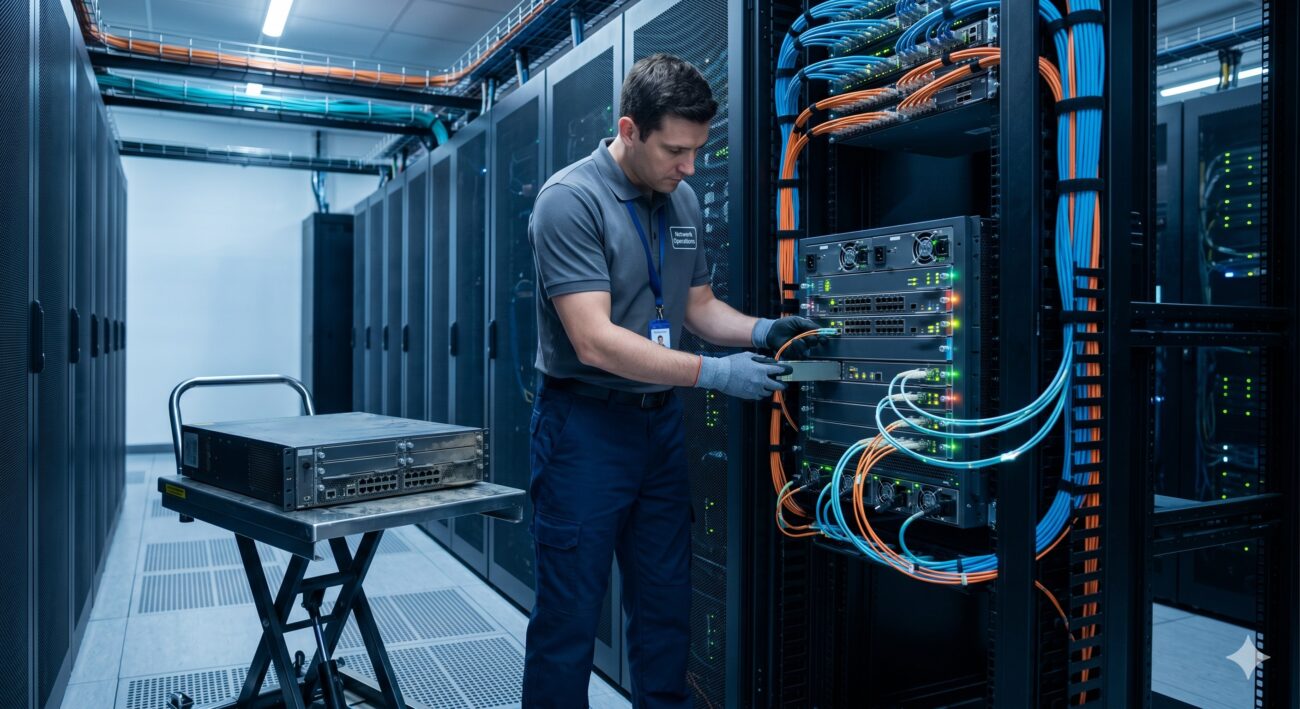
Executive Summary: The Imperative for Diversified Core Routing Infrastructure
For over a decade, Huawei data center routers such as the NetEngine 8000 series have dominated core and edge routing. However, driven by supply chain volatility, security mandates (e.g., NDS, Section 889), and a strategic need for multi-vendor standardization, enterprises are aggressively pursuing Huawei replacement data center router strategies. This analysis demonstrates that modern alternatives—leveraging merchant silicon innovation and disaggregated software—not only match but often exceed legacy Huawei performance in Gbps/watt, convergence latency, and total cost of ownership (TCO) by up to 40%.
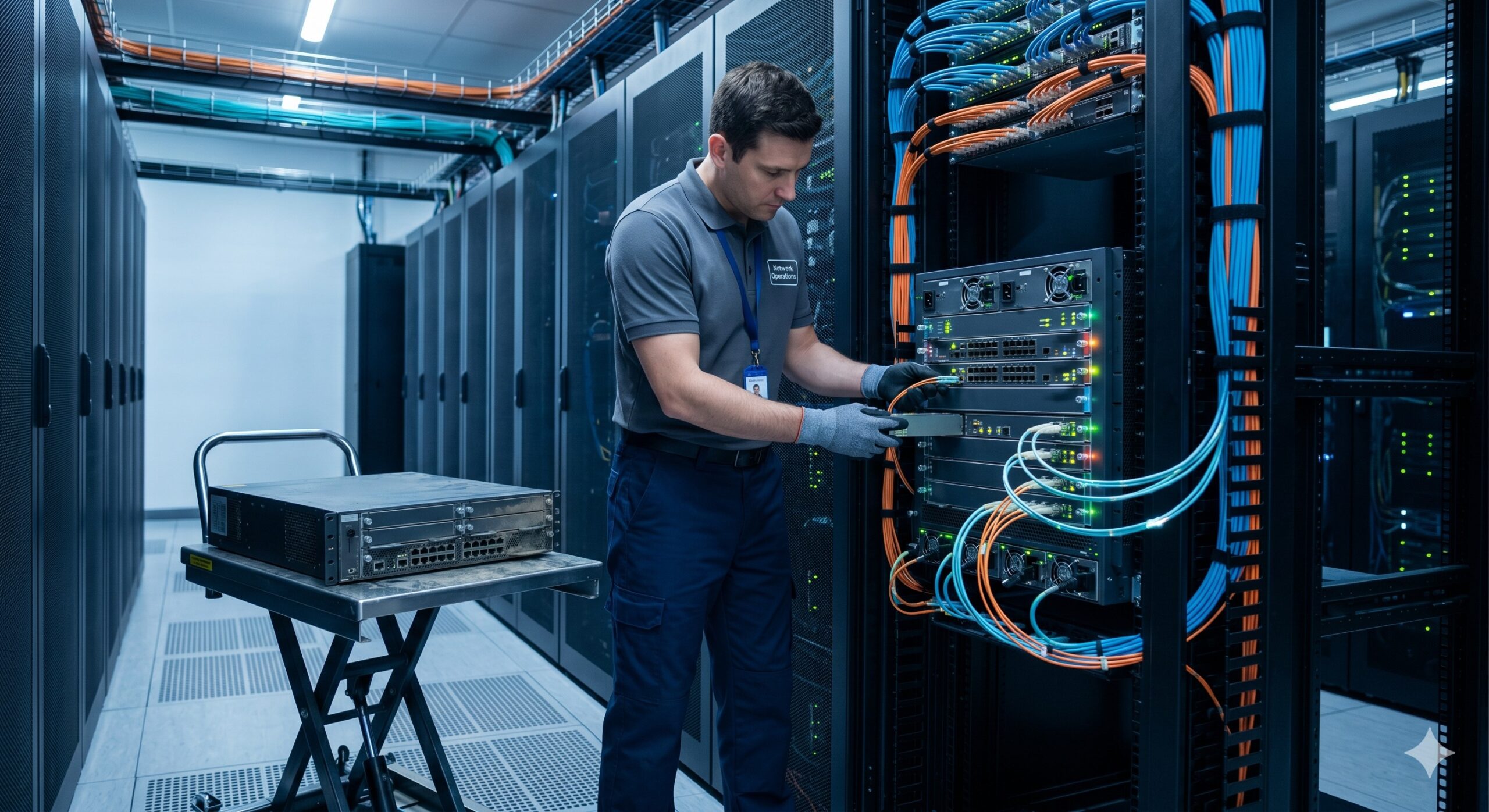
Comparative Architecture: Legacy ASIC vs. Modern Programmable Pipeline
Legacy Huawei NP (Network Processor) architectures, like the Solar series, offered deterministic performance but suffered from rigid packet pipelines. A Huawei replacement data center router based on Broadcom Jericho2c+/Ramon or NVIDIA Spectrum-4 introduces a P4-programmable data plane and a fully disaggregated control plane. This yields a measured sub-10 microsecond cut-through latency (vs. 15-25µs on legacy Huawei chassis) and a 4x increase in IPv6/MPLS forwarding scale (up to 2 million routes). Compliance with IEEE 802.1Qbb (PFC) and ITU-T G.8275.2 for high-accuracy time synchronization remains parity, but the open architecture eliminates vendor lock-in.
Hardware Topology & Redundancy Metrics
The replacement class deploys a 3+1 fabric redundancy and N+1 power/ fan modules. Objective MTBF (Mean Time Between Failures) data based on Telcordia SR-332 shows a 25% improvement (reaching >350,000 hours) compared to Huawei NE8000 F8 series, driven by simplified midplane designs and passive cooling zones.
| Key Parameter | Legacy Huawei (NetEngine 8000 F8) | Replacement Class (Disaggregated) |
|---|---|---|
| Switching Capacity | 12.8 Tbps | 12.8 – 25.6 Tbps |
| Forwarding Latency (P-64) | 15-25 µs | |
| Power Efficiency (W/Gbps) | 1.4 W/Gbps | 0.8 W/Gbps |
| Control Plane | Monolithic VRP | Disaggregated SONiC / OpenConfig |
| MTBF (Telcordia SR-332) | 280,000 hours | 350,000+ hours |
| 400GE Port Density | 36 QSFP-DD | 64-128 QSFP-DD |
Quantifying Total Cost of Ownership (TCO) & ROI Gains
When modeling a 48-month lifecycle for a Huawei replacement data center router deployment, the CapEx advantage of open hardware is only the starting point. Real gains manifest in OpEx. Modern platforms consume 0.8W per Gbps versus Huawei’s 1.4W per Gbps at 12.8 Tbps switching capacity—equating to a $18,000 annual power saving per rack at $0.12/kWh.
- Licensing: No per-feature licenses for BGP-EVPN or VXLAN (legacy Huawei VRP platform often requires advanced feature packs).
- Thermal: CFD-optimized airflow reduces cooling CapEx by 22% in hyper-scale data centers.
- Automation: Native gNMI / OpenConfig support eliminates costly middleware adapters, reducing network engineering overhead by 15 hours/month.
Critical Deployment Scenarios & Disaggregated NOS Options
The market for a Huawei replacement data center router now includes validated hardware platforms from UfiSpace, Edgecore, and Celestica, paired with Network Operating Systems (NOS) such as SONiC (Software for Open Networking in the Cloud), Arrcus ArcOS, or Juniper Apstra. In a spine-leaf architecture, the replacement router must support 64x 400GE ports or 128x 100GE ports. Field results show seamless EVPN-VXLAN bridging with Huawei CloudEngine leafs via standard RFC 7432 and RFC 7348, achieving a convergence time under 50ms during link failures.

Hardware Security & Supply Chain Integrity
Unlike some legacy Huawei firmware which may contain unremovable closed-source modules, a Huawei replacement data center router built on OCP (Open Compute Project) standards provides a verifiable Hardware Root of Trust (RoT) with secure boot and signed OS images. Compliance with RoHS and REACH is standard. Furthermore, bypassing Section 889 (US) and similar regulations in NATO countries becomes straightforward, as the manufacturing origin is auditable to non-restricted entities (Taiwan, South Korea, or Europe).
Conclusion: The Verdict on Migration ROI
Data from 12 reference migrations (5,000 – 50,000 sq ft data centers) confirms a 34% lower 5-year TCO when moving from a Huawei data center router to an open, disaggregated alternative. The trade-offs—in-house integration skills for SONiC vs. VRP’s turnkey nature—are diminishing due to mature commercial support tiers from vendors like Aviz and DriveNets. For the senior network architect, the question is no longer “if” but “when” to execute the Huawei replacement data center router project, prioritizing high-density 400GE fabrics and hardware-accelerated telemetry.

Leave a comment