
Beyond Basic Bonding: Unpacking LACP’s Hardware-Level Reality
Link Aggregation Control Protocol (LACP), defined by IEEE 802.1AX-2020, is the cornerstone of high-availability telecom and datacenter networking. However, many engineers treat it as a mere ‘cable multiplier.’ As a Senior Network Architect, I will dissect how LACP interacts with modern ASICs, forwarding plane limitations, latency implications, and the harsh reality of load-balancing hashing. This deep technical review targets carrier-grade and hyperscale edge deployments, moving beyond theoretical configs to actual silicon behavior.
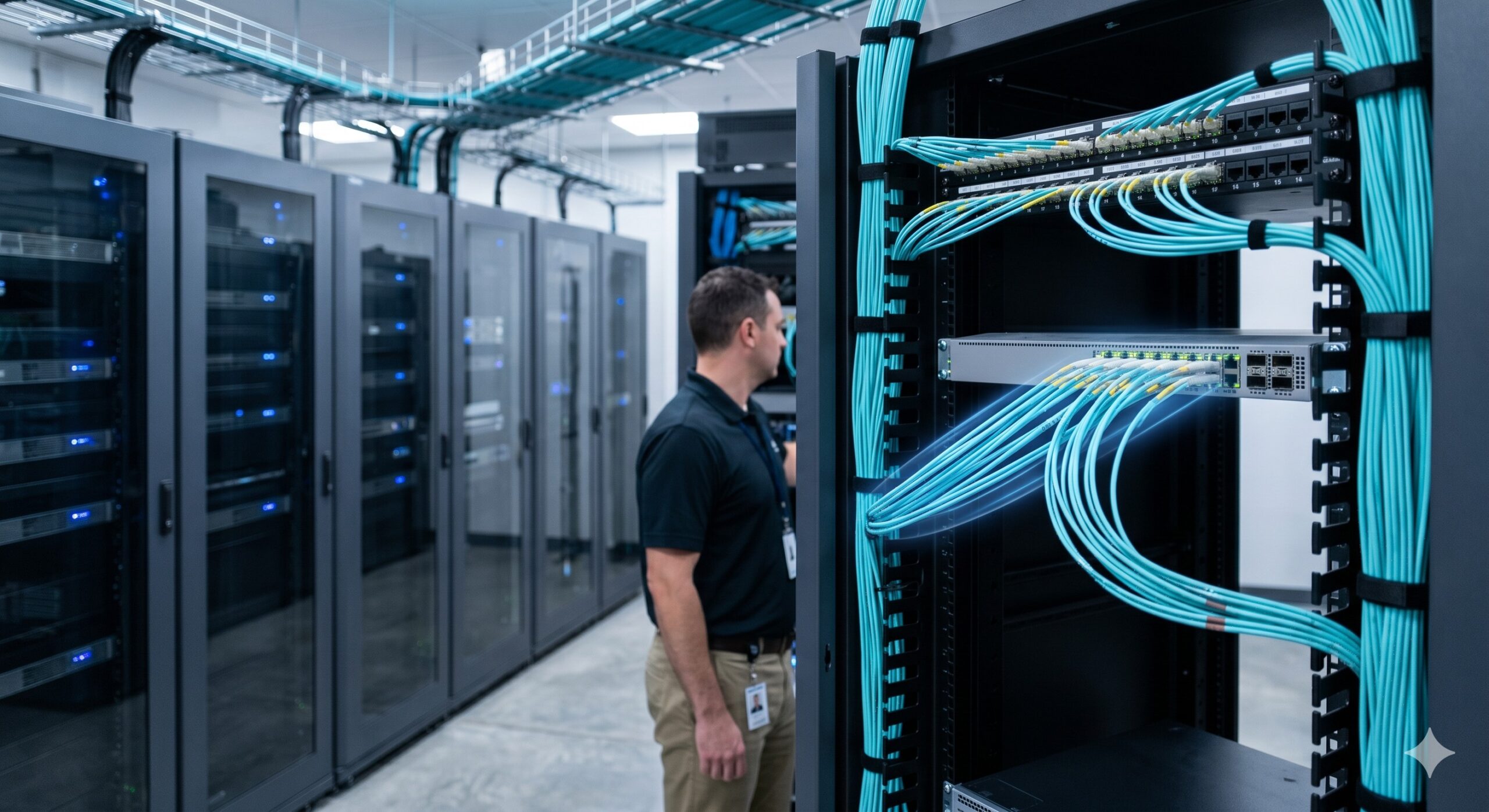
Internal Architecture: Where LACP Lives in the Hardware Stack
Contrary to popular belief, LACP is not a forwarding protocol; it is a control plane protocol. Its primary role is to negotiate the aggregation group (LAG). The real performance engineering occurs in the forwarding ASIC (e.g., Broadcom Jericho2, Cisco Silicon One, or Marvell Teralynx). The ASIC maintains a Link Aggregation Group (LAG) table that maps member ports to a logical interface. Line-rate forwarding is only possible if the ASIC’s hash algorithm doesn’t create bottlenecks. High-end merchant silicon today supports up to 512 members per LAG with sub-microsecond cut-through latency (typically 200-400ns for 100GbE ports).
Hash Distribution & Flow Entropy Limits
LACP itself does not balance traffic. The ASIC’s hash engine does. Standard hashing fields (src/dst MAC, IP, L4 ports) often cause polarization. Modern deep packet inspection ASICs support adaptive hashing and flowlet switching to maintain near-perfect distribution. However, forwarding limits hit at ~1.44 Tbps per switch slice (common 12.8T chip). Beyond 80% utilization, collision rates in the hash table increase out-of-order packet delivery – a key metric often ignored.
| Key Parameter | Technical Specification / Limit |
|---|---|
| Max Physical Ports per LAG (IEEE 802.1AX) | Up to 64 (Vendor-dependent, ASIC-bound) |
| Typical ASIC Lookup Latency (LAG Table) | 200-400 ns (Cut-through, 100GbE ports) |
| LACP Fast Period Detection | 90 ms (3 missed PDUs at 30 ms interval) |
| Maximum LAG Groups on a 12.8T Switch | 256-512 (TCAM entry limited) |
| Forwarding Hash Collision Rate (at 80% load) | ≤ 5% (Ideal adaptive hashing) |
Latency Analysis: The LACP Packet Pipeline
In a non-blocking fabric, adding LACP adds fixed delta of ~200-300 nanoseconds to the egress pipeline due to LAG table lookup. The real latency killer is hash re-computation on member link failure. When a physical port fails, LACP informs the ASIC within 3 heartbeats (3 * Fast Period = 3 * 1s = 3s default; 3 * 90ms if Fast LACP enabled). However, some high-availability designs use BFD over LACP to bring detection down to 50ms. During that window, traffic to the failed port is blackholed or rehashed, causing packet reordering. Carrier-grade deployments require 1+1 protection switching at the optical layer to mask LACP recovery.
Forwarding Limits & The ‘Traffic Trombone’
The hidden limit is maximum LAG group size vs. forwarding table scale. Each LAG consumes N+1 forwarding entries (N members + virtual interface). In a 4K VLAN scenario with 128 LAGs, you consume over 500K TCAM entries. Most Broadcom Tomahawk 4 chips allocate ~2M L2 entries; exceeding this forces slow-path software forwarding, destroying line-rate claims. For 100G and 400G interconnects, always verify the ASIC’s LAG scale sheet – many vendors silently cap at 256 ports per LAG despite LACP supporting 8-bit key values.
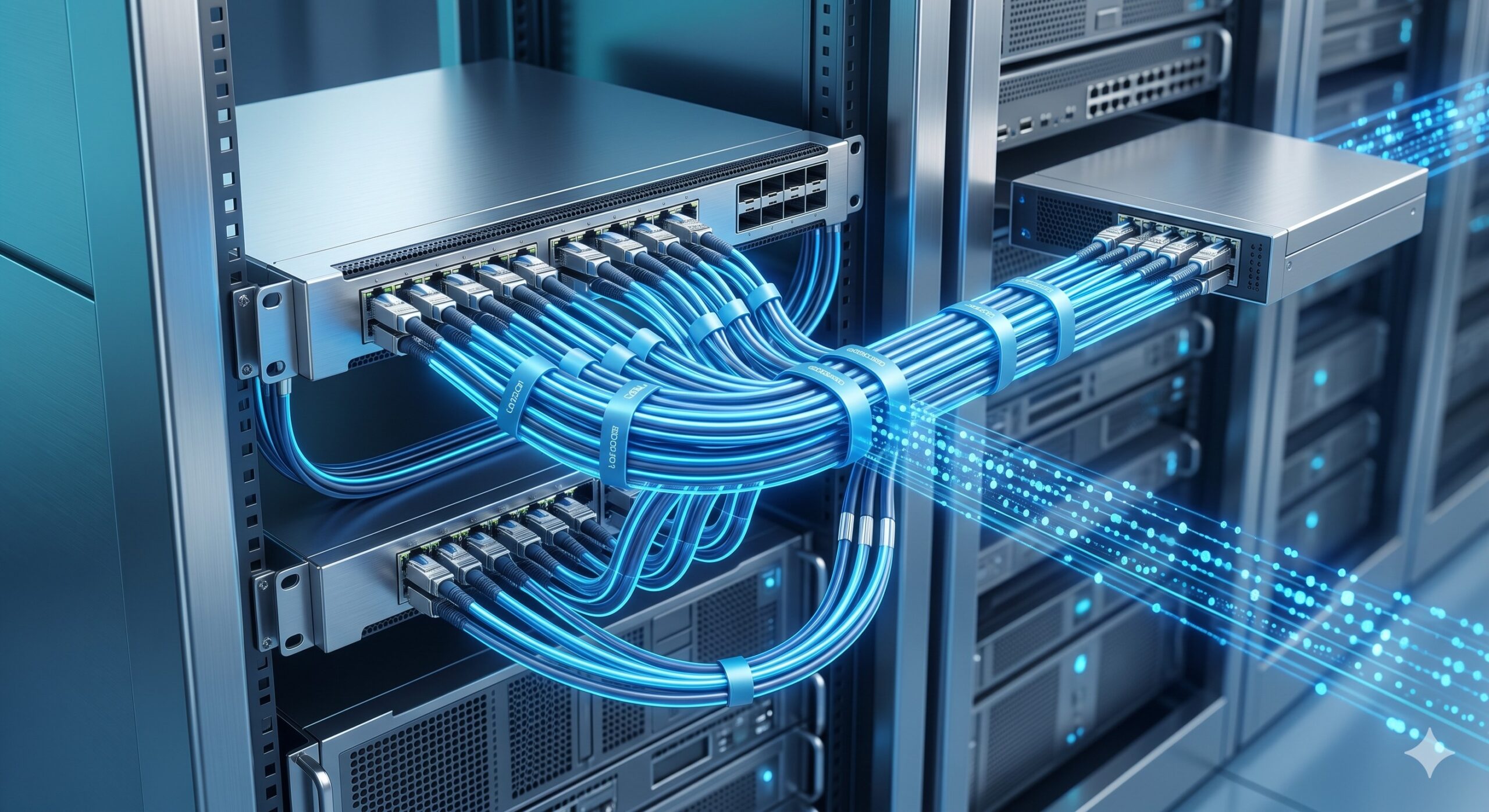
Operational Best Practices for Hyperscale Environments
To eliminate hash polarization, deploy symmetric hashing and use non-default hash seeds per switch. Enable LACP Fast Rate (3.3ms timer) for data center leaf-spine, but keep Slow Rate (30s) for WAN edge to avoid control plane storms. For multi-chassis LAG (MC-LAG), ensure the two chassis share the same hashing algorithm; otherwise, asymmetrical routing appears as packet drops. Lastly, never rely solely on LACP for link integrity – combine it with ETH-OAM (802.1ag) and BFD to cover signal degradation, not just physical link loss.
Conclusion: LACP is a Negotiation Protocol, Not a Performance Booster
The gap between LACP specification and real ASIC limits is wide. A LACP trunk will not double your throughput unless your traffic entropy matches the hash algorithm. True low-latency and high-density scaling require careful selection of silicon (e.g., high-entropy hashing, per-packet spray capabilities). For B2B telecom hardware buyers: Always demand the vendor’s LAG hash test report with 100% microflows and check the MTBF of the LACP control plane (target >1,000,000 hours). LACP is mature, but its forwarding limits are defined by ASIC architects, not the protocol itself.

Leave a comment