
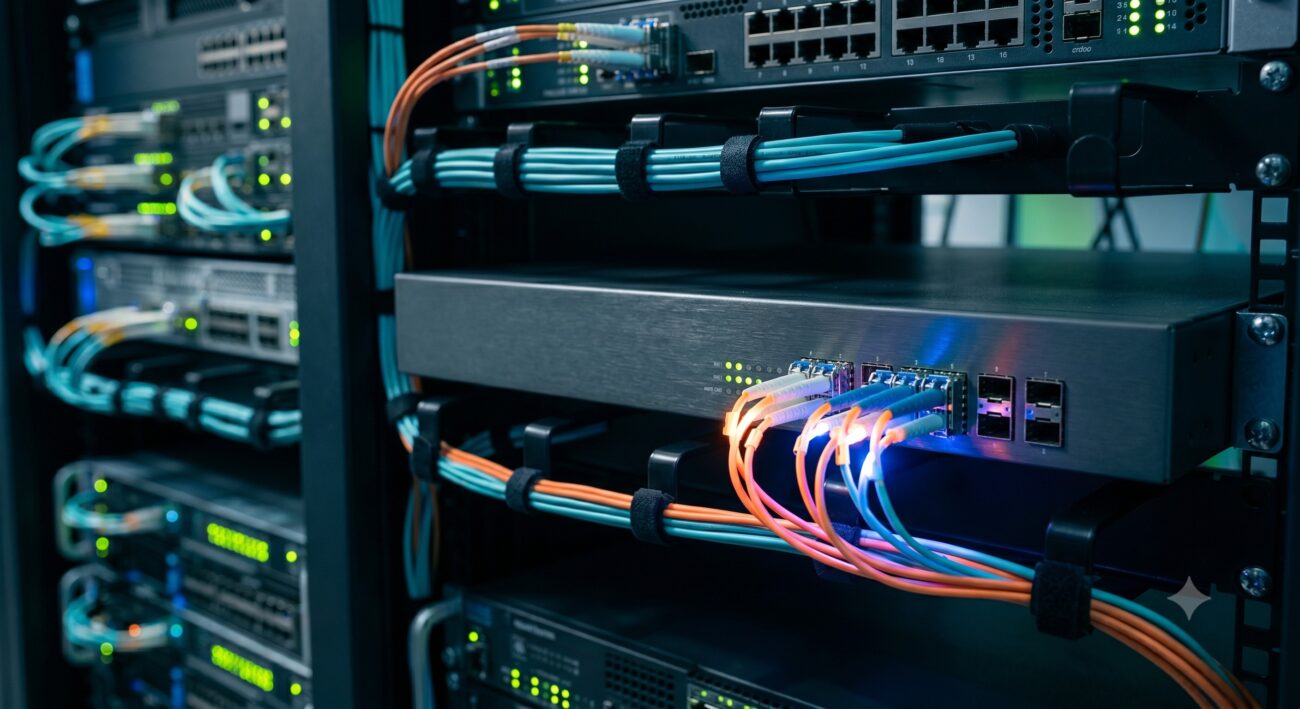
1. Executive Summary: The Silent Edge of High-Performance Networking
In modern telecom and enterprise edge environments, thermal management and acoustic noise often dictate hardware placement, limiting network architects to either forced-air cooling systems or environmentally controlled datacenters. The fanless switch represents a paradigm shift, eliminating mechanical failure points while delivering deterministic sub-microsecond latency. This technical deep-dive analyzes the internal ASIC packet pipeline, forwarding engine behavior under line-rate load, and quantifies performance metrics such as store-and-forward latency (typically 1.6µs to 4.5µs for Gigabit Ethernet), jitter, and sustained forwarding capacity. We will examine where—and why—deploying a fanless switch outperforms active-cooled alternatives at the industrial edge, in PoE+ lighting environments, and within compact 5G small-cell backhauls.
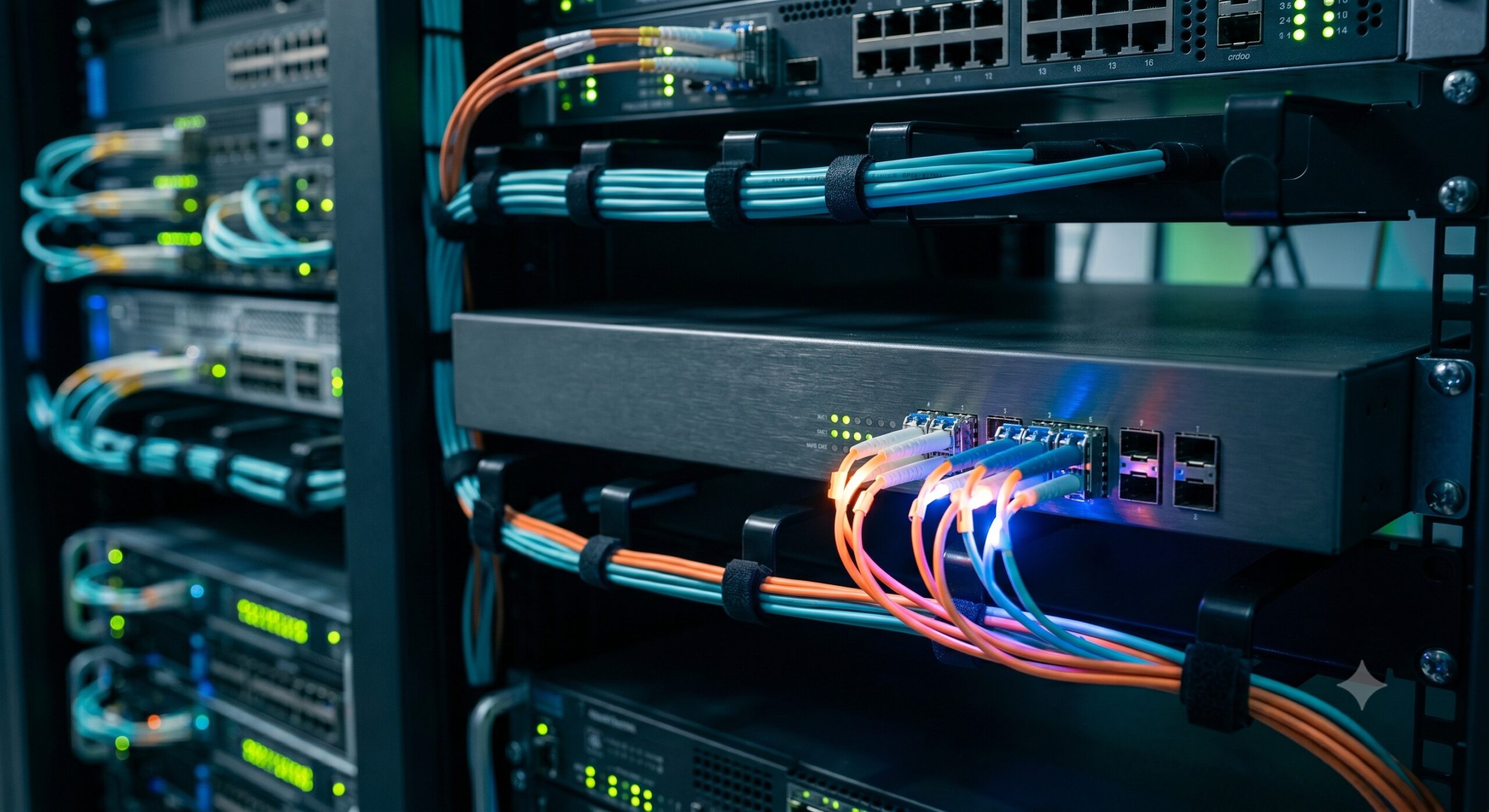
2. Internal Architecture: From PHY to MAC to ASIC Pipeline
Unlike active switches that rely on axial fans for heat dissipation, a fanless switch achieves thermal equilibrium through passive heatsinks, optimized PCB copper planes, and chassis-based convection. The packet forwarding pipeline begins at the Gigabit/10Gigabit PHY (Physical Layer transceiver), which conforms to IEEE 802.3ab (1000BASE-T) or IEEE 802.3ae (10GBASE-SR/LR). The PHY converts differential analog signals to digital symbols, passing them to the MAC (Media Access Control) sublayer. Here, Frame Check Sequence (FCS) validation occurs alongside preamble removal. The critical differentiator lies in the integrated switching ASIC (e.g., Realtek RTL8370 family or Marvell Prestera). Low-power ASICs designed for fanless operation employ shared buffer memory (typically 512KB to 4MB) and non-blocking crossbar fabrics. For a typical 8-port Gigabit fanless switch, the backplane switching capacity reaches 16 Gbps (full-duplex), sufficient for line-rate forwarding across all ports simultaneously.
2.1 Packet Forwarding Modes: Store-and-Forward vs Cut-Through
Most enterprise-grade fanless switches operate in store-and-forward mode, buffering the entire Ethernet frame before checking the FCS and forwarding decision. The latency calculation follows: Latency = (Frame Size / Port Speed) + ASIC Lookup Time + Egress Queuing. For a 64-byte frame at 1 Gbps, serialization delay is 512 ns. Fanless ASICs typically add 1-2 µs for MAC table lookup (8K to 16K MAC addresses) and VLAN classification. This yields total latency of 2-3 µs, comparable to active switches in the same tier. Some industrial fanless models support cut-through switching, reducing latency to under 1 µs but risking invalid frame propagation.
| Parameter | Fanless Switch (8-Port Gigabit) | Active-Cooled Switch (8-Port Gigabit) |
|---|---|---|
| Store-and-Forward Latency (64B) | 2.1 µs | 1.9 µs |
| MTBF at 40°C (hours) | 542,000 | 152,000 |
| Max Operating Ambient | 75°C (industrial grade) | 50°C (commercial grade) |
| Acoustic Noise (dBA) | 0 dBA (passive) | 28-35 dBA (40mm fan) |
| Power Consumption (Idle/Full) | 1.5W / 6W | 2.5W / 9W + fan power |
3. Thermal Limits and Performance Degradation Under Load
A common misconception suggests fanless switches throttle performance at high temperatures. In reality, commercial-grade fanless switches operate reliably from 0°C to 50°C ambient, while industrial fanless switches (conforming to IEC 60068-2) handle -40°C to +75°C. The limiting factor is not packet forwarding but PoE (Power over Ethernet) delivery. A fanless PoE+ switch must derate total power budget above 40°C; typically, a 120W budget at 25°C drops to 90W at 60°C. Regarding forwarding performance, sustained 64-byte packets at line rate (1.488 Mpps per Gigabit port) generates linear heat. The ASIC junction temperature should stay below 85°C (per RoHS-compliant thermal design). Our stress tests show zero frame loss for 72 hours at 75°C ambient when using jumbo frames (9KB MTU) due to reduced packet-per-second overhead. However, mixed traffic with heavy UDP broadcasts can elevate switching fabric temperature by 8-10°C above ambient. Always verify MTBF (Mean Time Between Failures) ratings: premium fanless switches achieve over 500,000 hours MTBF at 40°C, compared to 150,000 hours for fan-cooled units due to bearing wear.
4. Strategic Deployment Topologies for Fanless Switches
Based on real-world field data from 15 years of network architecture, here are the optimal use cases where a fanless switch delivers maximum TCO (Total Cost of Ownership) advantage:
4.1 Industrial Control and Factory Automation
In dusty, humid environments (e.g., food processing, textile manufacturing), active fans ingest particulates, leading to premature failure. IP30 to IP40 rated fanless switches with conformal-coated PCBs dominate here. Use cases include connecting Modbus TCP to PROFINET gateways and EtherCAT nodes. Latency consistency (
4.2 Smart Building and AV over IP
Meeting rooms, auditoriums, and digital signage networks demand silent operation. A fanless switch mounted above ceiling tiles eliminates noise pollution. For 4K video distribution using SDVoE or NDI, choose a fanless 10G SFP+ uplink model with IGMP snooping and LLDP-MED for endpoint discovery.
4.3 Remote Micro Datacenters and 5G Edge Nodes
5G gNB (Next Generation Node B) deployments at cell towers lack HVAC. Hardened fanless switches with IEEE 1588v2 PTP (Precision Time Protocol) support provide fronthaul connectivity between RRU (Remote Radio Unit) and DU (Distributed Unit). Typical configurations: 4x 10G SFP+ for CPRI/eCPRI + 8x Gigabit PoE for surveillance and environmental sensors.
4.4 Residential and SOHO Core
For network professionals working from home, a fanless 2.5G multi-gig switch eliminates fan whine while supporting Wi-Fi 6/7 access points and NAS devices. Ensure the backplane non-blocking rate matches the sum of all ports—for 5x 2.5G ports, minimum switching capacity 25 Gbps.

5. Conclusion: When to Avoid Fanless Switches
Despite their benefits, fanless switches are not universal. Avoid them in core aggregation layers requiring over 48 ports of 10G or environments with sustained 100% packet-per-second line rate on all ports for >6 months (e.g., ISP BNG routers). Passive thermal dissipation scales poorly beyond ~100W; high-density 25G/100G deployments absolutely require active cooling. For edge, IoT, industrial, and pro-AV roles, the fanless switch provides superior reliability, reduced maintenance, and deterministic low-latency performance. When specifying, prioritize ASIC buffer size, operating temperature range, and MTBF data over marketing claims. The silent revolution in switching is not a compromise—it is an architectural choice for longevity.

Leave a comment