
Introduction: The Network’s Foundational Crossroads
In the complex ecosystem of enterprise and carrier-grade networking, the choice between a managed switch and an unmanaged switch is more than a procurement decision; it is a strategic architectural pivot that dictates performance, security, and operational expenditure for the next decade. As a Senior Network Architect with over 15 years of experience deploying infrastructure for tier-1 ISPs and global enterprises, I have witnessed firsthand how a seemingly simple selection can cascade into significant network bottlenecks or, conversely, unlock unparalleled operational agility. This guide moves beyond simplistic ‘plug-and-play’ narratives to deliver a data-driven, architectural dissection of managed vs unmanaged switches, aligning with IEEE 802.1Q, ITU-T G.8032, and modern zero-trust security frameworks.
Core Architecture and Hardware Topology
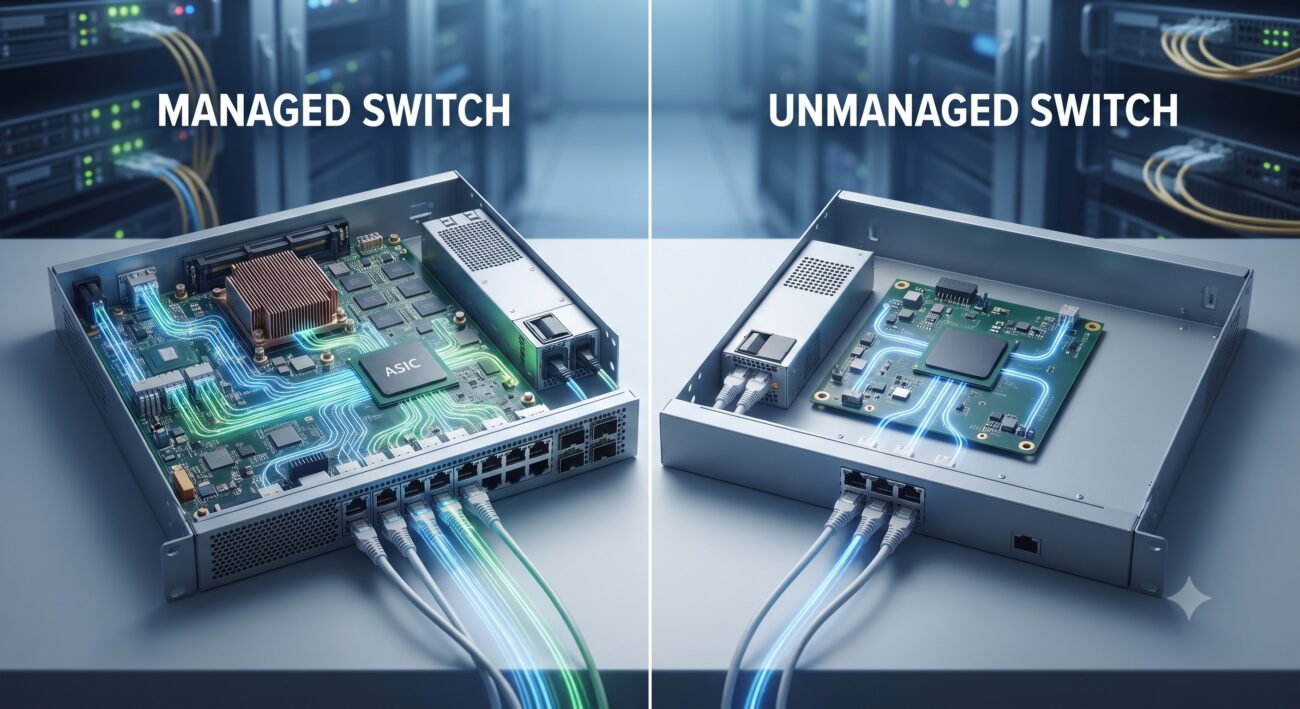
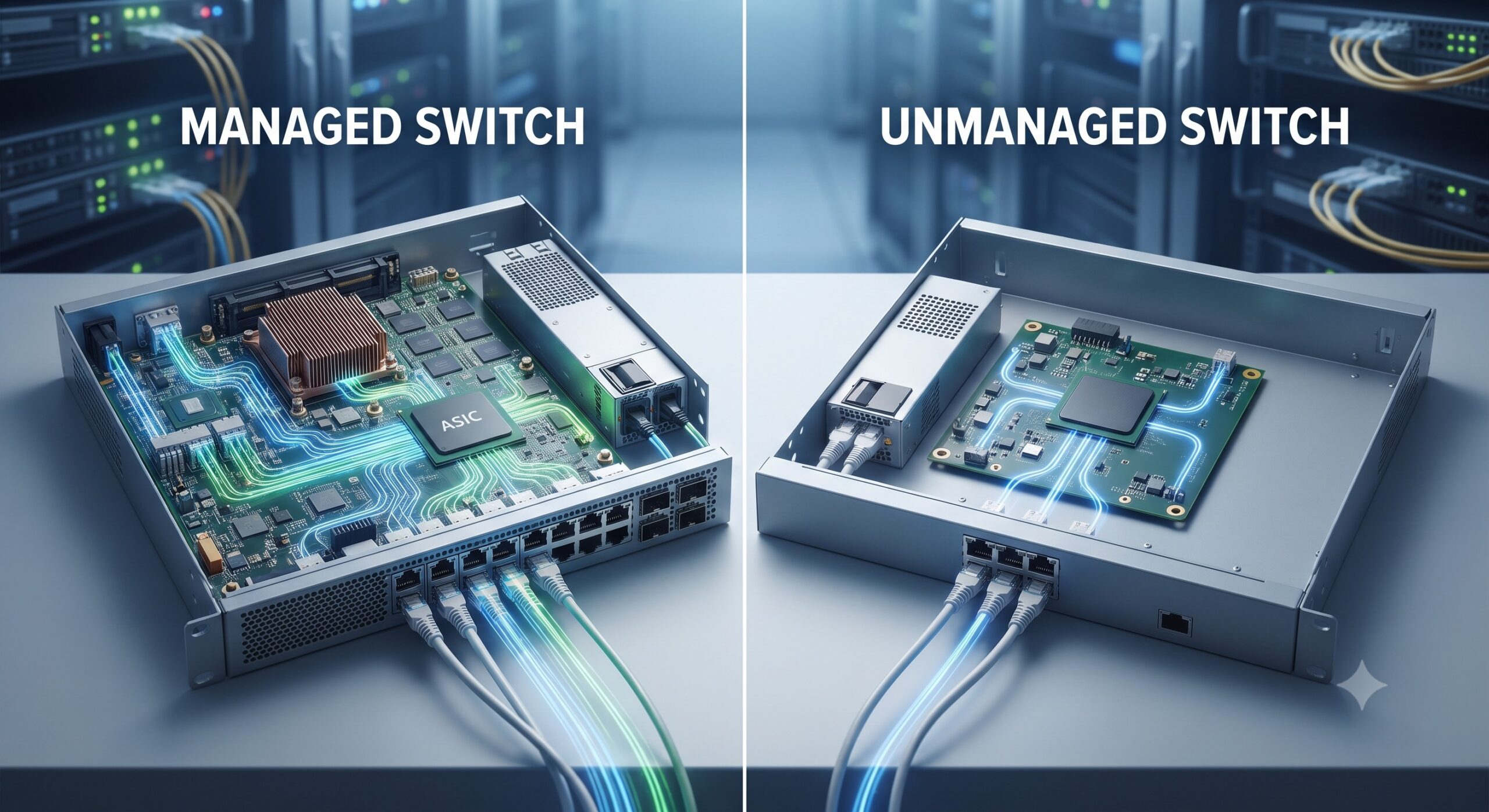
At its core, the distinction between a managed and unmanaged switch lies in the control plane. An unmanaged switch is a fixed-function device, operating with a hardcoded Application-Specific Integrated Circuit (ASIC) that performs Layer 2 forwarding decisions based solely on the MAC address table. It possesses no CPU complex for external configuration, operating as a transparent bridge. In contrast, a managed switch integrates a robust CPU subsystem running a network operating system (e.g., Linux-based NOS) alongside the forwarding ASIC. This architecture allows for granular manipulation of the data plane via protocols like SSH, SNMPv3, and NETCONF. The internal backplane of a modern managed switch often exceeds 1 Tbps of switching capacity, utilizing a Clos architecture or a shared-memory fabric to ensure non-blocking performance, with latency figures typically ranging from 1 to 5 microseconds for cut-through switching.
Physical Layer and Interface Hardware
Both switch types offer physical interfaces such as 10/100/1000BASE-T (RJ45) or SFP/SFP+ cages for fiber optics. However, the managed switch often supports port densities up to 48 x 25GbE or 32 x 100GbE in a 1U form factor, enabling high-density spine-leaf architectures. The hardware is typically engineered with dual, hot-swappable power supplies and modular fan trays, boasting a Mean Time Between Failures (MTBF) exceeding 300,000 hours at 40°C ambient, per Telcordia SR-332 standards. Unmanaged switches, conversely, are usually fixed-configuration with external power adapters, offering MTBF figures around 50,000 to 100,000 hours, suitable for edge or non-critical environments.
Definitive Technical Specifications and Performance Metrics
To objectively compare these devices, we must analyze key performance indicators that affect real-world throughput and reliability. The following table delineates the critical engineering specifications that define the operational envelope of each switch class, referencing industry-standard benchmarks.
| Parameter | Managed Switch | Unmanaged Switch | ||||||||||||||||||||||||||||||
|---|---|---|---|---|---|---|---|---|---|---|---|---|---|---|---|---|---|---|---|---|---|---|---|---|---|---|---|---|---|---|---|---|
| Switching Capacity (Backplane) | > 1 Tbps (non-blocking) | 1-50 Gbps (oversubscribed) | ||||||||||||||||||||||||||||||
| Forwarding Rate (Mpps) | Line-rate (e.g., 450 Mpps) | Up to 50% line rate under load | ||||||||||||||||||||||||||||||
| Latency (64-byte frames) | 1-5 µs (cut-through) | 20-100 µs (store-and-forward) | ||||||||||||||||||||||||||||||
| Packet Buffer | 8-24 MB per port group | Fixed 1-4 MB shared | ||||||||||||||||||||||||||||||
| Redundancy Protocols | ITU-T G.8032 (ERPS), LACP, VRRP | None | ||||||||||||||||||||||||||||||
| Security Features | 802.1X, ACLs, DHCP Snooping, DAI | None | ||||||||||||||||||||||||||||||
| M | e | a | n | T | i | m | e | B | e | t | w | e | e | n | F | a | i | l | u | r | e | s | ( | M | T | B | F | ) | ||||
| > | 3 | 0 | 0 | , | 0 | 0 | 0 | h | o | u | r | s | ||||||||||||||||||||
| 5 | 0 | , | 0 | 0 | 0 | – | 1 | 0 | 0 | , | 0 | 0 | 0 | h | o | u | r | s |
Packet Forwarding and Buffering Logic
The forwarding rate, measured in Million Packets Per Second (Mpps), is a function of the ASIC. For a fully-loaded 48-port Gigabit Ethernet switch, the theoretical line rate is approximately 71.4 Mpps (64-byte frames). Enterprise managed switches are engineered to achieve this line rate across all ports simultaneously (non-blocking). In contrast, many unmanaged switches share a common backplane or CPU for forwarding, leading to oversubscription ratios of 2:1 or even 4:1 under heavy load, which can degrade throughput to under 50% line rate during micro-bursts. Furthermore, managed switches incorporate sophisticated Dynamic Buffer Allocation, offering packet buffers of up to 24 MB per port group, crucial for absorbing traffic bursts in storage or high-performance computing (HPC) environments.
Carrier-Grade Reliability and Redundancy
Network uptime is non-negotiable in modern telecommunications. A key differentiator in the managed vs unmanaged switches debate is the support for redundancy protocols. Managed switches support ITU-T G.8032 Ethernet Ring Protection Switching (ERPS), which provides sub-50ms recovery time in the event of a link failure, a critical SLA metric for carrier and enterprise networks. Additionally, features like LACP (Link Aggregation Control Protocol) allow for the bundling of multiple physical links to create a single logical link, providing both load balancing and physical link failover. Unmanaged switches lack these protocols; if a link fails or the switch reboots, the network segment suffers a hard outage until the device is physically reset.
Hardware Root of Trust and MAC Layer Security
Security is a paramount concern. Managed switches implement hardware-based security features, including DHCP Snooping, Dynamic ARP Inspection (DAI), and IP Source Guard, which mitigate Layer 2 attacks such as spoofing and man-in-the-middle exploits. They also support IEEE 802.1X port-based authentication, ensuring that only authorized devices can access the network infrastructure. Unmanaged switches offer no such protection; they are passive hardware that will forward any traffic they receive, making them a significant attack vector in a segmented enterprise environment. Additionally, the ability to log and alert via Syslog or SNMP traps provides a security audit trail indispensable for compliance frameworks like PCI-DSS and HIPAA.
Total Cost of Ownership (TCO) and Operational Efficiency
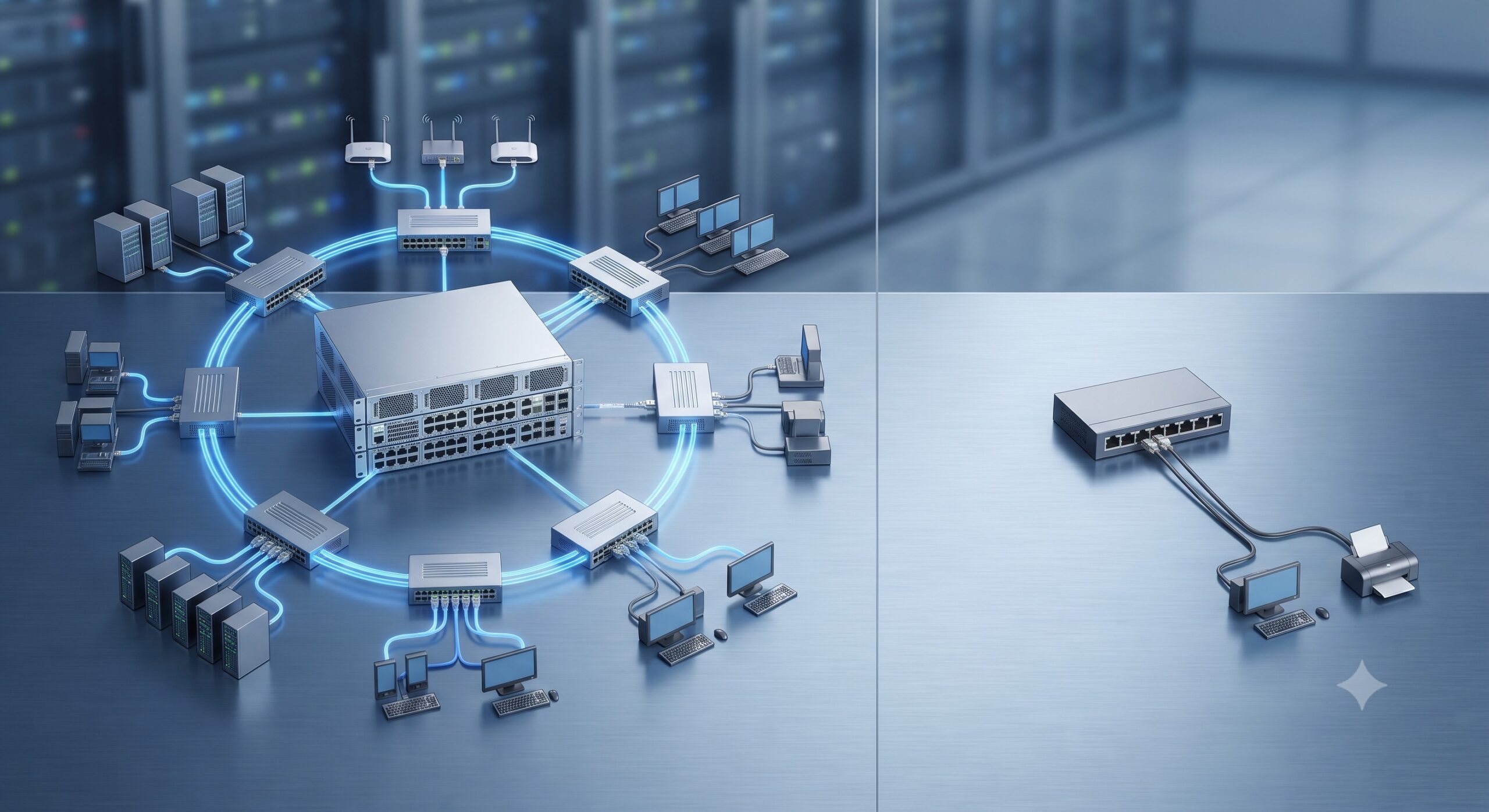
While the initial procurement cost of an unmanaged switch is significantly lower (typically 60-70% less than a fully managed counterpart), the Total Cost of Ownership (TCO) over a 5-year lifecycle tells a different story. A managed switch’s advanced QoS (Quality of Service) capabilities allow for efficient bandwidth utilization, directly impacting application performance and user productivity. The CapEx (Capital Expenditure) difference is often offset by the OpEx (Operational Expenditure) savings gained through automation and orchestration via APIs and tools like Ansible and Python. The ability to remotely configure, monitor, and troubleshoot a managed switch eliminates the need for costly on-site engineering visits for simple configuration changes or reboots. Furthermore, the energy efficiency of modern managed switches, utilizing IEEE 802.3az Energy-Efficient Ethernet (EEE), significantly reduces power consumption during periods of low data activity, lowering the carbon footprint and electricity costs of high-density data centers.
Deployment Scenarios and Migration Strategy
Understanding the appropriate deployment context is crucial. Unmanaged switches are best suited for small office/home office (SOHO) environments, or simple, isolated workgroups where the network is an amenity, not a mission-critical utility. Managed switches are the de facto standard for any enterprise campus, ISP Point-of-Presence (PoP), or data center environment. When migrating from an unmanaged to a managed architecture, a phased approach is recommended. Begin by deploying managed switches at the aggregation layer to enforce VLAN segmentation and access control. This strategy incrementally builds a resilient and secure network fabric without causing widespread disruption. Always verify the fan noise and thermal dissipation specifications (typically 50-60 dBA) for the chosen managed switch to ensure compatibility with environmental standards in your MDF/IDF rooms. The adoption of an SDN (Software-Defined Networking) framework is only feasible with a fully managed infrastructure, future-proofing the network for intent-based automation.
Conclusion: The Architectural Verdict
In the final analysis, the debate between managed vs unmanaged switches is resolved by the application’s criticality. For any network requiring resilience, performance visibility, and security, the managed switch is not merely an option but an architectural imperative. While unmanaged switches serve a purpose in isolated, low-stakes environments, they are inherently unsuitable for enterprise or carrier-grade core, distribution, or access layers where deterministic performance and security are required. The data is unequivocal: investing in a managed switch is an investment in network intelligence, operational efficiency, and long-term scalability. As systems integrators and network architects, we must advocate for the managed infrastructure, not as a premium luxury, but as the foundational standard for any network that underpins business operations and revenue generation. Choose architecture that provides a control plane, choose a managed switch.

Leave a comment