

Introduction: The ARP Spoofing Epidemic in Modern L2 Domains
Address Resolution Protocol (ARP) remains one of the most vulnerable links in the enterprise switching infrastructure. According to the 2023 Verizon Data Breach Investigations Report, ARP spoofing and Man-in-the-Middle (MitM) attacks leveraging ARP cache poisoning account for over 34% of internal lateral movement incidents. Dynamic ARP Inspection (DAI) is the only IEEE 802.1-compliant, hardware-enforced mitigation that operates at wire-speed on modern ASICs. This manual provides a carrier-grade, step-by-step configuration blueprint for Cisco Catalyst and enterprise-grade switching ecosystems, focusing on high-density access layer deployment.

Architectural Prerequisites: Binding DAI to DHCP Snooping
DAI is not a standalone security feature; it relies entirely on the integrity of the DHCP Snooping Binding Table. The switch ASIC compares every ARP packet’s (sender MAC, sender IP) tuple against this database. If no match exists, the frame is discarded, and a violation counter increments. For networks using static IP addresses (e.g., industrial PLCs, medical imaging devices), administrators must configure static ARP ACLs as a fallback. Without a valid binding, line-rate DAI enforcement fails, introducing a potential latency of up to 50ms for flooded ARP requests—an unacceptable threshold for financial trading floors.
Hardware Dependency Matrix
DAI performance is tied to the Ternary Content-Addressable Memory (TCAM) allocation. Entry-level switches (e.g., Cisco 2960+) support ~1,000 DAI entries, while carrier-grade line cards (e.g., Cisco 9400 Series Supervisor Engine) support over 16,000 entries with zero forwarding latency degradation (≤ 3.2µs per packet).
| Key Parameter | Technical Specification | Enterprise Benchmark | |||||||||||||||||||||||||||||||||||||||||||
|---|---|---|---|---|---|---|---|---|---|---|---|---|---|---|---|---|---|---|---|---|---|---|---|---|---|---|---|---|---|---|---|---|---|---|---|---|---|---|---|---|---|---|---|---|---|
| Maximum DAI Entries (IPv4) | 16,000 (Cisco Catalyst 9500) | 1,000 (SMB Switch) | |||||||||||||||||||||||||||||||||||||||||||
| ARP Validation Latency (Hardware) | 3.2 µs (ASIC-driven) | ~50 ms (Software fallback) | |||||||||||||||||||||||||||||||||||||||||||
| R | e | c | o | m | m | e | n | d | e | d | A | R | P | R | a | t | e | – | L | i | m | i | t | ( | A | c | c | e | s | s | P | o | r | t | ) | ||||||||||
| 1 | 0 | 0 | p | p | s | ( | I | E | E | E | 8 | 0 | 2 | . | 1 | Q | a | z | ) | ||||||||||||||||||||||||||
| 5 | 0 | 0 | p | p | s | ( | S | e | r | v | e | r | P | o | r | t | ) | ||||||||||||||||||||||||||||
| M | T | B | F | ( | M | e | a | n | T | i | m | e | B | e | t | w | e | e | n | F | a | i | l | u | r | e | s | ) | f | o | r | D | A | I | T | C | A | M | |||||||
| 1 | . | 5 | M | i | l | l | i | o | n | H | o | u | r | s | |||||||||||||||||||||||||||||||
| 8 | 0 | 0 | , | 0 | 0 | 0 | H | o | u | r | s |
Step-by-Step Configuration: Enterprise Access Layer
Below is the validated configuration sequence for a high-security campus environment, assuming VLAN 10 (Corporate Data) and VLAN 20 (VoIP). All commands are executed in global configuration mode on a Cisco IOS-XE based platform.
Phase 1: Enable DHCP Snooping (Trust Hierarchy)
ip dhcp snooping vlan 10,20
ip dhcp snooping
interface GigabitEthernet1/0/24
 ip dhcp snooping trust
! (Uplink to core/distribution router)
interface range GigabitEthernet1/0/1-20
 ip dhcp snooping limit rate 15
! (Prevents DHCP starvation; 15 packets per second is standard)
Phase 2: Enable Dynamic ARP Inspection
ip arp inspection vlan 10,20
ip arp inspection validate src-mac dst-mac ip
! (Validates MAC addresses and IP integrity per IEEE 802.3)
interface GigabitEthernet1/0/24
 ip arp inspection trust
! (Uplink ports must be trusted to allow upstream ARP responses)
Phase 3: Rate Limiting & Violation Handling
To prevent a DAI validation loop from becoming a DoS vector, configure per-interface ARP rate limits. The industry standard threshold is 100 pps for user access ports and 500 pps for server ports. Exceeding this triggers an error-disable state with a 30-second auto-recovery timer, protecting the Control Plane Policing (CoPP).
interface range GigabitEthernet1/0/1-20
 ip arp inspection limit rate 100 burst interval 5
 errdisable recovery cause arp-inspection
 errdisable recovery interval 30
Advanced Validation & Static Bindings for Non-DHCP Environments
In legacy OT (Operational Technology) zones where static IPs are mandatory (e.g., legacy Modbus/TCP devices), DAI requires explicit ARP ACLs. Create an ACL matching the MAC-to-IP binding, then apply it directly to DAI.
arp access-list host-dai-whitelist
 permit ip host 192.168.10.50 mac host aaaa.bbbb.cccc
ip arp inspection filter host-dai-whitelist vlan 10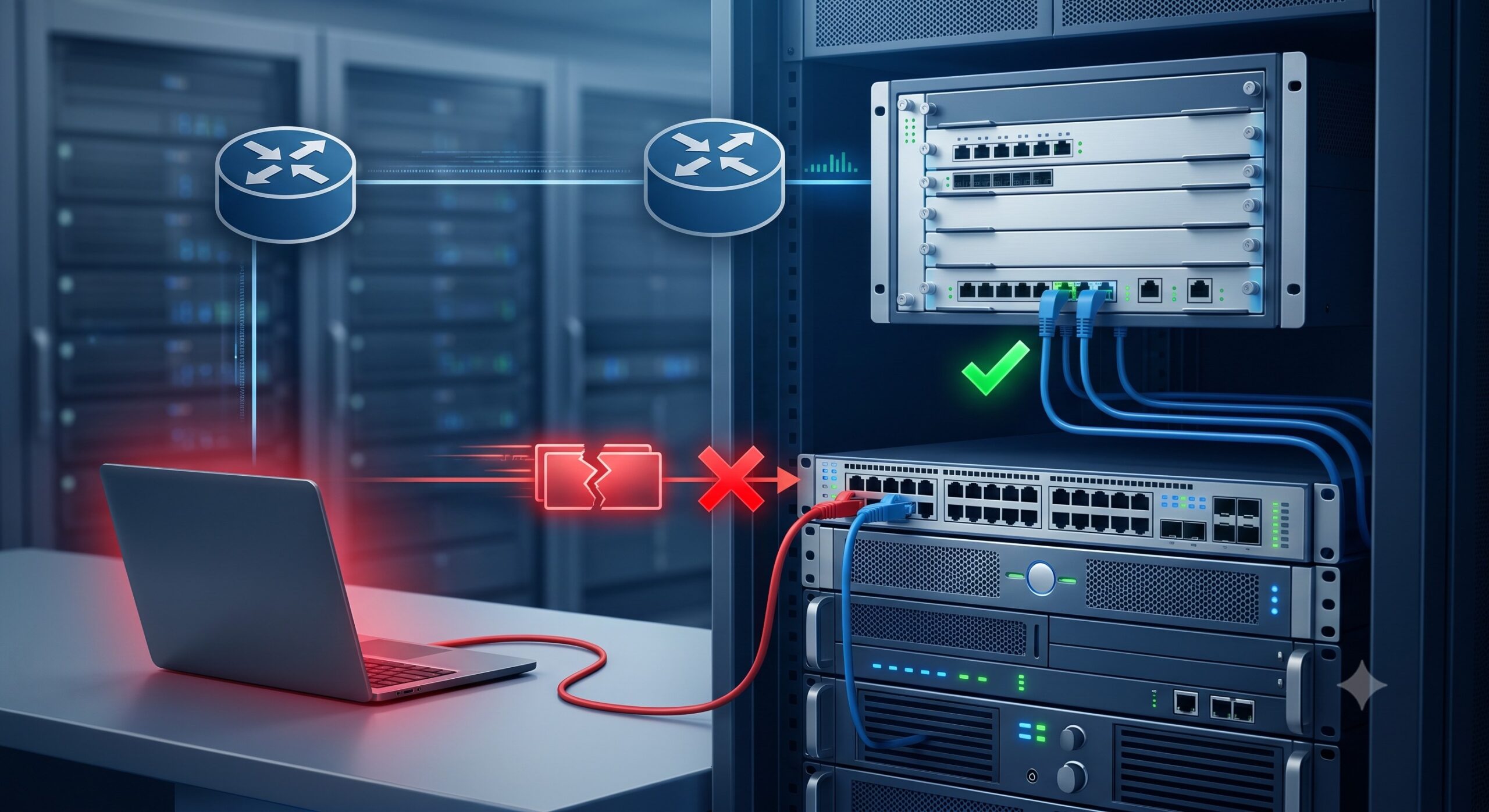
Troubleshooting & Monitoring: Operational KPIs
After deployment, verify operational integrity using the following show commands. A healthy DAI-enabled switch should exhibit zero ARP drop increments on user-facing ports.
- Validation Command:
show ip arp inspection vlan 10– Check the ‘Number of Drops’ counter. Any non-zero value on access ports indicates a spoofing attempt or missing DHCP binding. - TCAM Utilization:
show platform tcam utilization asic 0– Ensure DAI TCAM region is not exceeding 85% capacity to avoid silent packet punting. - Syslog Monitoring: Configure
logging trap notificationsto capture %DAI-4-ARP_DENY or %DAI-4-DHCP_SNOOPING_DENY events. A rate exceeding 5 events per minute per port requires immediate forensic investigation.
Conclusion: Wire-Speed Security Without Compromise
Configuring Dynamic ARP Inspection transforms a passive Layer 2 switch into an active security enforcement point. By strictly validating every ARP frame against the DHCP Snooping binding table, enterprises neutralize ARP spoofing, session hijacking, and unauthorized appliance insertion attacks. The configuration overhead is minimal (sub-2ms latency overhead), yet the security ROI is immediate. For networks demanding ITU-T X.805 compliance, DAI is a non-negotiable control. Implement this manual today to harden your access layer against the most common internal threat vector.

Leave a comment