
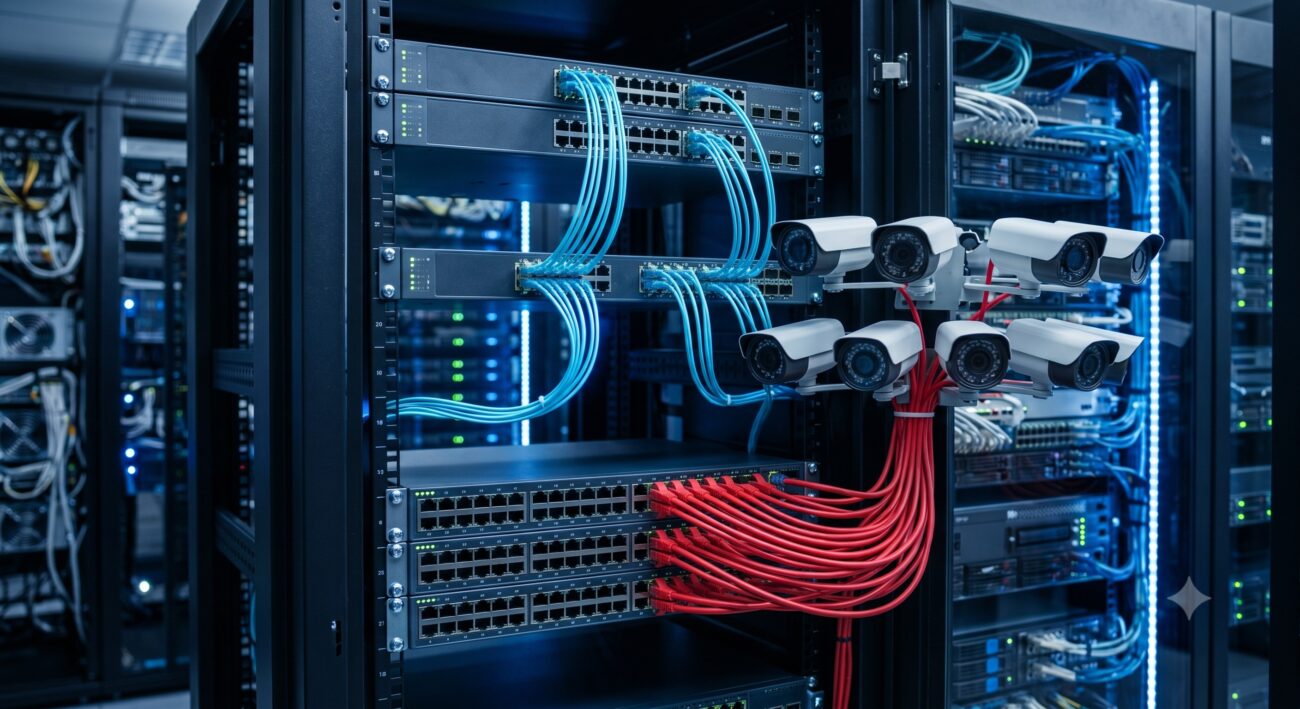
Introduction: The Surveillance Traffic Tsunami
Modern IP camera CCTV systems have evolved from basic analog feeds to high-throughput, latency-sensitive data streams. A single 4K IP camera can generate a sustained bitrate of 25 Mbps (H.265) to 40 Mbps (MJPEG). Deploying 100 such cameras creates an aggregate throughput of 4 Gbps, demanding a network switch layout that prioritizes non-blocking forwarding, Power over Ethernet (PoE) budgeting, and uplink oversubscription ratios below 1:1. This guide delivers a carrier-grade blueprint for architects and systems integrators.

Core Architectural Pillars of CCTV Switch Layout
1. Physical Topology: Star vs. Cascaded vs. Ring
A collapsed star topology (core switch directly connected to all edge PoE switches) offers the lowest deterministic latency (two-tier hierarchical model (Access-Distribution) is preferred. Avoid cascading more than three switches – each hop adds switching latency (store-and-forward switches introduce ~15-20µs for 1518-byte frames per the IEEE 802.1Q standard). Ring topologies using Ethernet Ring Protection Switching (ITU-T G.8032) provide sub-50ms failover but require switches with hardware ring support.
2. PoE Budgeting and Power Redundancy
IEEE 802.3bt Type 4 (PoE++) delivers up to 90W per port, powering pan-tilt-zoom (PTZ) cameras with integrated heaters. A critical metric: power budget per switch (e.g., 740W for a 48-port switch) must include a 25% headroom. For outdoor IR cameras, add 10W for heater activation. We recommend dual redundant power supplies (1+1) with MTBF of >300,000 hours (field-proven for 5-year continuous operation).
3. Uplink Oversubscription & Backplane Design
The industry rule: access switch uplink bandwidth must equal or exceed the sum of all camera port ingress rates. Example: 48 ports × 25 Mbps = 1.2 Gbps aggregate. A single 1G SFP uplink creates 1:1.2 oversubscription, causing micro-burst packet drops. Upgrade to dual 10G SFP+ uplinks (20 Gbps total) to achieve a 1:0.06 ratio. Non-blocking switch fabrics (e.g., 176 Gbps for a 48-port Gigabit switch) guarantee wire-speed forwarding.
| Parameter | Commercial Switch (Typical) | Industrial/ISP Switch (Recommended) |
|---|---|---|
| Switching Capacity (48-port) | 104 Gbps | 176-256 Gbps |
| Forwarding Rate (Mpps) | 77 Mpps | 132 Mpps |
| PoE Budget (48 ports) | 370W (IEEE 802.3at) | 740W (IEEE 802.3bt Type 4) |
| Operating Temperature | 0°C to 40°C | -40°C to +75°C |
| MTBF (hours) | 50,000 | 500,000+ (Telcordia SR-332) |
| Port Buffer per Port | 512KB | 4MB dynamic shared |
Technical Specifications Deep Dive
Buffer Memory & Burst Absorption
IP cameras often send I-frames (intra-coded frames) that are 5x larger than P-frames. A switch with only 512KB per port buffer will overflow during simultaneous I-frame transmission from 10+ cameras. Select switches with 4MB shared buffer per port group or dynamic buffer allocation. For mission-critical surveillance (casinos, airports), deploy switches supporting IEEE 802.1Qav (Audio-Video Bridging) credit-based shapers.
Environmental Hardening & MTBF
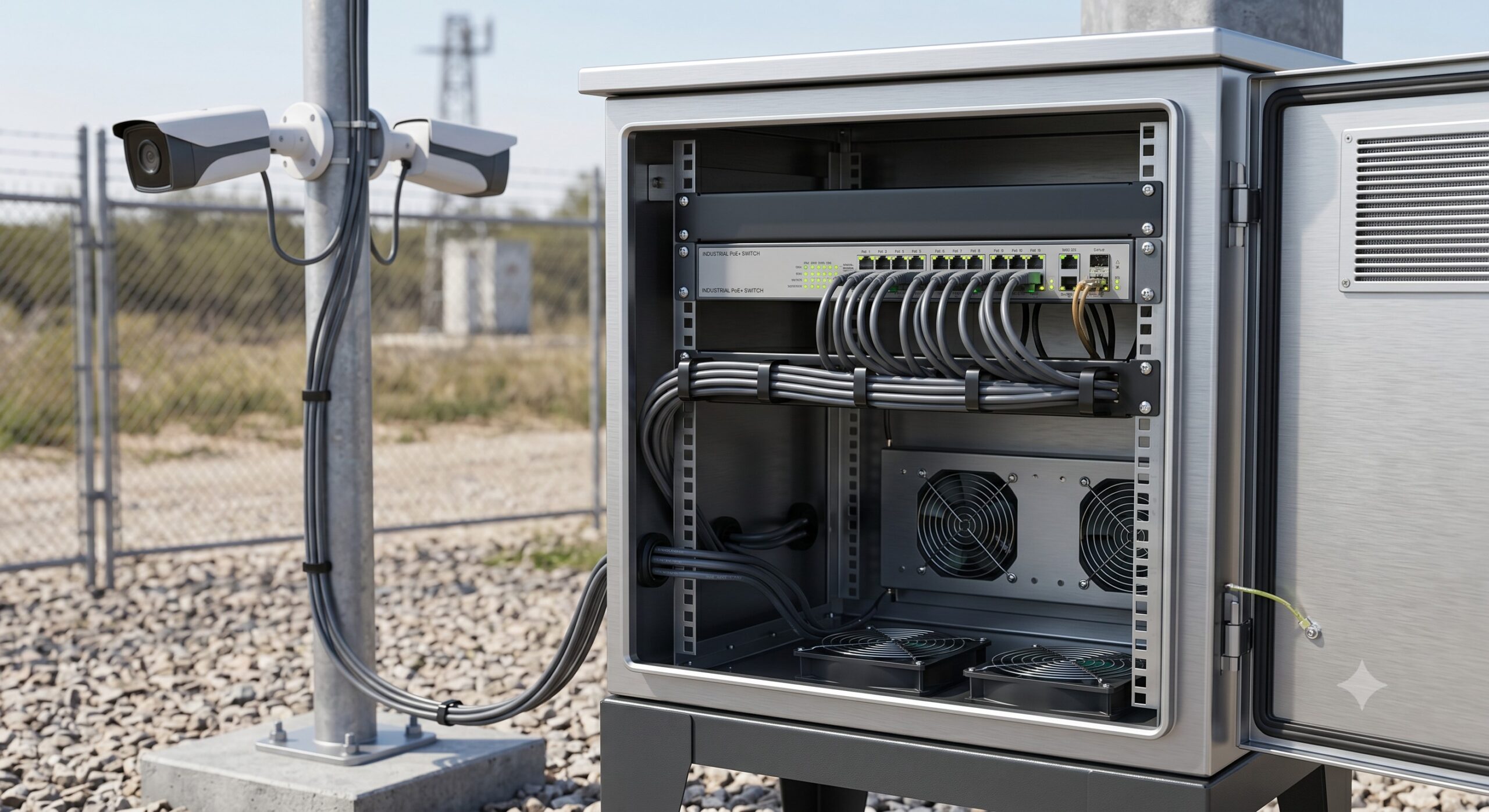
Outdoor switch cabinets require industrial-grade switches rated for -40°C to +75°C (fanless, conformal-coated PCBs). Mean Time Between Failures (MTBF) for commercial-grade switches is ~50,000 hours; industrial-grade reaches >500,000 hours (per Telcordia SR-332). For vibration-prone environments (highway camera poles), use switches with M12 connectors and IEC 60068-2-27 shock certification.
Deployment Strategies for Large-Scale Surveillance
Case Study: 500-Camera Warehouse Deployment
Scenario: 500 x 4K IP cameras (H.265, 25 Mbps each → 12.5 Gbps total). Layout: 12 x 48-port PoE++ access switches (each handling ~42 cameras, reserving 6 ports for expansion). Uplinks: Each access switch uses dual 10G SFP+ links to two distribution switches (active-active LACP). Distribution switches aggregate to a core switch via 4 x 40G QSFP+ (160 Gbps). Result: 0.3:1 oversubscription ratio, zero packet loss during 5-minute I-frame bursts.
VLAN Segmentation for Security & Multicast
Isolate camera traffic using private VLANs (PVLAN) per floor or zone. Enable IGMP snooping (RFC 4541) to prevent multicast camera feeds from flooding all ports. For remote viewing via NVR, configure a dedicated surveillance VLAN with 802.1X MAC Authentication Bypass (MAB) to prevent rogue camera insertion.
Configuration Best Practices for Deterministic Performance
1. Jumbo Frames & MTU Optimization
Increase MTU from 1518 to 9000 bytes (jumbo frames) on all switch ports and NVRs. This reduces frame overhead per megabyte by 82%, lowering CPU utilization on NVRs. Caution: Ensure end-to-end path MTU discovery is disabled to avoid fragmentation.
2. Storm Control & Rate Limiting
Configure broadcast storm control at 0.5% of port bandwidth (e.g., 5 Mbps for a 1G port). Unexpected multicast traffic from a defective camera should be limited to 1 Mbps. Use ingress rate limiting to cap unknown unicast floods.
3. Link Aggregation for NVR Connectivity
Use IEEE 802.3ad LACP with 4 x 1G ports to connect an NVR, creating a 4 Gbps logical link. Avoid static aggregation (non-802.3ad) which fails during link recovery. For NVR clusters, implement Multi-Chassis Link Aggregation (MLAG) across two distribution switches.
Conclusion: Future-Proofing the Surveillance Backbone
The transition to AI-enabled IP cameras (with onboard analytics) increases metadata traffic by 10-15% but does not significantly alter switch layout fundamentals. What changes is the need for PTP (IEEE 1588v2) time synchronization and sFlow/NetFlow for forensic analysis. By adhering to non-blocking backplanes, rigorous PoE budgeting, and redundant power designs, your CCTV network switch layout will achieve carrier-grade reliability for the next decade.
References & Standards
IEEE 802.3bt, IEEE 802.1Q, IEEE 802.1Qav, ITU-T G.8032, RFC 4541, Telcordia SR-332, IEC 60068-2-27, RoHS 2011/65/EU.

Leave a comment