

ENTERPRISE EDGE ROUTING SOLUTION – OFFICIAL TECHNICAL OVERVIEW & HARDWARE DATASHEET
EXECUTIVE SUMMARY
The Enterprise Edge Routing Solution (EERS) represents a paradigm shift in access and aggregation networking, purpose-built to address the escalating demands of modern enterprise connectivity, IoT proliferation, and secure cloud access. This next-generation routing platform converges carrier-class reliability, high-density interface flexibility, and advanced security features into a compact, energy-efficient form factor. Designed for deployment at the network edge, the EERS serves as a critical demarcation point, enabling enterprises to seamlessly transition to software-defined WAN (SD-WAN) architectures while maintaining the performance and resilience demanded by mission-critical applications. This document provides a comprehensive technical overview, detailing the platform’s hardware specifications, architectural innovations, and operational advantages.

ARCHITECTURE & CHASSIS DESIGN
The EERS platform is engineered around a modular, high-availability chassis architecture that scales from branch office deployments to regional aggregation points. The foundation of the system is a high-speed, low-latency backplane that provides non-blocking communication between all installed modules. The chassis design emphasizes front-to-back cooling airflow, optimizing thermal efficiency in dense datacenter and telecommunications environments. Key architectural components include:
* **Modular Chassis Options:** The platform is available in 1RU, 2RU, and 4RU form factors, accommodating a range of port densities and performance requirements.
* **Redundant Control Plane:** A dual-core control processor module with hot-swappable 1+1 redundancy ensures continuous network operation. The system provides sub-second stateful switchover (SSO) and non-stop forwarding (NSF).
* **High-Performance Switching Fabric:** The architecture is built with a multi-terabit, non-blocking fabric ASIC, ensuring line-rate forwarding for all packet sizes. Internal bandwidth scales with the chassis size, offering up to 3.2 Tbps in the 4RU system.
* **Power Supply Units (PSUs):** The platform features load-sharing, N+N or N+1 redundant power supplies with support for AC, DC, and high-voltage DC (HVDC) input options. PSUs are hot-swappable and field-replaceable.
HARDWARE FEATURES & CAPABILITIES
The EERS integrates a rich set of hardware features to support the complex routing, security, and management needs of the enterprise edge.
* **Interface Flexibility:** The platform supports a comprehensive range of interface modules, including:
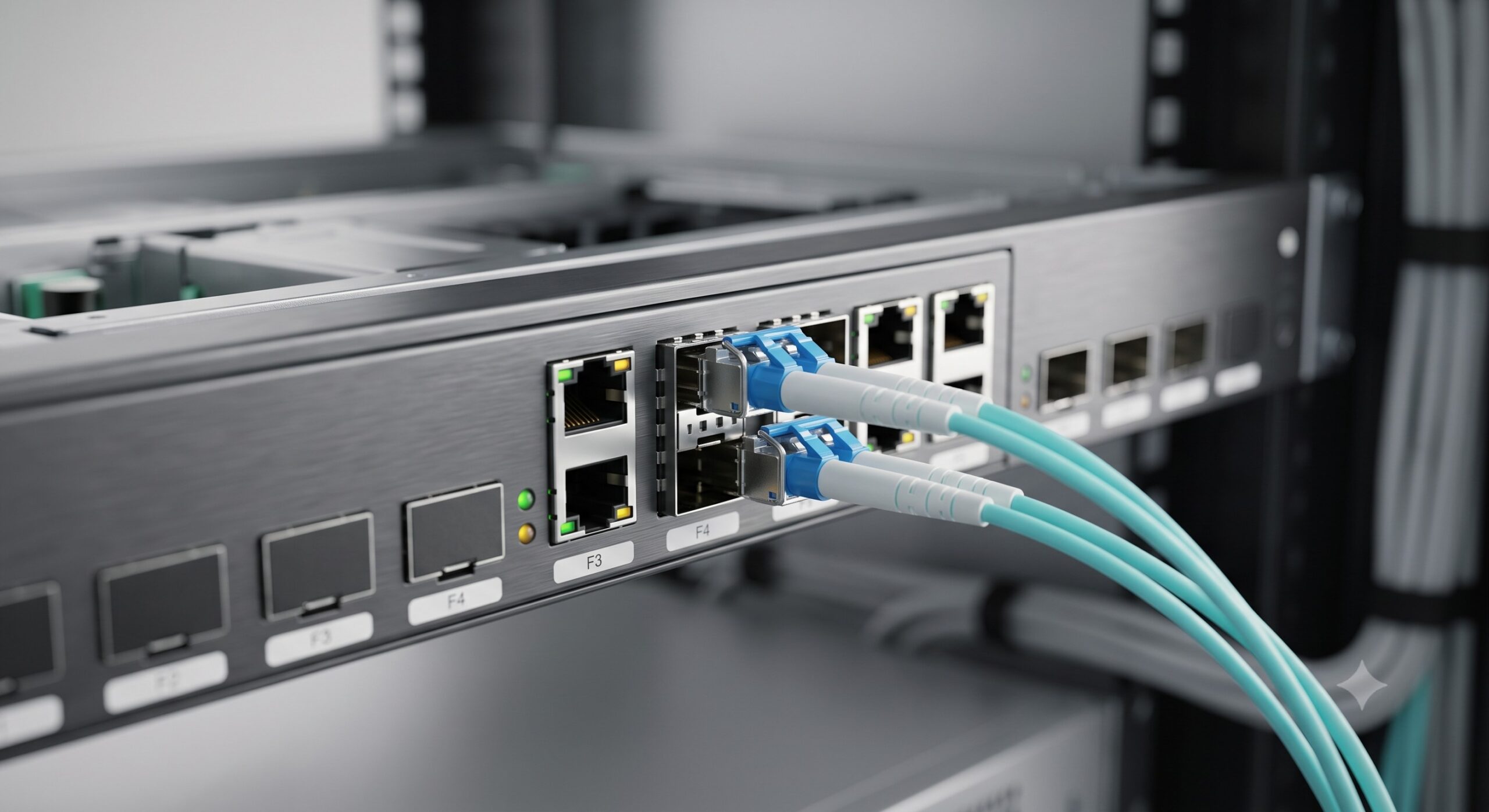
* Gigabit Ethernet (GE) and 10GE copper (RJ-45) and fiber (SFP/SFP+) ports.
* 25GE, 40GE, and 100GE optical ports (QSFP/QSFP28) for high-capacity uplinks and backbone connections.
* T1/E1, T3/E3, and Serial interfaces for legacy WAN connectivity.
* Dedicated management and console ports (RJ-45 and USB).
* **On-Board Security Engine:** A dedicated security co-processor enables hardware-accelerated IPSec encryption (AES-GCM-128/256), MACsec link-layer security, and secure boot, ensuring tamper-proof software execution and data-in-transit confidentiality.
* **Intelligent Traffic Management:** The forwarding engine provides hardware-based support for hierarchical Quality of Service (HQoS), Traffic Policing, Shaping, and Advanced Queuing, enabling granular control over application performance.
* **Advanced Telemetry:** Hardware support for in-band network telemetry (INT) and streaming telemetry (gRPC/ProtoBuf) provides deep, real-time visibility into network operations, facilitating proactive troubleshooting and capacity planning.
COMPLIANCE & STANDARDS
The Enterprise Edge Routing Solution adheres to a stringent set of industry standards and certifications, ensuring seamless interoperability and deployment readiness.
* **Networking Standards:** IEEE 802.3 (Ethernet), IEEE 802.1Q (VLAN), IEEE 802.3ad (Link Aggregation), RFCs for TCP/IP, BGP, OSPF, MPLS, and VXLAN.
* **Security Standards:** FIPS 140-2 Level 2 (pending), Common Criteria (EAL2), and IEEE 802.1AE (MACsec).
* **Telecom Compliance:** NEBS Level 3 (GR-63-CORE, GR-1089-CORE), ETSI EN 300 119 (Rack & Cabinet), and ITU-T standards.
* **Regulatory & Environmental:** Safety: UL/CSA 60950-1, IEC 60950-1; EMC: FCC Part 15 Class A, EN 55032, EN 55024; Environmental: RoHS, WEEE compliant.
TECHNICAL SPECIFICATIONS
The following are the base hardware specifications. Performance metrics are system-wide and vary depending on interface module population and feature activation.
| Parameter | Specification |
|---|---|
| Form Factor | 1RU, 2RU, 4RU Modular Chassis |
| Switching Capacity | Up to 3.2 Tbps (non-blocking) |
| Forwarding Rate | Up to 2.4 Bpps |
| Power Supply | N+N or N+1 Redundant AC/DC/HVDC, Hot-swappable |
| Control Plane | Dual-core CPU, 1+1 Redundant, Hot-swappable |
| Memory (DRAM) | 16 GB to 64 GB (depending on module) |
| Storage | Internal: eMMC (64GB), Optional: External USB, SD Card |
| Supported Ports | GE, 10GE, 25GE, 40GE, 100GE, T1/E1, T3/E3, Serial |
| Cooling | Front-to-back airflow, Hot-swappable fan trays, Field-replaceable |
| Operating Temperature | 0 to 40 Degrees Celsius |
| Operating Humidity | 5% to 90% (non-condensing) |
| Dimensions (H x W x D) | 1RU: 4.4 x 44.5 x 60 cm, Weight: ~8 kg |
| MTBF | > 300,000 hours |
ORDERING OPTIONS
The EERS platform offers a flexible ordering structure to tailor the system to specific network requirements. Customers can order a base chassis with a pre-configured number of power supplies and fan trays, and then select from a comprehensive portfolio of interface modules, control processors, and accessory kits. The primary orderable components are:
* **Base Chassis SKUs:** Defined by form factor (1RU, 2RU, 4RU) and included components (e.g., chassis, fans, PSUs).
* **Interface Module SKUs:** Defined by interface type, port density, and supported speeds (e.g., 48x10GE SFP+, 4x100GE QSFP28).
* **Control Processor Module SKUs:** Differentiated by CPU performance, memory capacity, and integrated features.
* **Power Supply SKUs:** AC (100-240V), DC (-48V), and HVDC options.
* **Software Licenses:** Feature-based licensing for advanced routing protocols, security, and SD-WAN functionality.
📥 Download Technical Specification
Click the button below to view or download the full official PDF datasheet.

Leave a comment