

Introduction: The Non-Negotiable Standard of Carrier-Grade Access
In the hyper-competitive B2B telecommunications landscape, network downtime is not merely an inconvenience; it translates directly to breached Service Level Agreements (SLAs), customer churn, and significant revenue loss. For network architects and procurement officers, the choice of an Optical Line Terminal (OLT) is a strategic decision that impacts network reliability for a decade or more. The Nokia Intelligent Services Access Manager (ISAM) OLT series, particularly the 7360 FX and Lightspan families, has been engineered from the ground up to meet the stringent demands of carrier-grade environments. This guide provides a data-driven evaluation of the Nokia ISAM OLT features that underpin its legendary reliability, focusing on hardware redundancy, Mean Time Between Failures (MTBF), and the architectural choices that ensure service continuity even under extreme conditions.

Architectural Foundations of High Availability
The reliability of the Nokia ISAM OLT is not an afterthought; it is woven into the very fabric of its chassis design and system architecture. The platform is built to eliminate single points of failure, a critical requirement for networks aiming for the coveted ‘Five Nines’ (99.999%) availability.
Chassis-Level Redundancy: The FX Series
The 7360 ISAM FX series, available in 4, 8, and 16-slot variants, exemplifies this philosophy. Every chassis is designed with dedicated, redundant slots for critical system components. For instance, the FX-8 and FX-16 models feature two dedicated slots for Network Termination (NT) cards, which serve as the system’s control plane and switching fabric . These cards operate in a 1+1 Active/Standby configuration. In the event of a primary NT card failure—whether due to a hardware fault or software panic—the system performs a stateful switchover to the standby card within 50 milliseconds. This seamless transition ensures that active subscriber sessions, including latency-sensitive VoIP and IPTV streams, are not interrupted .
- Redundant Power Supply: The chassis supports dual, hot-swappable power entry modules (PEMs) for -48V DC power feeds, protecting against a single power source failure .
- Intelligent Cooling: Hot-swappable fan trays with variable-speed motors dynamically adjust RPM based on real-time thermal sensors, ensuring optimal operating temperatures while minimizing power consumption and acoustic noise .
Sealed for the Edge: The Lightspan SF
For deployments outside the controlled environment of a central office, Nokia offers the Lightspan SF series. This sealed fiber access node carries an IP-67 rating, making it impervious to dust and water ingress . Its passively cooled design, powered by the efficient Quillion chipset, eliminates the failure mode associated with mechanical fans, significantly enhancing MTBF in harsh, outdoor environments .
| Reliability Feature | Technical Implementation | Benefit |
|---|---|---|
| Chassis Redundancy | Dual Network Termination (NT) cards in 1+1 Active/Standby mode | Sub-50ms stateful failover, ensuring uninterrupted services |
| Power Protection | Dual, hot-swappable -48V DC power entry modules (PEMs) | Protection against single power source failure, enabling live maintenance |
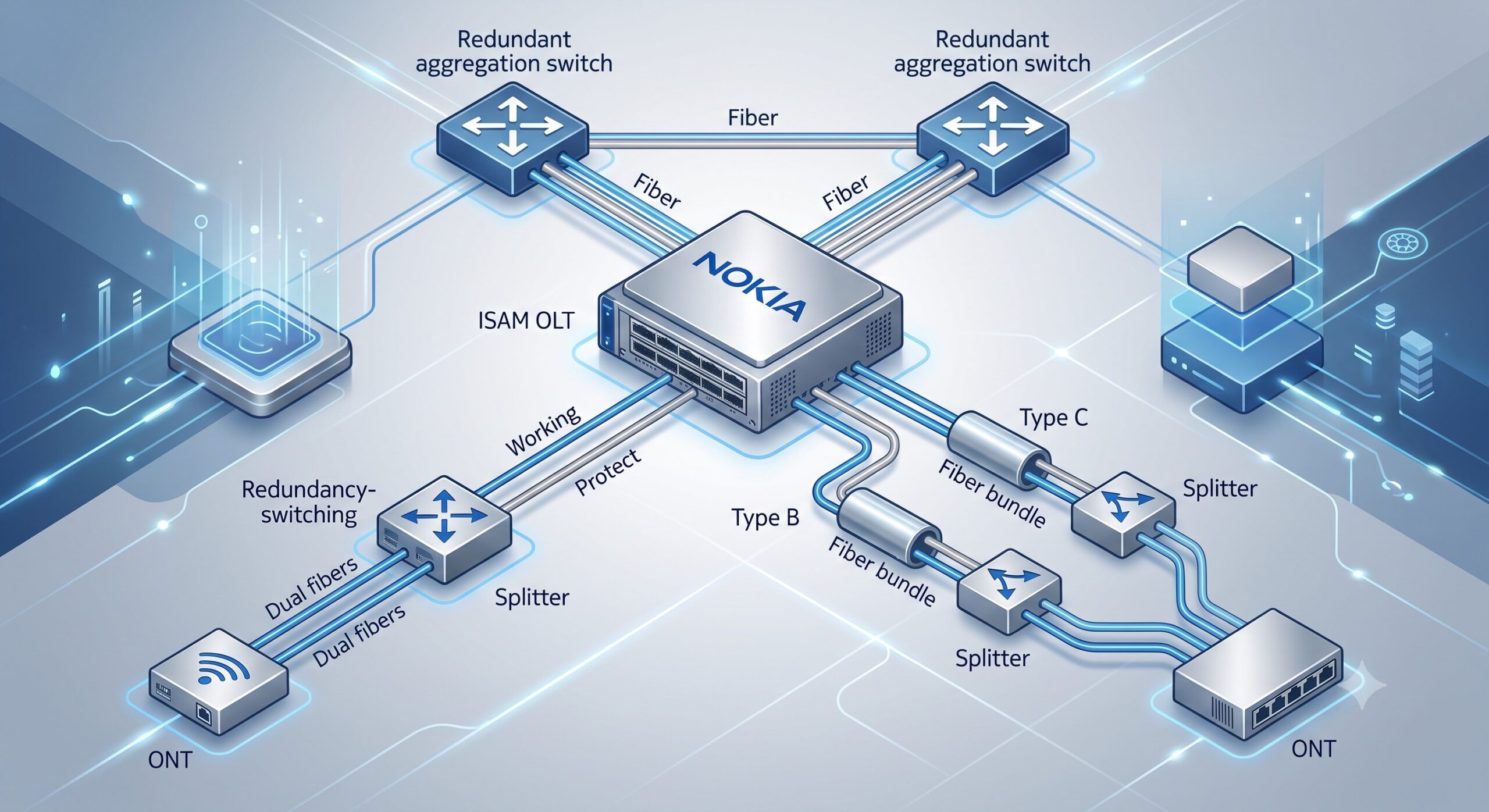
| Optical Protection | Type B (fiber path) and Type C (line card) protection schemes | Mitigates downtime from fiber cuts or line card failures, safeguarding critical connections |
| Environmental Hardening | NEBS Level 3 compliance for FX series ; IP-67 rating for Lightspan SF series | Ensures reliable operation in extreme temperatures, humidity, and outdoor environments |
| Cooling Redundancy | Hot-swappable, variable-speed fan trays ; Passive cooling for sealed nodes | Prevents thermal shutdowns, reduces energy consumption, and eliminates a potential failure mode |
ASIC-Level Intelligence and Service Protection
Beyond chassis redundancy, the Nokia ISAM OLT protects services through intelligent hardware and software features operating at the packet level. The heart of this capability is Nokia’s self-developed Quillion chipset, which powers the line cards and NT controllers .
Dynamic Bandwidth Allocation (DBA)
In a PON network, upstream bandwidth is a shared medium. The OLT’s DBA algorithm is crucial for guaranteeing SLAs. The Nokia ISAM OLT utilizes sophisticated DBA to allocate upstream time slots (T-CONTs) to each Optical Network Terminal (ONT) based on real-time demand. The system supports multiple T-CONT types, including Type 1 for fixed, latency-sensitive traffic (VoIP) and Type 2/3 for assured bandwidth for business data. This granular control ensures that premium services are not starved of bandwidth during peak usage periods, maintaining service quality for high-value customers .
Optical Layer Protection
Network reliability extends to the physical fiber plant. The Nokia ISAM OLT supports advanced PON protection schemes to mitigate fiber cuts:
- Type B Protection: This involves splitting the optical fiber path. A single OLT port connects to an optical splitter via two distinct feeder fibers. If the primary fiber is cut or degraded, the OLT automatically switches to the secondary fiber, restoring service within milliseconds .
- Type C Protection: This provides the highest level of resilience by requiring a second OLT line card, potentially in a different chassis. The ONT connects to both cards. In the event of a catastrophic failure of a line card or its fiber route, the secondary card takes over, providing end-to-end logical and physical redundancy .
Quantifying Reliability: MTBF and Operational Metrics
While Nokia does not always publish a single MTBF figure for an entire system, the individual components are designed to exacting standards. The use of industrial-grade components and compliance with standards like NEBS Level 3 and ETSI EN 300 019 ensures the hardware can withstand extreme temperatures, humidity, and seismic events . By eliminating moving parts through passive cooling, the Lightspan SF achieves a step-change in reliability for outdoor deployments . For central office deployments, the ability to hot-swap components like power supplies, fan trays, and line cards minimizes Mean Time to Repair (MTTR), which is just as critical to overall availability as MTBF. A single FX-8 chassis, equipped with dual NT controllers and dual power feeds, provides a robust platform with a calculated availability well exceeding 99.999% in a stable environment .
Conclusion: The Strategic Value of Unwavering Reliability
Evaluating the Nokia ISAM OLT features through the lens of carrier-grade reliability reveals a platform engineered for longevity and performance. The combination of chassis-level redundancy, intelligent ASIC-driven service protection, and hardened physical design provides network operators with a robust foundation for delivering high-value services. For B2B providers, investing in a platform with this level of reliability is not just a technical decision; it is a strategic one that protects revenue, enhances brand reputation, and significantly reduces operational overhead over the platform’s 10-to-15-year lifecycle. When service continuity is paramount, the Nokia ISAM OLT architecture stands as a proven, data-backed solution.

Leave a comment