

EXECUTIVE SUMMARY
As telecommunications networks evolve toward packet-based architectures, a vast installed base of Synchronous Digital Hierarchy (SDH) equipment continues to serve as the critical transport infrastructure for legacy TDM services, leased lines, and critical government or financial sector connectivity. This document provides an authoritative technical overview of best practices for maintaining legacy SDH equipment, ensuring carrier-grade reliability, maximizing operational lifespan, and minimizing total cost of ownership (TCO). The practices outlined herein are derived from decades of field experience and rigorous OEM testing, addressing hardware degradation, environmental stressors, and operational procedures to sustain performance at near-original specification levels.

ARCHITECTURE & CHASSIS DESIGN
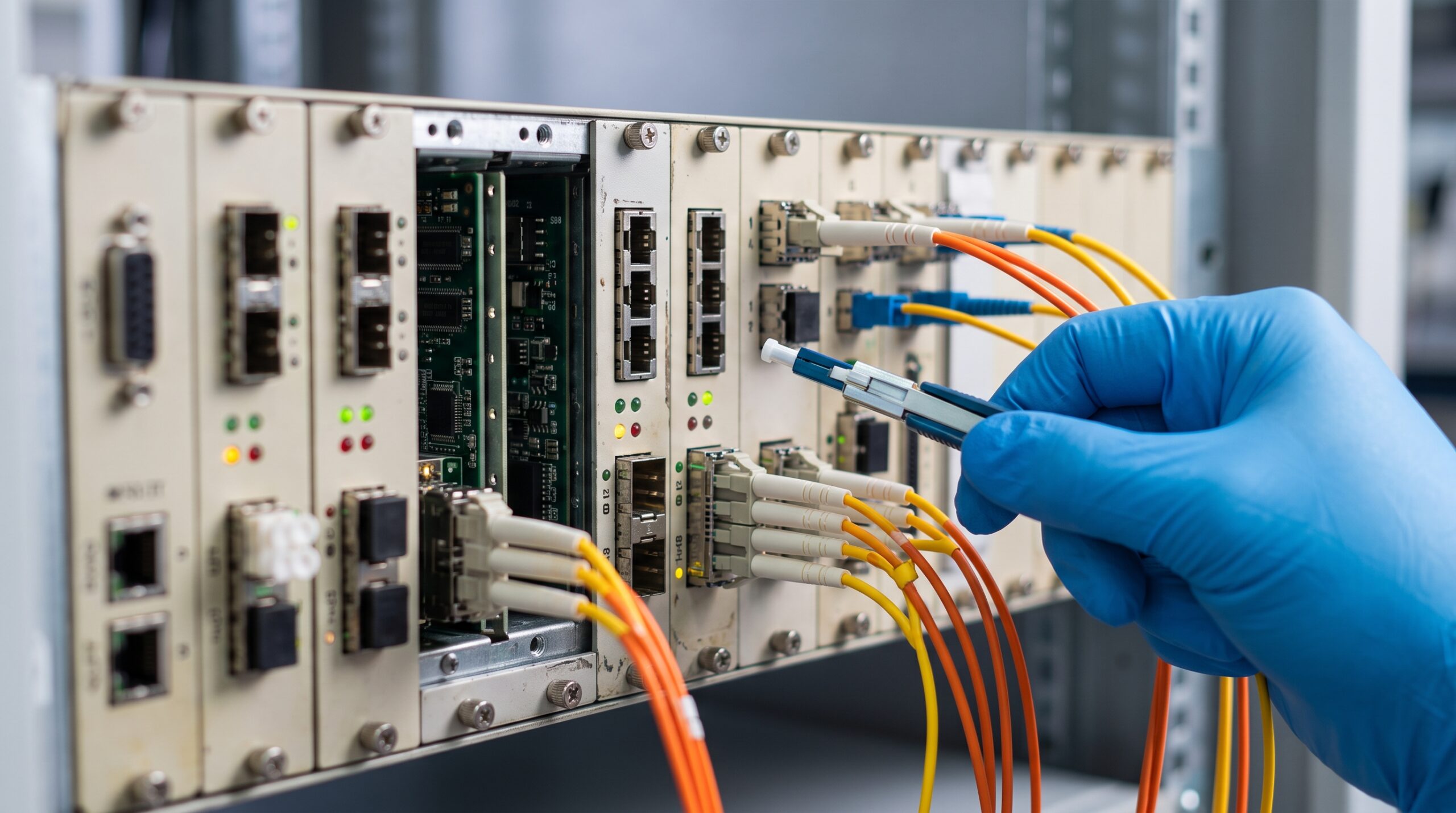
The fundamental architecture of legacy SDH equipment is built around a centralized timing and switching fabric, with physical layer interfaces adhering to ITU-T G.707, G.783, and G.813 standards. The typical maintenance framework must address three distinct hardware domains: the optical transceiver layer (SFP, XFP, or fixed optical modules), the multiplexing and cross-connect matrix (typically realized via custom ASICs or FPGA-based switching fabrics), and the system control and management plane (including embedded CPUs and timing reference units).
Chassis designs ranging from compact 1RU edge multiplexers to large 12RU or 18RU core cross-connects share common maintenance principles. Environmental ingress protection (IP ratings) and forced-air cooling systems are paramount; dust accumulation within the chassis is the primary contributor to thermal stress and premature fan failure. Best practice mandates an annual inspection and non-abrasive compressed air cleaning of all air intake grilles, fan trays, and individual line card heatsinks. For equipment deployed in uncontrolled temperature environments, supplementary external filtration or positive-pressure cabinet solutions are strongly recommended.
HARDWARE FEATURES
Maintenance best practices are predicated on a detailed understanding of the hardware’s critical subsystems:
1. Optical Interfaces and Transceivers: Aging optical modules experience laser diode degradation, resulting in reduced optical power and increased bit-error-rate (BER). Routine performance monitoring using optical time-domain reflectometers (OTDR) and power meters is essential. Recalibration or replacement of transceivers must be performed proactively, based on a combination of operational hours and measured degradation trends, rather than on failure-only basis.
2. Power Supply Units (PSUs): Legacy SDH systems typically operate on -48 VDC or 230 VAC with 1+1 or N+1 redundancy. Electrolytic capacitor aging within PSUs is a well-known failure mechanism. Best practice includes cyclic load testing of each PSU module during scheduled maintenance windows, with immediate replacement of units exhibiting ripple voltage exceeding 5% of nominal output or capacitance degradation beyond 20% of rated value.
3. Timing and Synchronization: SDH networks rely on precise Stratum 3 or PRC (Primary Reference Clock) synchronization. Maintenance routines must include verification of external BITS (Building Integrated Timing Supply) clock inputs, internal oscillator drift testing, and re-timing of the synchronization status messages (SSM). Annual oscillator calibration against a GPS-derived reference is mandatory for maintaining network-wide jitter and wander compliance.
4. Cooling Subsystem: Fan tray health is often overlooked but is a leading cause of thermal shutdown. Active monitoring of fan rotational speed and internal chassis temperature sensors is critical. OEM guidelines typically recommend fan tray replacement every 5 to 7 years, or immediately when any fan module reports a speed deviation greater than 10% from nominal.
COMPLIANCE & STANDARDS
Maintenance procedures must align with international standards to ensure ongoing regulatory and network interoperability compliance. Key standards referenced include:
– ITU-T G.784: Synchronous Digital Hierarchy (SDH) management.
– ITU-T G.957: Optical interfaces for equipments and systems relating to SDH.
– ETSI EN 300 019: Environmental conditions and environmental tests for telecommunications equipment.
– IEC 60825-1: Safety of laser products.
– NEBS GR-1089-CORE and GR-63-CORE (for carrier-grade installations).
Compliance verification checklists should be created and executed annually, with particular focus on laser safety interlocks and grounding resistance (recommended
Parameter
Specification
ORDERING OPTIONS
To facilitate effective maintenance and lifecycle management, operators are advised to maintain a strategic inventory of critical spares. The following ordering options are recommended:
– Full Spare Chassis Kits: For core nodes, a full spare chassis with pre-installed backplane and power distribution board reduces Mean Time To Repair (MTTR) dramatically.
– Line Card Bundles: Specific ADM (Add/Drop Multiplexer) and cross-connect cards (e.g., STM-1/4/16, tributary interface cards for E1/T1, DS3, and Ethernet over SDH).
– Optical Transceiver Packs: Standardized SFP-2.5G (1310nm/1550nm) modules, as well as SFP-155M and SFP-622M variants, with temperature range options (commercial vs. extended).
– Power Supply Module Kits: Redundant AC and DC PSUs, with front-access hot-swappable designs.
– Fan Tray Assembly Kits: Complete fan trays with integrated speed controllers and environmental sensors.
OEM technical support and maintenance contracts are highly recommended, providing access to firmware updates, critical bug fixes, and advanced replacement logistics. For end-of-life components, a formal obsolescence management plan, including a Last-Time-Buy (LTB) strategy, must be executed to avoid uncontrolled hardware scarcity.
📥 Download Technical Specification
Click the button below to view or download the full official PDF datasheet.

Leave a comment