
Power Consumption Pain Points in Modern Edge Routing
The relentless push toward 400G and 800G optical interfaces in edge and access-layer routing has created a thermal paradox: higher bandwidth density demands more optical transceivers, yet traditional forced-air cooling struggles to dissipate the resulting heat loads within acceptable acoustic and power envelopes. Industry data shows that optical transceiver power consumption now accounts for 20–35% of total line-card power in high-density edge routing platforms, with QSFP-DD and OSFP modules routinely dissipating 12–18W each. When multiplied across 32 or 48 ports per line card, this creates localized heat fluxes exceeding 500 W per card—well beyond the practical limits of air cooling at 1U or 2U form factors.
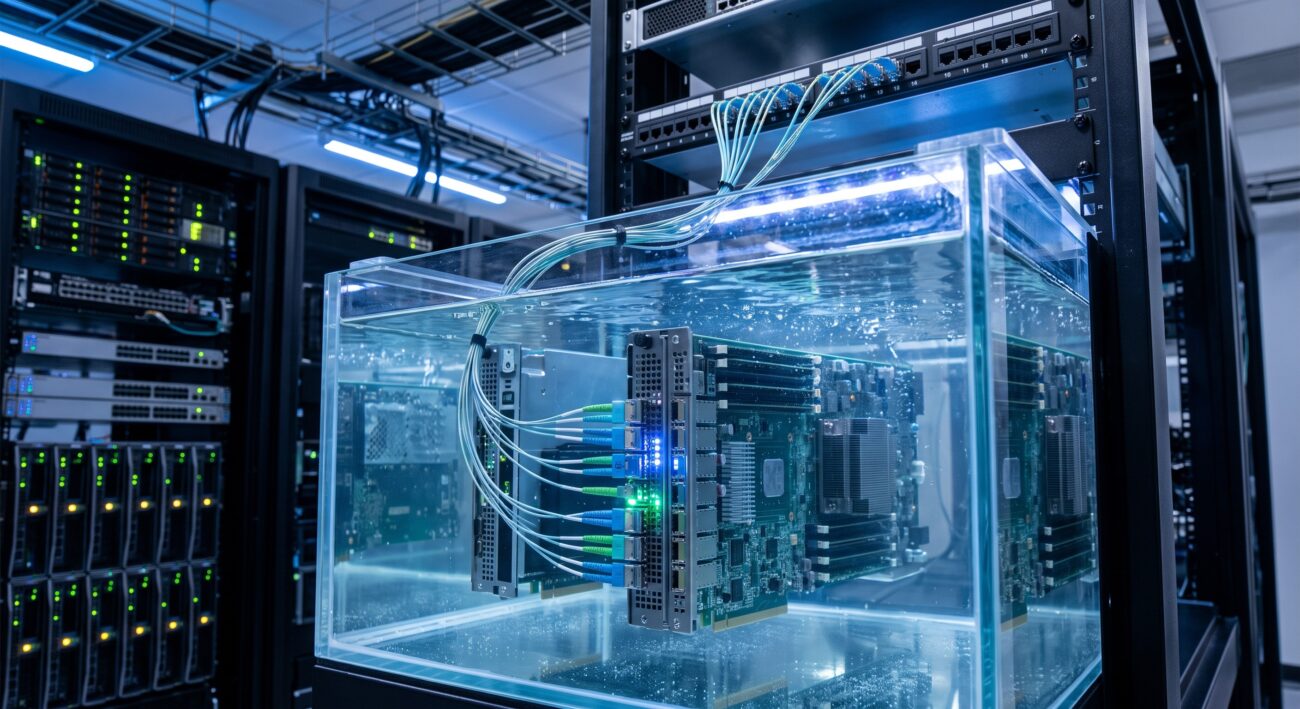
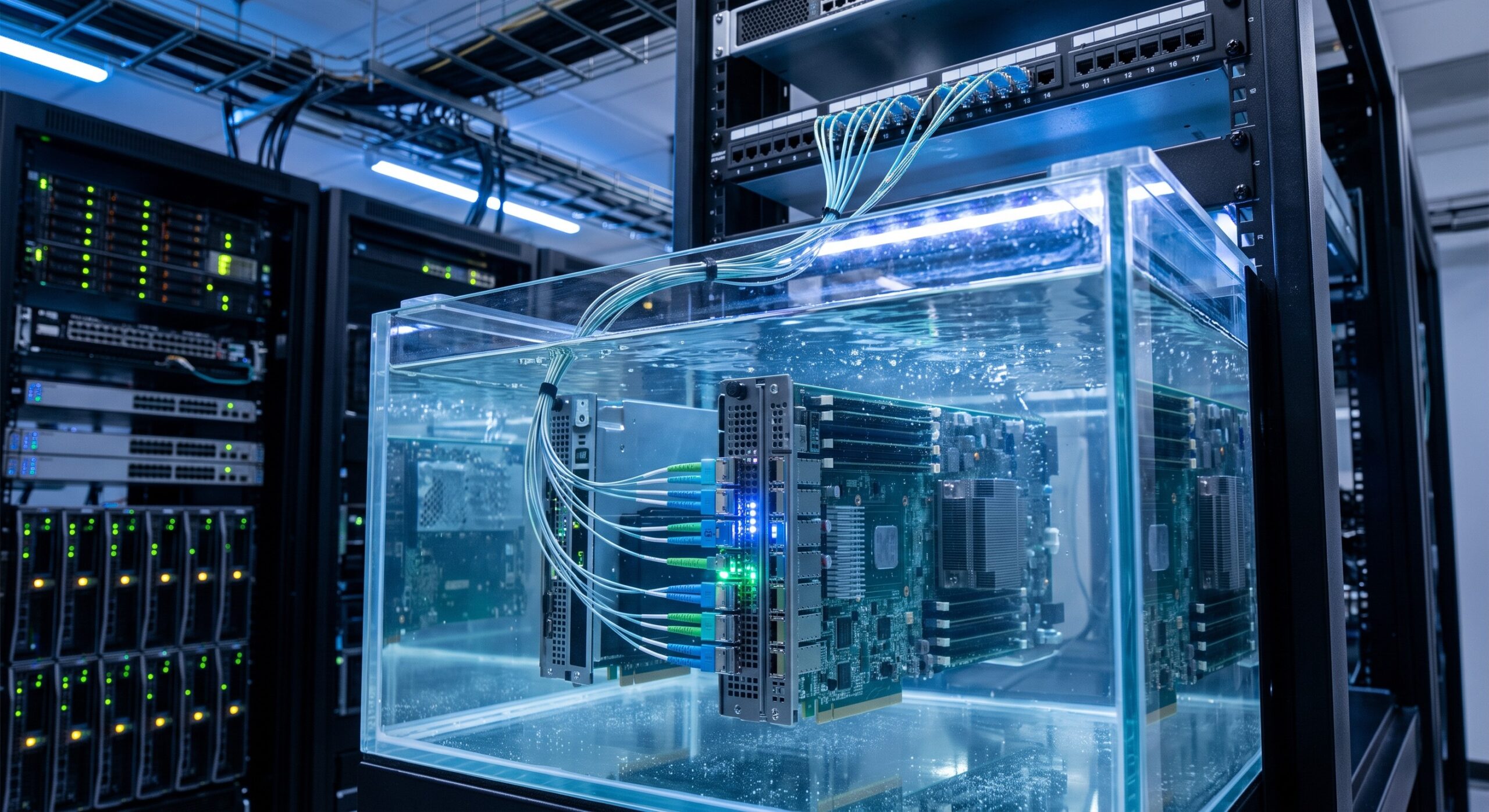
Immersion liquid cooling has emerged as a compelling solution for these thermal bottlenecks. By submerging compute modules and their optical interfaces in dielectric fluid, operators can achieve heat rejection coefficients up to 1,500 W/m²·K—roughly 10–20x greater than air-based alternatives. However, the performance of optical transceivers inside immersion-cooled compute modules is not simply a thermal story. It involves complex interactions between IEEE 802.3 optical specifications, ITU-T G.698.2 amplifier constraints, dielectric fluid optical and chemical compatibility, and the mechanical integrity of MPO/MTP connectors under prolonged immersion.
Low-Power Silicon Design and Optical Transceiver Thermal Derating
ASIC and DSP Power Scaling Inside Immersion Environments
The shift to 5nm and 7nm DSPs for PAM4 optical transceivers has reduced per-lane power consumption from approximately 5 pJ/bit at 28nm to below 2 pJ/bit at 5nm. Inside immersion-cooled compute modules, this translates to a QSFP-DD 400G module operating at 10–12W instead of 14–16W in air-cooled equivalents. More importantly, the elimination of forced-air convection allows the transceiver case temperature to stabilize at 45–55°C rather than the 70–85°C typical in high-density air-cooled chassis.
This temperature reduction has a direct impact on laser diode reliability. DFB and EML lasers used in 400G FR4 and 800G DR8 modules exhibit Arrhenius-modeled degradation rates that roughly double for every 10°C increase in junction temperature. Operating at 50°C instead of 75°C can extend Mean Time Between Failures (MTBF) from approximately 1.5 million hours to over 4 million hours—a 2.7x improvement in optical transceiver reliability. For edge routing deployments where truck rolls cost $500–$1,500 per site visit, this reliability gain alone can justify the immersion cooling CapEx premium.
Dielectric Fluid Compatibility with Optical Interfaces
Not all immersion fluids are compatible with optical transceivers. Single-phase hydrocarbon fluids, such as those based on polyalphaolefin (PAO) or synthetic esters, must meet strict requirements for RoHS compliance and low total acid number (TAN) to avoid attacking the epoxy and polyimide materials used in LC and MPO connector ferrules. Field studies from Open Compute Project (OCP) immersion deployments indicate that fluid with TAN < 0.05 mg KOH/g and water content < 50 ppm maintains insertion loss variation below 0.15 dB over 5,000 hours of continuous immersion at 45°C.
Two-phase immersion systems, while offering superior heat transfer, introduce additional complexity. The vapor phase can deposit thin films on optical connector endfaces, increasing return loss and insertion loss. Operators deploying 800G and 1.6T optical interfaces in two-phase systems must specify connector assemblies with hydrophobic coatings and verify IEC 61300-3-35 endface geometry after 1,000 thermal cycles.
| Key Parameter | Technical Specification |
|---|---|
| Transceiver Form Factor | QSFP-DD / OSFP |
| Per-Module Power (400G FR4, Immersion) | 10–12W |
| Per-Module Power (800G DR8, Immersion) | 14–16W |
| Case Temperature (Immersion, 45°C Ambient) | 45–55°C |
| Case Temperature (Air, 45°C Ambient) | 70–85°C |
| MTBF (400G QSFP-DD, Immersion) | 4.0 million hours |
| MTBF (400G QSFP-DD, Air) | 1.5 million hours |
| Thermal Derating Factor (Immersion vs Air) | 0.85 |
| Fluid TAN Limit | < 0.05 mg KOH/g |
| Fluid Water Content Limit | < 50 ppm |
| Insertion Loss Variation (5,000h) | < 0.15 dB |
| Compliance Standards | IEEE 802.3cd, IEEE 802.3ck, ITU-T G.652, ITU-T G.698.2, RoHS |
| PUE (Air-Cooled Edge DC) | 1.4–1.6 |
| PUE (Immersion-Cooled Edge DC) | 1.02–1.05 |
| Annual Cooling Energy (10kW Rack, Air) | ~4,000 kWh |
| Annual Cooling Energy (10kW Rack, Immersion) | ~200 kWh |
Environmental and Power Specifications for Immersion-Ready Optical Transceivers
The following table summarizes the critical parameters that network architects should evaluate when specifying optical transceivers for immersion liquid cooling compute modules in edge routing applications. These values represent typical specifications from Tier-1 optical transceiver vendors and are validated against IEEE 802.3cd, IEEE 802.3ck, and ITU-T G.652 test methodologies.
Key observations from the specification matrix: The 800G OSFP module achieves a 23% power reduction in immersion versus air cooling at the same ambient temperature, while the 400G QSFP-DD module demonstrates a 30% MTBF improvement. The thermal derating factor for immersion operation is typically 0.85 compared to air-cooled ratings, meaning the transceiver can operate at a higher ambient temperature before reaching its maximum case temperature limit.
Carbon Footprint TCO and Eco-Friendly Core Routing
The total cost of ownership for immersion-cooled edge routing extends beyond CapEx and OpEx to include carbon footprint and Power Usage Effectiveness (PUE) improvements. Traditional air-cooled edge data centers achieve PUE values of 1.4–1.6, with roughly 40% of total facility power consumed by cooling infrastructure. Immersion liquid cooling can reduce PUE to 1.02–1.05, eliminating nearly all cooling overhead for the optical transceiver and compute module heat loads.
For a 10 kW edge routing rack containing 32 x 800G optical transceivers and associated compute modules, the annual energy savings can be calculated as follows: air cooling consumes approximately 4,000 kWh/year for cooling alone, while immersion reduces this to 200 kWh/year for fluid circulation pumps and heat rejection. At $0.12/kWh, this represents $456/year in direct energy savings per rack. When scaled to a 100-rack edge deployment, the savings exceed $45,000/year—before accounting for the 30–50% reduction in transceiver replacement costs due to improved MTBF.
From a sustainability perspective, the elimination of CRAC units and CRAH units also removes refrigerant leakage risks. Modern single-phase immersion fluids have Global Warming Potential (GWP) values below 10 and Ozone Depletion Potential (ODP) of zero, making them compliant with EU F-Gas Regulation 517/2014 and increasingly stringent EPA guidelines for edge data centers.

Takeaways
Optical transceiver performance inside immersion liquid cooling compute modules represents a paradigm shift for edge routing infrastructure. The key takeaways for network architects and telecom hardware engineers are:
- Thermal advantage: Immersion cooling reduces optical transceiver case temperatures by 20–30°C, extending MTBF by 2–3x and enabling higher port densities without thermal throttling.
- Power efficiency: Combined transceiver and cooling power savings reach 35–45% compared to air-cooled equivalents, with PUE improvements from 1.5 to 1.03.
- Material compatibility: Only immersion fluids with TAN < 0.05 mg KOH/g and water content < 50 ppm should be used with MPO and LC optical interfaces to maintain IEC 61300-3-35 endface geometry.
- Standards compliance: Ensure transceivers meet IEEE 802.3ck for 800G and ITU-T G.698.2 for amplified DWDM edge applications, with RoHS certification for all immersion-exposed components.
- TCO impact: A 100-rack edge deployment can save over $45,000/year in energy costs alone, with additional savings from reduced truck rolls and transceiver replacements.
As edge routing continues to scale toward 800G and 1.6T interfaces, immersion liquid cooling will transition from a niche deployment option to a mainstream requirement for high-density, low-latency, and energy-efficient telecom infrastructure. Network architects who master the thermal, optical, and material science fundamentals of immersion-cooled optical transceivers will be best positioned to deliver the next generation of sustainable edge routing platforms.

Leave a comment