
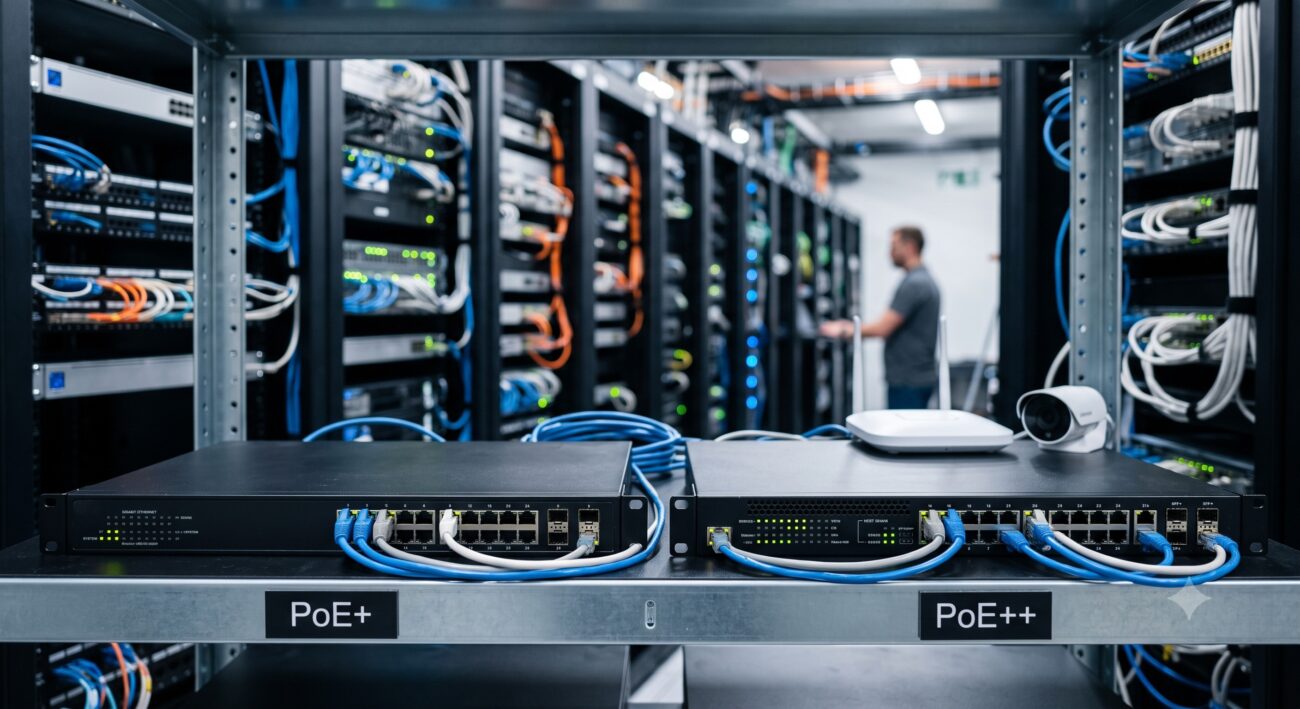
Introduction: The Evolution of the Powered Network
The modern enterprise network is no longer just a data conduit; it is a critical power utility. As the Internet of Things (IoT), high-density Wi-Fi 6/7, and intelligent building systems proliferate, the demand for both bandwidth and electrical current over a single twisted-pair cable has skyrocketed. For senior network architects and systems integrators, the decision is no longer if to use Power over Ethernet (PoE), but which standard to deploy. The debate between PoE+ vs PoE++ switches is a strategic choice impacting Total Cost of Ownership (TCO), scalability, and future-proofing. This guide provides a comprehensive technical deep dive into the IEEE 802.3at and IEEE 802.3bt standards, offering data-driven insights for next-generation network infrastructure.
Core Architecture and Hardware Topology: From 2-Pair to 4-Pair Power
The fundamental distinction between PoE+ (Type 2) and PoE++ (Type 3/4) lies in the physical layer power delivery mechanism. PoE+ (802.3at) utilizes two of the four twisted pairs in a Cat5e or better cable (pins 1-2 and 3-6) to deliver up to 30W at the Power Sourcing Equipment (PSE), with approximately 25.5W guaranteed at the Powered Device (PD) . This architecture relies on a single power pairset and is constrained by a maximum current of 600mA per pair .
Conversely, PoE++ (802.3bt) represents a paradigm shift by utilizing all four twisted pairs for simultaneous power and data transmission. This 4-pair architecture enables significantly higher power budgets: Type 3 (60W PSE / ~51W PD) and Type 4 (90-100W PSE / ~71-90W PD) . The transition to a 4-pair system introduces new complexities in ASIC (Application-Specific Integrated Circuit) design, requiring advanced bridge rectifiers and PoE Management ICs to handle increased PD signature detection and power negotiation. High-end ASICs now support Automatic Class Discovery via LLDP (Link Layer Discovery Protocol), allowing granular 0.1W power adjustments, a significant upgrade from the legacy hardware classification .
Logical Layer Deep Dive: Negotiation and Autoclass
The intelligence of modern PoE++ switches is driven by sophisticated hardware-level signaling. While PoE+ often relies on simple resistive signatures for power classification (Classes 0-4), PoE++ (802.3bt) introduces a dual-signature detection mechanism that identifies PDs requiring up to 8 distinct power classes (Classes 0-8) .
This hardware logic allows for “Autoclass” operation, where the PSE measures the actual power draw of the connected PD during a “Maintain Power Signature” (MPS) cycle and adjusts output accordingly, optimizing the overall power budget of the switch and reducing thermal overhead. This is critical in high-density deployments where switch oversubscription is common; administrators must consider the switch’s total power budget—often not enough to run all ports at maximum load simultaneously—and the per-port PSE output limitations .
| Key Parameter | PoE+ (IEEE 802.3at) | PoE++ Type 3 (IEEE 802.3bt) | PoE++ Type 4 (IEEE 802.3bt) |
|---|---|---|---|
| Max Power at PSE | 30W | 60W | 100W |
| Max Power at PD | 25.5W | 51W | 71.3W |
| Voltage Range (PSE) | 50-57V | 50-57V | 52-57V |
| Cable Pairs Used | 2-pair | 2-pair or 4-pair | 4-pair (mandatory) |
| Max Current | 600mA/pair | 960mA/pair | 960mA/pair |
| Supported Cabling | Cat5e or better | Cat5e or better (Cat6A recommended) | Cat5e or better (Cat6A recommended) |
| Temperature Derating | 5°C (2-pair) | 10°C (4-pair) | 10°C (planned) |
| Typical Applications | PTZ cameras, Wi-Fi 5 APs | Wi-Fi 6/7 APs, LED lighting | Laptops, digital signage, high-power IoT |
High-Density Datacenter Scaling and Thermal Management
For enterprise and carrier-grade environments, the switch is the heart of the network. Deploying PoE++ switches requires an architectural review of the data center’s physical layer. The 4-pair power delivery of 802.3bt nearly doubles the current over Cat5e/Cat6 cabling. To prevent overheating and ensure MTBF (Mean Time Between Failures) benchmarks are met, temperature derating must be applied. The IEEE 802.3bt standard specifies a 10°C derating for bundled cables (more than half of the bundle pairs active), compared to 5°C for PoE+ .
For high-density environments, selecting Cat6A or better cabling is recommended to mitigate voltage drop and heat buildup . Network Architects must evaluate the switch’s thermal design power (TDP); while PoE+ switches often feature passive cooling for lower port counts, PoE++ chassis typically require industrial-grade heatsinks and variable-speed fan trays to dissipate the heat generated by delivering up to 1440W of total system power .
ISP and Enterprise Use Cases: The PoE++ Advantage
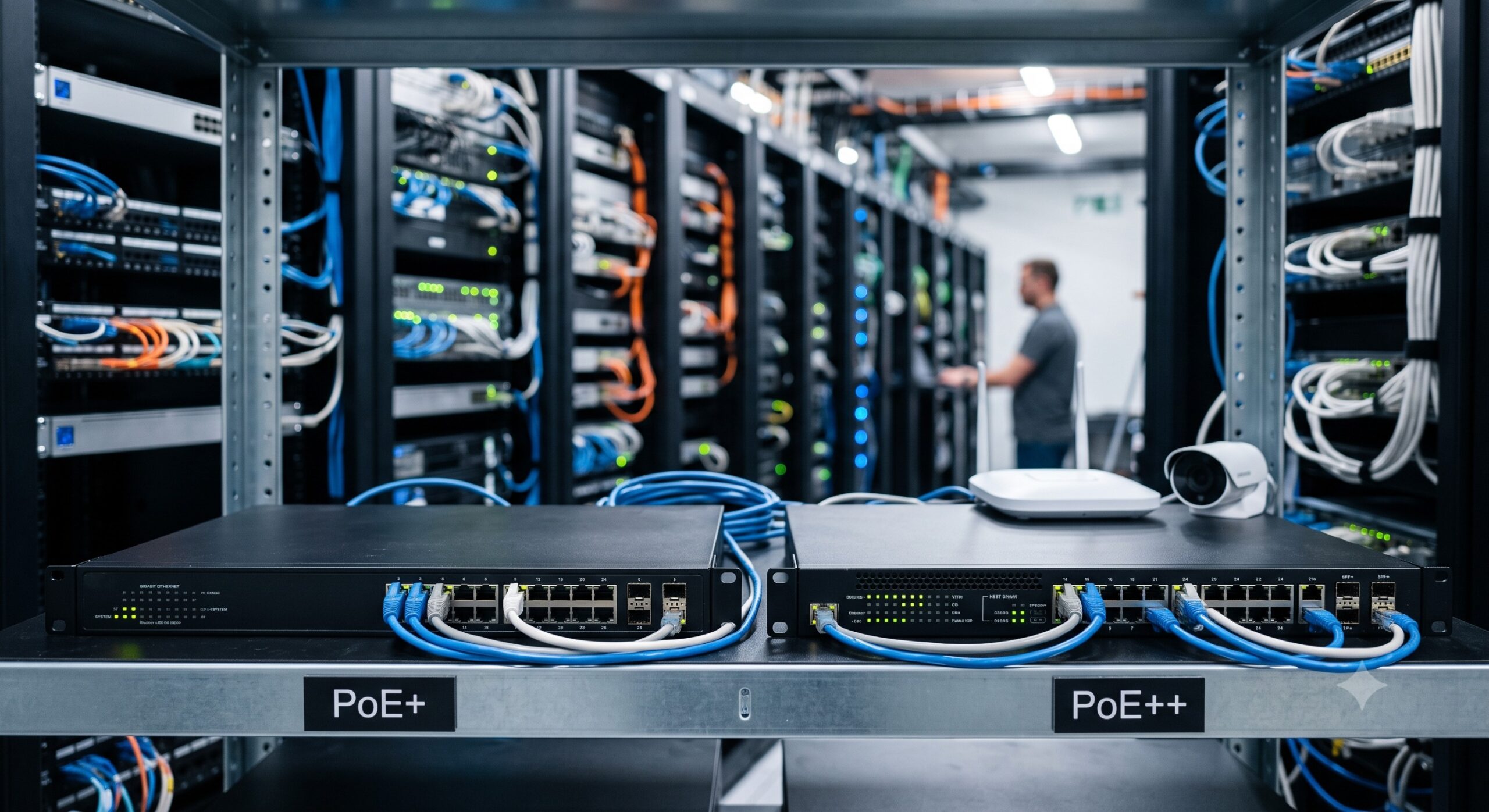
Understanding use cases clarifies the shift from PoE+ to PoE++. PoE+ (30W) is sufficient for PTZ cameras, fixed wireless access points, and video IP phones . However, modern requirements are pushing the envelope:
- Wi-Fi 7 (802.11be) Access Points: With multi-radio architectures and advanced beamforming, these often exceed 30W, falling into the Type 3 PoE++ bracket .
- Digital Signage and LED Lighting: High-brightness displays and PoE-powered lighting grids require 51W+ from the PD.
- Industrial Automation: High-power sensors and small computers (thin clients/laptops) demand the 71W+ offered by Type 4 PoE++ .
[IMAGE_2]
Conclusion: The Strategic Verdict for Network Resilience
Selecting between PoE+ and PoE++ is a balancing act between current power needs and future CapEx/OpEx planning. PoE+ remains the “practical baseline” for most business-class networks, offering a reliable, well-understood architecture with lower switch costs . However, for organizations deploying Wi-Fi 6/7, IoT, and smart building technologies, PoE++ switches are the only path forward.
The investment in 802.3bt infrastructure ensures headroom for high-power applications without needing to forklift-upgrade PSE hardware. Furthermore, the advanced ASIC-level power management and LLDP negotiation capabilities of PoE++ offer granular control over the carbon footprint and energy efficiency of the network. As the industry moves toward a converged power and data fabric, adopting PoE++ (Type 3/4) is not just an upgrade—it’s a strategic architectural decision for mission-critical network resilience.

Leave a comment