

EXECUTIVE SUMMARY
This document provides a comprehensive technical overview of Forward Error Correction (FEC) principles as implemented within the OTN (Optical Transport Network) framework. FEC is a critical enabler for high-capacity, long-haul, and metro optical transmission, allowing systems to achieve extended reach, higher baud rates, and enhanced link reliability without a corresponding increase in optical signal-to-noise ratio (OSNR) requirements. This datasheet details the architectural integration, algorithmic underpinnings, and performance specifications of our carrier-grade FEC solutions, designed to meet the stringent demands of next-generation 400G, 800G, and multi-terabit optical infrastructures.

ARCHITECTURE & CHASSIS DESIGN
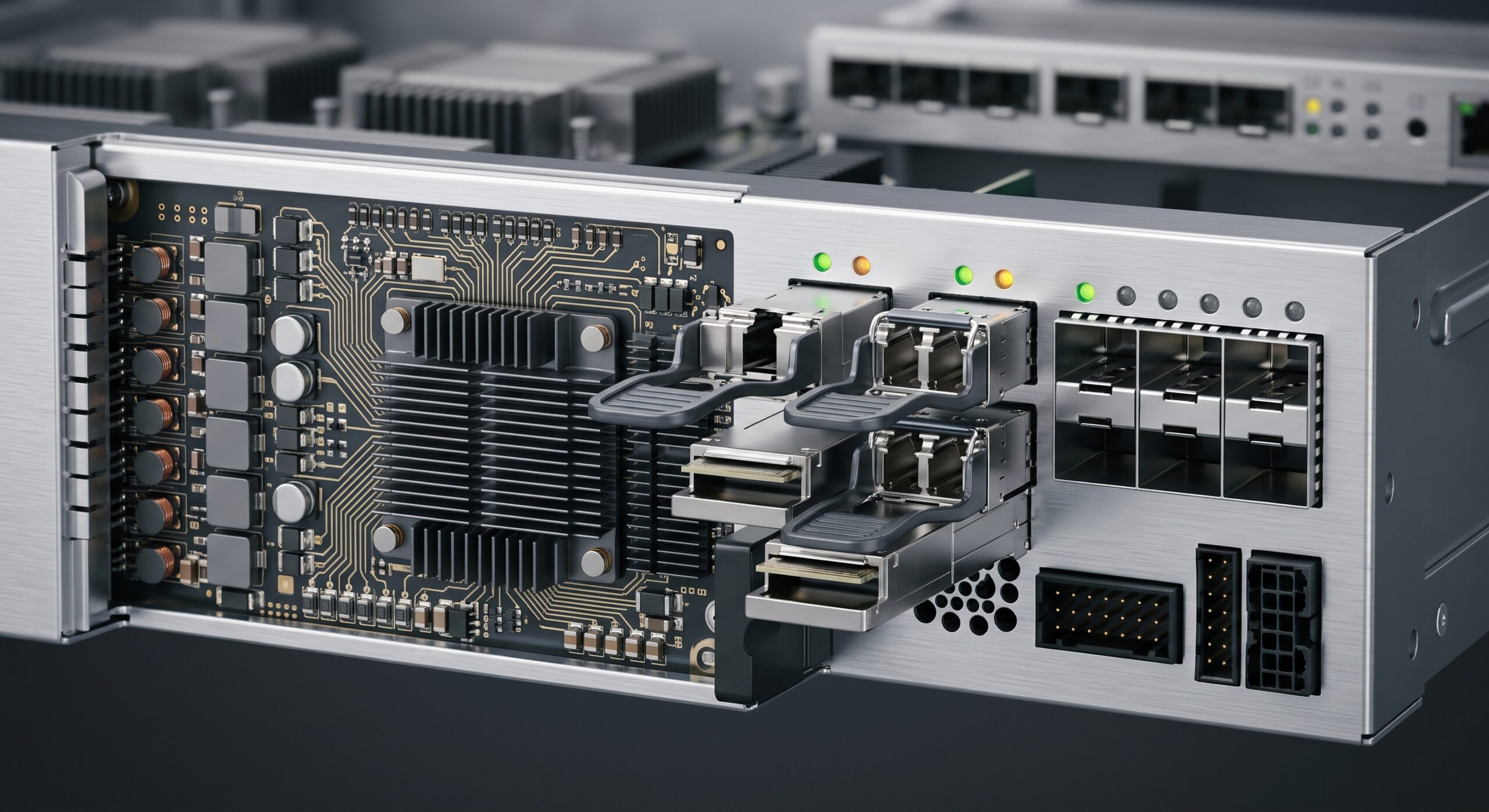
The FEC processing engine is an integral component of our OTN line cards and transponder modules, designed for seamless integration into the modular chassis system. The architecture leverages dedicated hardware accelerators based on advanced 7nm ASIC technology to perform real-time FEC encoding and decoding with sub-microsecond latency. The system supports both standard G.709 compliant FEC (Reed-Solomon RS(255,239)) and high-gain, proprietary concatenated FEC codes, including Soft-Decision FEC (SD-FEC) and staircase codes. The hardware backplane is optimized for high-bandwidth, low-latency data exchange between FEC processors and optical transceivers, supporting flexible partitioning of FEC resources across multiple line cards and sub-wavelength channels. A sophisticated control plane manages dynamic FEC mode selection, allowing operators to adapt the coding gain and overhead ratio based on real-time link conditions and distance profiles. The chassis design incorporates hot-swappable FEC processing blades and front-accessible optical interfaces, ensuring minimal service disruption during upgrades or maintenance.
HARDWARE FEATURES
Our FEC implementation is distinguished by a suite of hardware features engineered for uncompromised performance and carrier-grade reliability. Key features include:
– **Multi-Algorithm Support:** Programmable FEC engine supporting G.709 RS(255,239), SD-FEC, and up to 25% overhead concatenated codes, selectable per channel or per wavelength.
– **Transparent FEC Bypass Mode:** Enables low-latency passthrough for legacy equipment or specialized test configurations.
– **Integrated Performance Monitoring:** Hardware-based monitoring of pre-FEC and post-FEC Bit Error Rates (BER), Q-factor, and channel OSNR, with continuous reporting to the network management system.
– **Dynamic Bandwidth Adjustment:** Support for hitless FEC code switching, allowing granular trade-offs between coding gain and payload bandwidth without traffic disruption.
– **Low-Power Consumption:** Optimized logic design that achieves industry-leading power efficiency of less than 1.2W per 100G FEC lane.
– **Advanced Error Correction Capabilities:** Ability to correct up to 12 errors per symbol (RS) and effectively eliminate error floors in high-QAM modulation formats.
– **Interoperability:** Adherence to OIF and ITU-T standards for inter-vendor compatibility over DWDM links.
COMPLIANCE & STANDARDS
The FEC platform is fully compliant with the following key industry standards and regulatory requirements:
– ITU-T G.709 / G.975.1: Optical Transport Network Forward Error Correction.
– ITU-T G.798: Characteristics of optical transport network hierarchy equipment functional blocks.
– OIF 400ZR and 800ZR Framing and FEC standards.
– IEEE 802.3bs and 802.3ck: FEC clauses for 200G, 400G, and 800G Ethernet.
– NEBS Level 3 certification for environmental and safety compliance.
– CE and FCC Part 15 Class A compliant for electromagnetic compatibility (EMC).
– RoHS and REACH compliant materials.
TECHNICAL SPECIFICATIONS
| Parameter | Specification |
|---|---|
| Form Factor | Modular Line Card / Standalone Transponder (1RU, 2RU) |
| Supported FEC Algorithms | G.709 RS(255,239), SD-FEC, Concatenated (Staircase, Turbo), BCH |
| Maximum Net Coding Gain | Up to 12.5 dB (SD-FEC, 25% overhead) |
| FEC Overhead Options | 7%, 15%, 20%, 25% (programmable) |
| Processing Latency | |
| Per-Lane Throughput | 100G, 200G, 400G, 800G per FEC lane |
| Power Consumption | |
| Operating Temperature | 0°C to +45°C (Standard), -5°C to +55°C (Extended) |
| Management Interfaces | SNMP, NETCONF/YANG, CLI, Web GUI |
ORDERING OPTIONS
The FEC processing capability is offered across our portfolio of line cards and modules. Base models and upgrades can be ordered using the following SKU structure:
– **FEC-ACC-100G-S:** Standard G.709 RS(255,239) FEC accelerator for 100G transponders.
– **FEC-ACC-200G-P:** Enhanced SD-FEC accelerator for 200G coherent line cards.
– **FEC-ACC-400G-X:** High-gain concatenated FEC engine for 400G and 800G multi-rate applications.
– **FEC-LIC-FLX:** Flexible FEC upgrade license enabling programmable coding overhead adjustment.
– **FEC-LIC-ADV:** Advanced performance monitoring and enhanced error correction analytics.
Each SKU includes full hardware integration, software licensing, and global 24/7 technical support.
📥 Download Technical Specification
Click the button below to view or download the full official PDF datasheet.

Leave a comment